
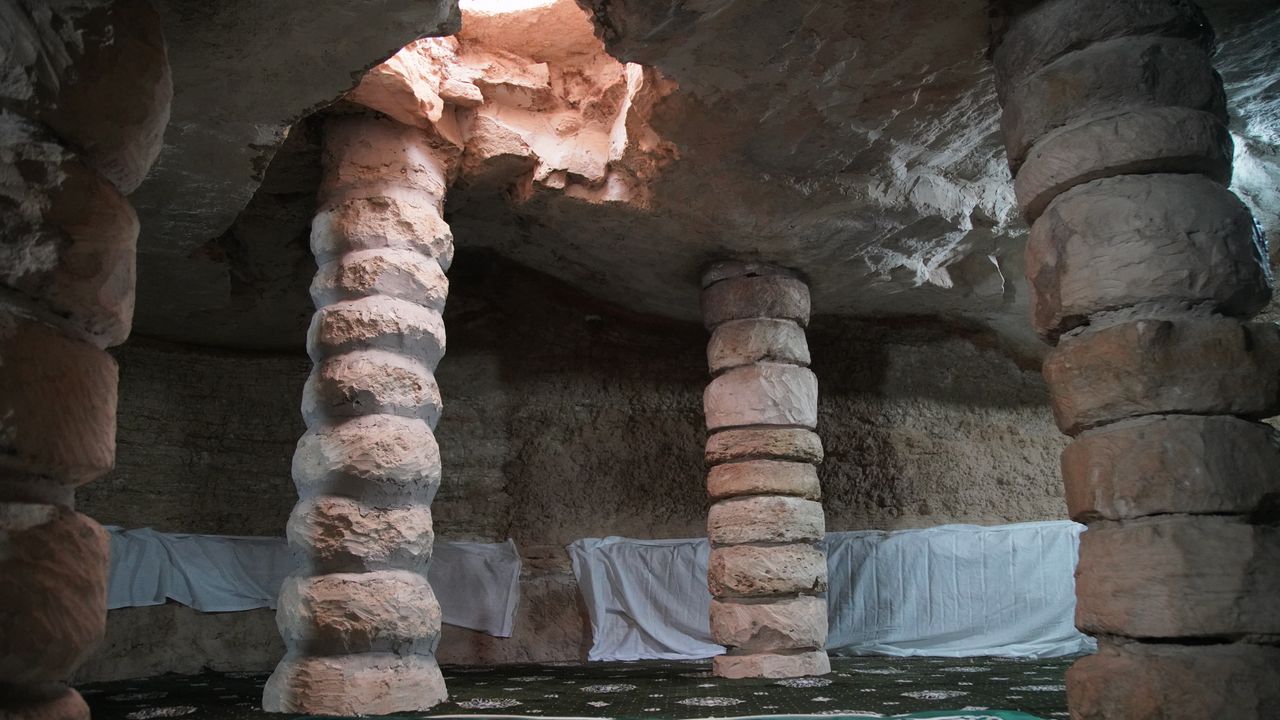
Up until about 20 years ago, a faint trail up a steep hill through limestone-and-chalk cliffs was the only way to reach Beket-Ata, one of the sacred underground mosques—as they’re colloquially known—of Kazakhstan’s Mangystau desert. “There was no proper path then, but people made the difficult climb in the heat and wind,” my guide, Yerzhan Nagmanov, tells me as we embark on our way to the holy site—eased slightly by the stairs now carved into the stone. That arduous journey, the travelers believed, “was part of the pilgrimage.”En route to Beket-Ata with Mangystau Tour 999, visitors walk a trail cutting through the steep hill. Photo: Avantika ChaturvediThe trail of stairs descending into the canyon en route to Beket-Ata. Photo: Avantika ChaturvediAs inhospitable as the roughly 64,000-square-mile desert may seem, it has attracted scores of people over the years arriving to see Beket-Ata and the four other sacred complexes scattered across its expanse: Shopan-Ata, Karaman-Ata, Shakpak-Ata and Sultan-Epe. Traveling between the five holy sites, the distinction between architecture and geology evaporates into the desert heat: Walls, ceilings, and floors are all variations of the rock from which the mosques were excavated. For pilgrims, the journey to these sacred sites is an act of devotion, where people come to honor revered Sufi masters, pray for blessings, and seek spiritual guidance in times of difficulty.The mosques are hundreds of years old, collectively dating between the 12th and 18th centuries, but they’re new to the UNESCO World Heritage List as of this summer. The “Rock Mosques and Associated Sacred Sites of Mangystau” were added to the esteemed collection of landmarks in July.Each mosque is associated with a different spiritual master within Sufism, the mystical branch of Islam. The five Sufi masters’ influence shaped the region’s religious landscape, and then the landscape itself, as all of the mosques—crafted in a rock-cut style that grew out of nomadic building traditions—seem to grow directly from the desert terrain; they’re carved into caves, tucked along the contours of cliffs and hillsides, and tunneled below the ground.After three weeks travelling through Kazakhstan’s cities, mountains, and pine forests, I spent my final week in Mangystau, a landscape so different from anything I’d seen so far in the country that it felt like a whole world unto itself. Having recently visited Astana’s Grand Mosque, with its blue domes, soaring minarets, and gleaming expanses of marble, I wondered whether Mangystau’s rock-cut shrines might fall flat by comparison. For me, however, their lack of splashy grandeur is precisely what made them so compelling.A stately arch welcomes travelers to the steps leading to Beket-Ata. Photo: Avantika ChaturvediWhile I am not Muslim, I was fascinated by how the Sufi masters traversed this unforgiving terrain along with their families. Some walked hundreds of kilometers to establish places of worship far from the comforts of the world, spending years in prayer and contemplation before eventually being buried here. I was drawn to the way the rock mosques embody a humble yet stunning expression of faith shaped by the austere landscape, where instead of gilded shrines or massive palaces, devotion found a more organic form. Through guided 4x4 tours with Red Maya Travel and Mangystau Tour 999, I visited all five.A necropolis inside the Shopan-Ata complex. Photo: Avantika ChaturvediShopan-Ata, the 12-chamber mosqueMy first stop on the tour is Shopan-Ata, named after the 12th-century Sufi teacher. The complex consists of a vast necropolis (a large burial ground with tombs of religious figures and generations of pilgrims) of more than 2,000 monuments, including domed mausoleums and kulpytas, which are ornately carved stone steles traditionally used as Kazakh gravestones. The 12-chamber mosque is carved into the rock, and a shaft of daylight is cast onto two sacred wooden poles below. According to a local tradition, pilgrims recite a prayer and circle the poles three times counterclockwise, which is believed to help the spirits hear them. Visitors also tie strips of white cloth around the poles, the knot symbolically binding a prayer to the sacred site. These practices likely come from Shamanic and Tengrian traditions of tying strips of cloth to sacred trees and mountain passes to honor nature spirits––customs that became intertwined with local forms of Muslim saint veneration over time.Nearby, a well offers pilgrims a much-needed respite; these sacred complexes grew around the few natural resources that made life in the desert possible.Domed mausoleums at the Shopan-Ata necropolis. Photo: Avantika ChaturvediThe entrance to Shopan-Ata, shaded by a mulberry tree. These mosques were built around oases that sustained life in the harsh desert climate. Photo: Avantika ChaturvediLegend holds that centuries later, Shopan-Ata appeared to Beket-Ata in a dream, offering spiritual guidance, making this shrine an important stop before continuing to Beket-Ata. Nearby, a well offers pilgrims a much-needed respite, its water an incongruous presence in a landscape this dry––a reminder that these sacred complexes grew around the few natural resources that made life in the desert possible.The sacred wooden pole, around which visitors tie white cloth to seek blessings. Photo: Avantika ChaturvediBeket-Ata, the mosque carved into the cliffsideThe final few stairs leading up to the Beket-Ata shrine. Photo: Avantika ChaturvediJust over an hour away, Beket-Ata is perhaps the best-known of the five mosques. Founded by the 18th-century Sufi teacher Beket Myrzagululy, the shrine lies in a remote canyon about 170 miles from Aktau, the Caspian-side gateway to Mangystau. The steep descent into the canyon is a reminder that the effort needed to reach these shrines has always been a part of the devotion.The structure is carved into the pale rock, its interconnected chambers following the curves of the cliff. Narrow openings in the ceilings pull shafts of daylight into the cool, dim rooms, where rugs are spread across the stone floor.Communal dining is integral to Kazakh culture. Photo: Avantika ChaturvediAn imam is usually on hand to receive visitors and share information about the site. As we settle on the carpets, he details each of the chambers, one of which contains Beket-Ata’s grave, and another is associated with his sister. The remaining rooms are used for prayer, with separate spaces for men and women.My pilgrimage continues into the dining hall, where a long, continually replenished table runs through the room, with pilgrims sitting on either side and eating together. The mosque provides some freshly cooked meat free of charge, while visitors leave bread, sweets, tea, yogurt, jam and other provisions for those who arrive after them—an especially vivid expression of Central Asian hospitality.Shakpak-Ata, the oldest of the fiveNext we drive across remote country to the Tyub-Karagan Peninsula for Shakpak-Ata, whose cruciform mosque is carved into a massive chalk cliff. Its porous white surface, which looks almost like honeycomb against the desert, was shaped millions of years ago when this part of Mangystau lay beneath the ancient Tethys Sea. Inside, drawings and inscriptions in Arabic, Persian, and Turkic—some dating back to the 18th century—offer a tangible record of the pilgrims who traveled here from across Central Asia, long before air-conditioned 4x4s and Starlink internet made traversing this unforgiving landscape simpler.A honeycomb-like pattern along the rock face of Shakpak-Ata. Photo: Avantika ChaturvediThe chalk chambers of Shakpak-Ata. Photo: Avantika ChaturvediSultan-Epe, the seafarer’s shrineSlightly west, Sultan-Epe lies beside a deep canyon, where a stream threads through thickets of mulberry, buckthorn, blackberry, and wild herbs—another improbable pocket of green in one of Kazakhstan’s driest regions. Sultan-Epe is revered as a protector of seafarers and fishermen—a fitting association for a shrine overlooking the Caspian. According to local tradition, Sultan-Epe was the son of Hakim-Ata, a renowned Sufi poet and disciple of Khoja Ahmed Yasawi, which connects the shrine to the spiritual tradition associated with Shopan-Ata and, through his later spiritual mentor, Beket-Ata.The stacked-stone entrance to Sultan-Epe. Photo: Avantika ChaturvediSultan-Epe from within. Photo: Avantika ChaturvediKaraman-Ata, one of the largestThe final stop on the circuit is Karaman-Ata, where a seven-hectare necropolis stretches across a low, open plot of desert dotted with funerary monuments, some more than 1,000 years old. The mosque is carved into the slope of a small marl hill, and as you descend into the rock, the temperature drops noticeably from the heat outside. A narrow passage leads to a circular room believed to be associated with Sufi rituals including devotional whirling, a type of worship that is expressed through physical movement.Karaman-Ata, the largest of the five rock mosques of Kazhakstan’s Mangystau desert. Photo: Yakov Fedorov / Wikimedia Commons / CC-BY-SA-4.0Reaching each site still means long drives across remote terrain, with limited to no mobile coverage or fuel services–making a sturdy vehicle and a trusted local guide essential. But after days spent traveling the region, these places begin to alter your sense of the desert. Around a well, beneath a mulberry tree, or at a table crowded with food and strangers, the landscape that seemed so stark and inhospitable reveals an unexpected generosity, preserved in the rituals of those who continue to make the journey here.
Inside the Underground Mosques of Kazakhstan’s Surreal Mangystau Desert
Full Article
Original Source
Read the full article at Architecturaldigest →KhanList aggregates and links to publicly available news content. We do not host full articles from third-party sources. Always verify important information with original sources.