
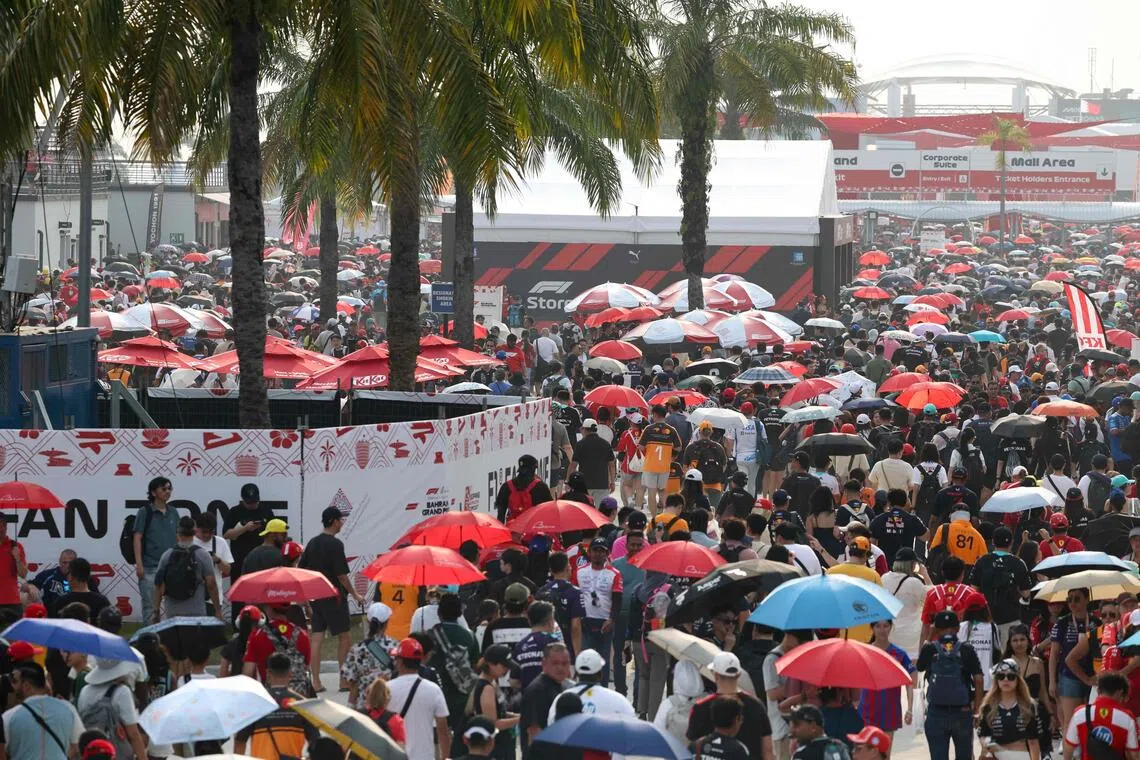
KUALA LUMPUR – Formula 1 fans in Malaysia faced chaotic transport gridlocks and hours-long queues upon the sport’s return to Malaysia, prompting organisers and transport operators to vow immediate improvements.But for some spectators, the improvements came too little and too late after the disappointment during the practice and qualifying sessions on Oct 2 and 3.Mohd Khalimi Ashraf Mohamed Rethuan, a 43-year-old banker who attended the Oct 2 sessions, said he and his wife were forced to walk 11km from the Sepang International Circuit (SIC) towards Mitsui Outlet Park, where he had parked his car.“The buses couldn’t come at all, they were stuck (in traffic). People were chasing buses like in a zombie movie,” he told The Straits Times.“It was super chaotic, with zero planning. There was no proper management. Even police officers were clueless and didn’t know what to do. Traffic management was really bad. A special lane for buses was not utilised properly,” Khalimi added.The complaints pose questions about Malaysia’s readiness to host the popular event should it return permanently after a nine-year absence – even as organisers were arguably hobbled by the short preparation time after the Bahrain GP was relocated to Sepang.Khalimi was among thousands affected, as social media was awash on Oct 2 with images and videos of massive shuttle queues and streams of spectators walking towards transport hubs.Some said they waited hours for buses, while others walked to Kuala Lumpur International Airport’s (KLIA) Terminal 2, about 20km away from SIC.Spectator Amir ‘Arif Azmi, a 34-year-old legal officer, said he ended up walking 7km on Oct 2 after the sessions ended at 5pm and arrived home only at 11.30pm due to the traffic. The trip home would usually just take an hour.“Every time a bus came, people crowded it even when it hadn’t stopped. People were getting frustrated and started to bang on the buses and shout at the drivers,” he told ST.“There were other people walking, and some even had to stop by the roadside due to cramps,” he added.Only a limited number of ride-hailing vehicles were authorised to pick up and drop off passengers at SIC, adding to the transport problems amid heavy traffic and closed roads around the circuit.Some individuals began advertising unauthorised motorcycle shuttle services online, charging between RM25 (S$7.80) and RM50 for rides between SIC and the designated parking spots.Access to drinking water was another source of frustration, with spectators reporting long queues and some water stations being out of service amid the hot weather.A few fans even put their tickets up for resale at lower prices after seeing the huge crowds.Situation improves after fixRapid KL, the shuttle bus service provider that deployed 95 buses for the event, said on Oct 3 that it had made changes to the arrangements following feedback, working together with the SIC and relevant agencies to improve pickup and drop-off points.Rapid KL, the shuttle bus service provider that deployed 95 buses for the event. PHOTO: BERITA HARIANMeanwhile, the SIC said it was working closely with its transport partners and the relevant authorities to strengthen traffic, shuttle and crowd management arrangements for the race.“The experience and safety of our fans remain our highest priority at Sepang International Circuit,” it said in an Oct 3 statement.Khalimi said the situation had improved slightly on Oct 3, but there were still lengthy wait times of around two hours for the buses.Amir ‘Arif added that while the queues were more orderly after the sessions ended on Oct 3, he said he managed to get on a bus only after waiting for two hours.For them, the experience has marred the 2026 F1 weekend, though they hope the problems will be addressed if the race returns to Malaysia.“For me, this weekend was a great opportunity to prove that F1 still belongs in Malaysia and, hopefully, permanently. That could bring in more spectators and create significant benefits for tourism, hospitality, airlines, F&B and businesses,” said Khalimi.“Crowd management is the biggest problem. They have to make sure this doesn’t happen again.”Student Muhammad M. Azlan Noor, 20, said this was not how he wanted to experience his first F1 race.“It was actually kind of frustrating as I was so excited to attend my first Grand Prix,” he said.M. Zulkarnain Hamzah, co-founder of transport advocacy group Transit Malaysia, said the experience pointed to shortcomings in capacity and crowd management.“It’s just simply a case of not enough buses and poor crowd management,” he told ST. “There wasn’t any proper queue management for boarding and the wait times were getting too long.”He said the level of service was inadequate in terms of bus capacity, frequency and reliability. “Coordination is clearly lacking for sure,” he said.Could this be solved with longer planning time?Organisers explained that the problems arose because they had to prepare for an event on a much larger scale than a normal race weekend. However, they had far less time to do so after the Bahrain GP was relocated to Malaysia at short notice due to geopolitical tensions in the Middle East.SIC chief executive Azhan Shafriman Hanif said on Sept 30 that the circuit was 100 per cent ready, despite having less than two months to prepare, compared with the usual six to seven months.“It has been a roller-coaster moment for all of us,” he was quoted as saying by local media.Nearly 100,000 tickets had been sold by then, setting a record for ticket sales at Sepang.Similarly, Bahrain International Circuit CEO Sheikh Salman Isa Al Khalifa told sports news The Athletic in an article published on Oct 3 that preparing the race in eight weeks instead of the usual eight months has been “a challenge”.He said that to pull it off, his side worked with Sepang officials to bring the older track up to F1 standards and brought 561 marshals. They flew in furniture, chefs and even a falconer to recreate the Bahrain paddock.“We shocked the infrastructure because of the number of fans. We just need manpower and we can sort it out,” Salman was quoted saying, referring to the situation over the weekend.Malaysia previously hosted the Malaysian GP at the circuit from 1999 to 2017, when crowds typically numbered between 40,000 and 50,000. It dropped out of the F1 calendar from 2018 amid the rising cost of hosting the event.The scale of the crowd also reflected the continued appetite for F1 in the region, with international fans accounting for about half of ticket buyers.The operation at SIC involved some 5,000 people, including personnel from Bahrain and Malaysia.Even so, many attendees remained remarkably positive about the sport’s return.Muhammad, the student, still believed the race should be a permanent fixture in Malaysia.“The Sepang circuit itself is perfect and it’s well-known that almost every driver loves racing here. The flowing challenges of the track layout make it incredibly fun and competitive, and our unpredictable weather always adds an exciting element of drama to the race.“Plus, the F1 fan base is growing rapidly in Malaysia right now. Bringing the Grand Prix back permanently would be amazing for the country,” he said.Sign up for our weekly Asian Insider Malaysia Edition newsletter to make sense of the big stories in Malaysia.
Inside the transport chaos that marred F1’s return to Sepang
Full Article
Original Source
Read the full article at Straitstimes →KhanList aggregates and links to publicly available news content. We do not host full articles from third-party sources. Always verify important information with original sources.