
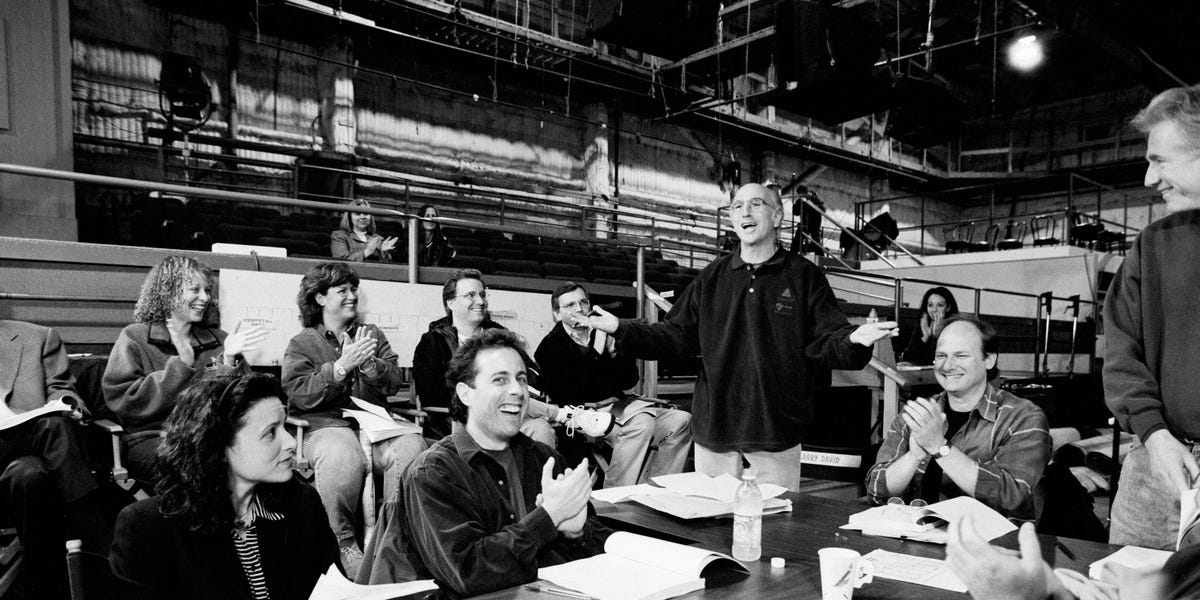
17 min readIn a career spanning from Fridays and SNL to Seinfeld and Curb Your Enthusiasm, Larry David has been arguably the most influential comedian of the golden age of television. But he hit a career low in 1998 with what should have been a crowning achievement, writing the Seinfeld finale. (Cue the tuba.) This exclusive first excerpt from the forthcoming biography Emperor of Nothing: The Making of Larry David, out October 20, goes behind the scenes of one of the most-watched TV episodes ever.On September 14, 1997, approximately two weeks before Seinfeld would triumphantly return to air for its ninth season, Larry David was perusing the Los Angeles Times when he was struck by an article in the Opinion section.The article, entitled “We All Have a Duty to Help One Another,” argued that “the US needs the equivalent of France’s Good Samaritan law.” Enacted in 1941, the law mandated that individuals must assist those in danger, or, at the very least, call for help. Like most World War II–era French legal statutes, this one was not well known by most of the world outside of France—until the last day of the previous month, when Princess Diana was involved in a fatal car accident and members of the paparazzi were criticized for snapping photos of the scene instead of aiding the victims or calling for help.“If any good is to come of the Princess Diana tragedy . . .” declared the Los Angeles Times article, “it should be a call to change American law to require each of us to render at least minimal assistance, where possible, to those at risk of suffering grievous injury or death.”Clearly, the intention of this article was to spark a national conversation and, ideally, create a groundswell of support for change. But Larry had a very different takeaway.“I thought, ‘If I went to France, I could get myself into some trouble!’” Larry says. And like most self-inflicted difficult situations (real or hypothetical), Larry saw this one as potentially fertile ground for comedy. So he wrote it down in his notebook.“It seemed like a good premise,” Larry says.A premise for what? At the time, he did not know. Nor should he have. It had been two seasons since he quit his job as showrunner of Seinfeld, and currently his focus was on his directorial debut, Sour Grapes. But that would all soon change. Especially after Jerry Seinfeld—a little over three months later—shocked the world by announcing this current season of Seinfeld would be its last.New York TimesJerry’s announcement of the end of his groundbreaking sitcom made the front page of The New York Times.The day after Christmas, Bill Carter at The New York Times became the first to publicly share the big news.In “Seinfeld Says It’s All Over, and It’s No Joke for NBC,” Carter reported, “The most popular television comedy of the 1990’s, and the centerpiece of the most profitable night in television history, will stop production at the end of this season.”“That was the first time an entertainment story was on the cover of The New York Times,” says publicist Lori Jonas.Even though the news was now out there, there was still another half season of Seinfeld that needed to be made. Most important, writing and producing the most anticipated series finale in modern TV history—a finale destined to draw so many eyeballs that advertisers would be willing to pay Super Bowl–caliber rates of around $2 million for thirty seconds of airtime. Needless to say, the expectations for this finale were unprecedentedly high. So high that Jerry could think of only one person capable of exceeding such expectations: the person who had created the show with him in the first place.Days after informing NBC of his decision, Jerry called Larry to see if he’d like to come back and write the final episode of Seinfeld.“I wanted to invite Larry back to do the last episode so we could do it together,” Jerry explains. “So we could end it the way we started it.”“I was happy that he asked,” Larry remembers. “I liked the idea of finishing the show up together.”For Larry, the timing was perfect. Not only because he’d just locked the edit on Sour Grapes—which meant that between now and April, when the film was scheduled to hit theaters, he could focus entirely on Seinfeld—but also because after feeling a bit outside his depth as a film director, it would be nice for him to return to doing the one thing that he did better than anyone else in the world: writing an episode of Seinfeld.Granted, as Larry was well aware, he wasn’t just returning to write “an episode” of Seinfeld; he was coming back to write the series finale—which, for better or worse, was an entirely different beast.“You’d see these finales,” Larry says, “and they all kind of felt the same.”In the decades to follow, this homogeny would change. But as of 1998, most finales did seem very much the same. Typically, they began with the show’s main character finally getting a chance at the thing they’ve always wanted (for example, on Family Ties, Alex P. Keaton is offered the dream job in New York, and on Cheers, Sam Malone gets another chance with the dream girl who got away); then—over the course of a highly sentimental episode (in which characters frequently reminisce and, more often than not, long-lost characters return to the fray)—these main characters, now on the cusp of happily-ever-after, must ask themselves, is this really what I want? If it is (like on Family Ties), then the cast will come together for an emotional and uplifting we’ll-always-be-a-family-style goodbye, and if it isn’t (like on Cheers), then the main character will realize that they’ve already been living their happily-ever-after (as epitomized by Sam Malone in the final scene of Cheers, where—alone in his bar and speaking aloud only to himself—he declares, “Well, I tell ya. I’m the luckiest son of a bitch on earth”).Had Larry wished for the Seinfeld finale to follow in the proud tradition of highly sentimental sayonaras, then there were plenty of options at his disposal. Jerry and Elaine could get back together; George could pursue his dream of becoming an architect (or a marine biologist); and Kramer, who had started the show as a recluse, could decide it’s time to leave the Big Apple and see what the rest of the world has to offer.“Looking back,” Seinfeld writer Jeff Schaffer says, “I think those were the kinds of endings that people were expecting, which is crazy! Because at no point was Seinfeld ever a show like that—where the characters ‘grew’ or learned some sort of lesson. So why would it end like that?”“People had all sorts of crazy theories,” Alec Berg, another writer, recalls. “As did we [the writers]. Because we didn’t know!”David Hume Kennerly/Getty ImagesWhen Larry “came back” to write the Seinfeld finale, he actually wrote on his own, apart from the show’s writers’ room.It may seem odd that Seinfeld’s own writers had no idea how the show was going to end, but that largely came from one of the big misconceptions about Larry “coming back” to Seinfeld. As Berg explains, “Larry ‘came back’ in the sense that he was gracious enough to write the finale. But he didn’t physically come back to the office. So, there was a period of time [approximately 2.5 months] where Larry was writing the script on his own [at production company Castle Rock]. So obviously, during that period, we had no idea what the finale would look like, which was good, because we were super busy with all the other episodes!”With most ideas—good or bad—it’s difficult to pinpoint the precise moment of origin. But with Larry’s idea for the Seinfeld finale, he remembers exactly where it came from.“It was that article,” he explains, referring to the Los Angeles Times article he’d read about the Good Samaritan law in France. The one that he’d read and thought, “This would make for a good comedic premise.”Back then, Larry had not known where or how that comedic seed could be harvested. But now things were falling into place. Larry could have Jerry, George, Kramer, and Elaine temporarily leave New York and wind up somewhere that had a Good Samaritan law in place. Inevitably, they’d come across someone in danger, choose not to intervene, and suddenly— after getting arrested—Jerry, George, Kramer, and Elaine would be on trial for their lives.“Now I’m starting to think, ‘This is a great way to get everybody in the history of the series to come back and testify,’” Larry says. “And we could show clips at the same time! So now, of course, I’m very excited about this idea.”So excited that there were never even any other ideas that he considered.“That was it,” Larry says. “I thought it was a really good idea. So I brought it to Jerry and he liked it too. He was all for it.”And so, with Jerry on board, Larry got to work writing the most anticipated finale in the history of television.When writing the finale, Larry made two deliberate decisions about how to approach the episode that separated it from those that came before. The first had to do with its structure, which can be summed up by a quote he gave at the time to a magazine reporter: “The script is dense but not split into the usual A, B, C and D plots (one for each lead part). Everybody gets swept up in one climactic A story.” And the other significant change was that Larry loaded up this particular episode with callbacks to earlier Seinfeld moments.Through the trial conceit, Larry was thrilled that he’d be able to organically bring back dozens of favorite characters, some to take the stand as character witnesses, others as mere bystanders to the proceedings. Additionally, Larry utilized callbacks to help drive the story—most notably, by opening the episode with this throwback-to-season-4 catalyst:JERRYDo you remember five years ago, we did that pilot, Jerry? Well, the new guy at NBC wants to do it. They’re putting it on the air! They’re giving us a thirteen- episode commitment. George and I are moving to California!KRAMERYou’re moving to California?JERRYYeah, only for a while . . . And my agent said as a bonus, I can use their private jet.By setting things up like this—and allowing Jerry use of NBC’s private jet—Larry effectively gave himself a mechanism that would get the characters out of New York and into wherever the Good Samaritan saga would take place.“At the time,” Larry explains, “I was obviously aware of what I was doing [differently from previous episodes]. But I probably underestimated the impact of it.”Whether or not Larry properly anticipated the impact, there’s a larger underlying question at play: Why do it in the first place? Why did Larry decide to alter such a magical recipe—one that had served him so well over the course of 130+ episodes?The cynical answer is that Larry—the notorious storytelling rebel—couldn’t resist rebelling against the rules he himself had created.The psychoanalytical answer is that Larry—the infamous self-saboteur—couldn’t risk happily riding off into the sunset.And the sentimental answer is that Larry—Mr. No Hugging, No Learning (his mantra for the series)—couldn’t help but get swept up in the emotions of ending his creation.Amazingly, any of these three answers can be seen as confirmed by the actual explanation that Larry gave to Newsweek at the time: “I wanted it to come full circle.”In mid-March—with a completed draft of the finale—Larry returned to the Seinfeld offices. Upon arrival, he received something of a hero’s welcome.“It was just so great to see him back,” writer Andy Robin recalls.“It just felt right,” fellow writer David Mandel adds.Larry hated whenever a fuss was made in his honor. So he made liberal use of phrases like “relax” and “I wasn’t gone that long.” Still though, it was nice to be back. Especially when Larry stepped into the office that he had shared with Jerry for so many years, inching his chair into a ready position as they looked at each other from the back-to-back desks.Even Jerry, who was rumored not to have cried since his eighth birthday, got a little choked up.“Jerry and I did a pass on [the script],” Larry remembers. “And it was just like I hadn’t left.”Further adding to that hadn’t-left feeling was the fact that over the next few weeks, Larry would essentially be resuming all of his old showrunner responsibilities.In the lead-up to the finale, Larry became very anxious about details leaking.“I didn’t want people to know,” Larry says. “So, yeah, precautions were taken.”It all began with a triangle of trust. Between January (when Larry came up with the idea) and March (when he and Jerry edited the script), there were only three people in the world who knew what the episode was about: Larry; Larry’s wife, Laurie; and Jerry.Keeping the secret during that time wasn’t always easy, but pragmatically speaking, with three trusted souls, there was no risk of a leak. But come late March, when the script was shared with the cast, crew, and executives, Larry started to get uncomfortable.“With the intense media interest, not to mention viewer interest . . .” NBC executive Rick Ludwin recalls, “I thought there was no way we could film this show in, I think, March, and that it could go on the air in May and that the story of it wouldn’t get out.”To combat the risk, security experts were consulted; there was even talk about using some sort of groundbreaking uncopyable ink. Ultimately, it was decided that everyone who received the script had to sign a comprehensive NDA, and after reading the script, they had to return it to the production staff so that it could be shredded.“I don’t want to speak for anyone else,” director Andy Ackerman says, “but I thought Larry was being, almost, a little paranoid.”While these precautions might have been understandable, they had the unintended consequence of further raising public expectations. After all, if Seinfeld was being this secretive about the finale, then they must have had some juicy, secret-worthy things to hide.“In retrospect,” Larry laments, “another mistake.”Joseph Del Valle/NBCU Photo Bank/NBCUniversal via Getty Images via Getty ImagesShooting in perhaps the most famous diner in history.On Tuesday, March 31, the entire cast showed up to set, and after signing that comprehensive NDA, they sat down for their last-ever table read.“It was a little emotional,” Jason Alexander recalls.Case in point: Julia Louis-Dreyfus was in tears before they even got to the first scene. And even Jerry, who was rumored not to have cried since his eighth birthday, got a little choked up. But emotions aside, there was still a job to do. So, Jerry kicked things off with a formal welcome—which included the warning “You’re going to hear me say ‘thank you’ a lot during the week; here’s the first one”—and then it was time for the end to officially begin.On the evening of April 8, Stage 9 at CBS’ Radford Studio Center was buzzing with the sort of nervous energy usually reserved for opening nights, not farewells. Crew members moved with quiet precision, setting lights and checking camera angles, but their hushed tones betrayed something more: reverence. After nine seasons and one hundred seventy-nine episodes, Seinfeld was about to film its curtain call.In a way, filming the Seinfeld finale felt less like a TV shoot and more like a family reunion. Not only because of all the familiar faces that Larry had brought back to appear in the episode; but also on hand were many of those who had been involved with the earlier years and since left.By the time they rolled cameras on the opening diner scene—Jerry and George, in their usual booth, bickering about nothing—the entire cast had gone quiet. The jokes were sharp, the delivery flawless, but there was a heaviness that lingered just beyond the punch lines. Between takes, Michael Richards wandered the set like he was memorizing every detail: the counter’s chrome edge, the napkin holders, the smell of burnt coffee that had been carefully replicated since 1989.Joseph Del Valle/NBCU Photo Bank/NBCUniversal via Getty Images via Getty ImagesThe Seinfeld foursome on trial in a scene from the finale.Although the energy off-screen was different, everything on-screen seemed to click as it always did. In particular, the finale’s courtroom scenes were a spectacle unto themselves: a gallery of Seinfeld’s most memorable oddballs, all gathered to testify against the show’s beloved foursome. There was the Soup Nazi; the marble rye–wielding Mrs. Choate; the gruff library cop, Lieutenant Bookman; and oh so many more. And each time one of these familiar faces appeared, the audience went absolutely wild.Unlike with the filming of most episodes (which went until only 9 or 10 p.m.), this one stretched until the early hours of the morning. And then finally, a little after 1 a.m., the final “cut” was called and the audience broke out in thunderous applause.As was customary at the end of TV shows, there was still one thing that needed to happen before everyone headed to NBC’s after-party: a final curtain call for the principals who had made this show.Joseph Del Valle/NBCU Photo Bank/NBCUniversal via Getty Images via Getty ImagesThe show’s four primary actors take a final curtain-call—a valedictory gesture Larry was unhappy to miss out on.Had Larry never left, he almost definitely would have been included in this final curtain-call festivity. But because he had, and because he wasn’t one of the show’s principals, the bright-light send-offs were only for Jerry, Jason, Julia, and Michael, which, logically, made total sense, of course. After all, Larry hadn’t even been with Seinfeld these past two years. Still, though, watching this all from the sidelines couldn’t help but sting a little.Like most things that truly bothered Larry, he said nothing to those involved. Instead, he simply put it aside, picked up a champagne flute, and spent the next few hours happily reminiscing with the people who over the past decades, in ways both big and small, had helped to bring alive the crazy, hilarious world that, without them, had risked forever existing only in Larry’s mind.During the five-week period between when the Seinfeld finale was filmed and when it aired, Larry’s directorial debut, Sour Grapes, was released in theaters, on April 17.Just prior to the release, Sour Grapes had a friends-and-family screening. These kinds of screenings were customary in Hollywood, and one of the customs was that—as a friend or family member—you should go out of your way to laugh a little harder than you normally would and tell the filmmakers how great their film was.All things considered, it was a reasonable custom, one that, on the night of the Sour Grapes screening, Larry’s longtime friend Steve Adams was more than happy to oblige. After all, the two of them went all the way back to when they worked together on the early 1980s ABC sketch show Fridays, and kindness came easily to Adams, so hamming up a little extra laughter or praise didn’t seem like it would be too hard.But then . . . he saw the movie and suddenly found himself in the midst of a moral quandary. Because on the one hand, he wanted to support his friend, but on the other, the movie was, shall we say, not up to Larry’s typical caliber. Even so, Adams couldn’t bring himself to lie. So he came up with something that sounded like a compliment and wasn’t a lie. And when he spotted Larry and Laurie after the screening, he knew exactly what to say.“What I said was ‘Boy, you really should be proud of yourself!’ ” Adams recalls.Adams even delivered the line exactly how he had practiced it in his head. But unfortunately, this backfired. Because, as Adams explains, “Larry turned to Laurie and said, ‘Oh, brother. We agreed last night that if somebody says to you “You should really be proud of yourself,” that is shorthand for “I just didn’t like that movie.”’”Hearing this, Adams felt terrible. And not just emotionally but, apparently, physically as well.“I remember this moment,” Adams continues. “We were standing on the sidewalk in Santa Monica. And I felt so bad [about what I’d just said to Larry] that it was like my bowels almost gave way. And I let out the loudest fart.”Years later, when looking back on this moment, Larry would find Adams’s uncomfortable guilt fart to be as funny as it was endearing. Larry, in retrospect, would also even praise Adams for his honesty, admitting, “He was right. The movie wasn’t any good at all.”But back then, Larry hadn’t yet come to accept that Sour Grapes wasn’t the movie he had wanted it to be. So Adams’s feedback was disappointing—literally the last thing he wanted to hear from an old friend.Any time another hit show came to the end, Seinfeld would be invoked as the cautionary tale. If only there was a way to rewrite history.Though sadly, over the next couple of weeks, as the movie opened in theaters around the country, Larry quickly came to realize that Adams’s reaction (including the fart) was far kinder than most of the feedback he would receive.For example, Roger Ebert, the renowned Chicago Sun-Times film critic, gave the film zero stars and brutally declared, “I can’t easily remember a film I’ve enjoyed less.” Meanwhile, at the box office, the film ranked twenty-first its opening weekend, falling well behind the likes of films that were considered flops in their own right (such as My Giant and Major League: Back to the Minors).As a result, Sour Grapes was pulled from theaters after just one week—and Larry’s once-bright future in film was suddenly looking dim. But as bad as things now seemed, Larry knew that his Seinfeld finale would air in only a matter of weeks. And surely that would remind the world—as well as Larry himself—about what Larry David was capable of achieving.At 8:00 p.m. on May 14, 1998, NBC aired a clip show that Berg and Schaffer had put together. Then at 8:45 came the main event: the Seinfeld finale!The episode brought in a record-breaking seventy-six million viewers, but the more relevant reaction lay behind the numbers. Because in an era where public opinion was increasingly fracturing and it seemed there were few things that people could agree on anymore, along came the Seinfeld finale, and the world was suddenly united—though it was united in its disapproval.Collectively, and nearly unanimously, critics and fans felt that the finale was a letdown, to say the least. Entertainment Weekly, for example, called the finale “off-key and bloated,” and USA Today not only called it “dismal” but also suggested that “NBC should have left well enough alone with the introductory 45-minute clip show. It was self-congratulatory too but at least it was a reminder of how funny Seinfeld could be.”In the decades to come, Larry’s finale would gain a bit of appreciation. But at the time, the reaction seemed to be unanimous. And even those who appreciated the finale’s attempt to “do something different” generally agreed that, even so, they rarely laughed during the seventy-five-minute episode.Barbara Alper/Getty ImagesSeinfeld fans watch the finale in Times Square. Seventy-six million people watched the episode, and afterwards, it felt like every single one of them hated it.Back in the early days of Seinfeld—when the show was typically panned by critics—Larry took the slings with more of a shrug than almost any other human would. And in the later days of Seinfeld—when the show became a global phenomenon and the word “genius” was routinely thrown around—Larry took the praise with, again, more of a shrug than almost any other human would. So it would have been reasonable to expect that—win or lose—Larry would react to feedback on the finale with a shrug.But this time, that wouldn’t be the case. It couldn’t be. Because in previous instances of public criticism, Larry’s certainty in his own work was what insulated him from worrying about the negativity. This time, though, there were parts of the criticism that he couldn’t help but agree with, to such an extent that if he’d been given a chance to do it over, he’d likely have done several things differently, which, in turn, led to a second reason for his being unable to shrug off the critical sting: because this time—with no more episodes and no chance of course correction—there was simply no way to get a do-over. And as a result, this dismal feeling would forever linger.Larry could already see the future: Any time someone mentioned Seinfeld—something from one of the nearly two hundred episodes that were great—there would always be someone else to obligatorily point out, yeah, but the finale stunk. And similarly, going forward, any time another hit show came to the end, Seinfeld would be invoked as the cautionary tale.If only there was a way to rewrite history.If only there was a way to get a do-over.Amazingly—in the decades ahead—Future Larry would twice figure out a way to get some semblance of this critical do-over. But in the moment, Present Larry did not know these things. Instead, what he knew was that in the span of only six weeks, he had twice shot himself in the foot. And, as a result, 1998 didn’t turn out to be the banner year that not long ago it had very much appeared to be.Excerpted from the book EMPEROR OF NOTHING: The Making of Larry David by Blake J. Harris. Copyright © 2026 by Blake J. Harris. To be published on October 20, 2026, by Dey Street Books, an imprint of HarperCollins Publishers. Excerpted by permission.
Inside the Secretive, Anxiety-Ridden Making of the Seinfeld Finale
Full Article
Original Source
Read the full article at Esquire →KhanList aggregates and links to publicly available news content. We do not host full articles from third-party sources. Always verify important information with original sources.