
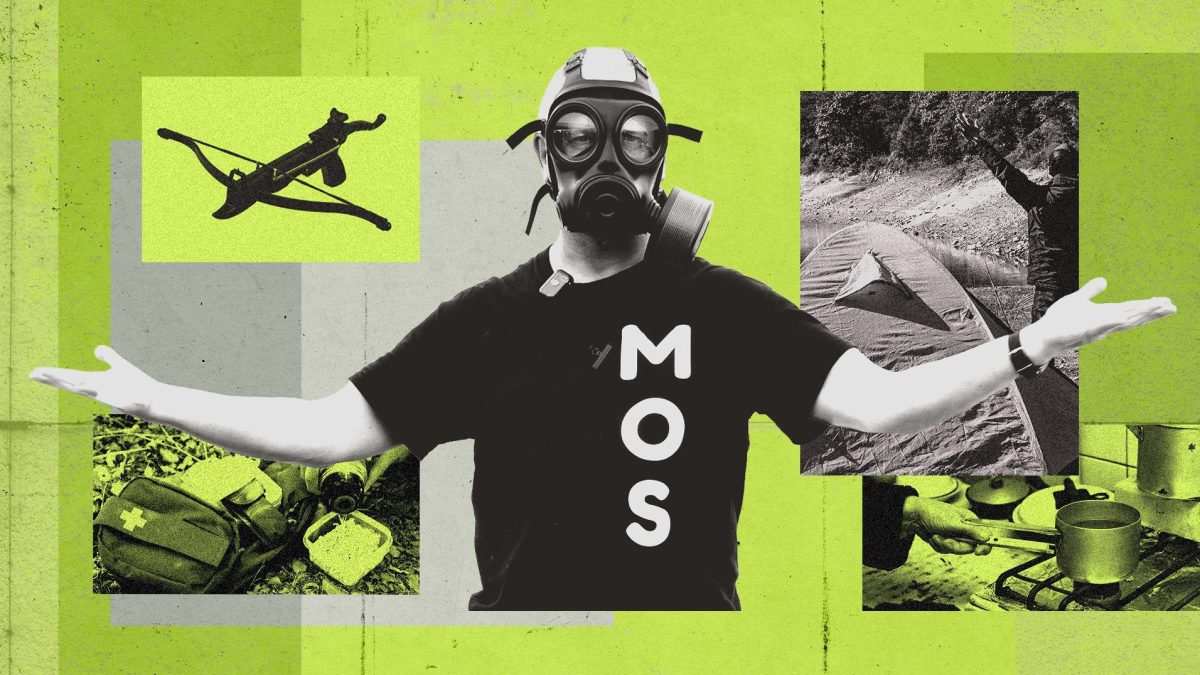
There are no guns, but there are crossbows. And Katherine, 31, is the proud owner of one. “It’s for when the rioters start pillaging people’s houses,” she explains. Petite and with a disability that sometimes leaves her in a wheelchair, Katherine knows she would be vulnerable in such a scenario. “While you’d probably be arrested if you shot someone with a crossbow, it’s slightly reassuring to have the option,” she adds. Katherine, an admin assistant at a residential care home, has travelled five hours from her home in Oxford to a dew-damp field on the Cornish coast. She has come for a gathering of people like her: people who are preparing for the end of the world. A gas-mask demo at the meet-up in Cornwall (Photo: Dispatch) Preppers, sometimes known as survivalists, are a varied bunch, united by a belief in the looming collapse of society and the necessity of self-sufficiency when it comes. Some, like Katherine, believe it will be caused by riots and civil unrest. Others cite financial crashes, pandemics, solar flares and nuclear armageddon. This weekend’s haven is a farm outside of Newlyn, near Penzance, where Katherine will camp alongside 30-or-so concerned citizens – mostly, though not exclusively, middle-aged men in camo and combat boots. It is one of a loose network of prepper meet-ups that take place across Britain, from Pembrokeshire and the Midlands to Dumfries and Galloway. It is an opportunity to learn the essentials: how to forage, remove fluoride from tap water, put on a gas mask. It is also a safe space to discuss potential threats, such as a Carrington Event – a geomagnetic storm that would knock out all modern technology, including the microchip in your dog. Jim, a 50-year-old “manager” who won’t disclose his surname, is one of the organisers. He is also the host of the What If? podcast, where he distributes practical prepping advice to No Shit Radio’s 136 listeners every week. Unsure what to pack in your “bug-out” bag (the supplies needed if you had to flee your home)? Need help choosing the tastiest Meal, Ready-to-Eat (MRE) military rations? Jim has you covered. Jim, one of the organisers (Photo: Dispatch) Attendance, says Jim, is growing at these meets, which are advertised on YouTube and social media. Covid-19 and the invasion of Ukraine triggered a spike in interest, exposing fragilities in the UK’s supply chains and briefly emptying supermarket shelves. The biggest Facebook group for UK preppers now has more than 24,000 members, while the biggest UK-based YouTube channel dedicated to prepping has well over 100,000 subscribers. Even so, Jim is still frustrated by what he calls the “American stuff”. In 1976, James Ellison, a round-faced man with toddler-like cheeks, established a small, fundamentalist Christian community in the Ozarks of Arkansas. The Covenant, Sword and Arm of the Lord (CSA) believed that doomsday was imminent. By 1985, the CSA had morphed into a full-blown anti-government militia. Operating from a 224-acre compound, the group practised polygamy and preached white supremacy. That year, a three-day standoff with 200 federal agents became the first of its kind: an armed confrontation between the US government and a heavily fortified, survivalist cult. With the group’s leaders arrested, the organisation dissolved, but not before it helped cement an association between survivalism and far-right, conspiratorial politics. The link was reinforced in 1993 during the FBI siege of the Branch Davidian compound in Waco, and again in 1995, when Timothy McVeigh, an associate of James Ellison, bombed a federal building in Oklahoma City. Vehicles are stacked full of supplies from top to bottom (Photo: Dispatch) Within minutes of arriving at the Cornish campsite, I am pulled aside and asked: “Were you born in this country?” The man, in a plaid, wool hunting jacket with racer sunglasses wrapped around his face, gestures at me with a can of San Miguel. Before I can ask what he means, we are interrupted by Jim. “Don’t mind him. He’s just my attack dog.” Jim, a towering man with a full, pioneer-like beard, explains to me that his attack dog’s “protectiveness” stems from years of media suspicion. American news coverage, he explains, has tended to focus on “extremist” preppers – leaving the community “tarred with a nasty brush from the US”. It is only recently, he adds, that they have no longer felt the need to disguise what they are doing. After outing himself on social media as a prepper last year, Lewis, 41, who works as a web developer in Lancashire, says his employer asked him to scrub all mention of his job from his accounts. But when blackouts hit the Iberian Peninsula earlier this year, he felt vindicated. His boss asked him to give advice to the firm’s Spanish staff. Lewis, who has asked for a pseudonym, has little patience for the survivalists at CSA and Waco, or anyone itching for a fight. “The No 1 rule of prepping is don’t die,” he says. “If you’re antagonising the government like that, you’re just not a prepper.” Later that evening, I spot the attack dog – by then a few cans worse for wear – being carried to bed by other attendees. I wouldn’t learn about his two-year suspended sentence for grievous bodily harm until after the weekend is over. A whiteboard showing the main threats to be aware of (Photo: Dispatch) “F**king conspiracy theorists are like f**king vegans,” says Mitch, 54. “They always want to shove their bullshit down your throat.” A former soldier in the British Army, he claims he saw “bodies drop like flies” from Ebola in Sierra Leone. In Bosnia, he saw concentration camps and the horrors within. For veterans like him, who make up a striking proportion of the Cornwall meet-up, deadly crises aren’t abstract or imagined. “For years and years, the government put us in the fringe bucket,” Mitch says. But now, he claims, politicians are belatedly waking up to the threat of war and disease. He points to the publication last year of the government’s National Security Strategy (NSS), which urges civilians to “actively prepare” for attacks on British soil. But not everyone reads the NSS in good faith. On the public Facebook group associated with the Cornwall event, it is not hard to find anti-government conspiracy theories. Vaccine-sceptic posts are shared widely, along with claims that cashless societies and digital currencies are “a new form of slavery”. On the most popular British prepping YouTube channel (unconnected to the Cornwall group), there are videos about “the global Islamic takeover” and warnings about an impending “migrant army armed to the teeth”. Mitch doesn’t believe these ideas are representative. “They’re on the other side of the pond,” he says, when I ask about America’s more extreme preppers. “We speak the same language, but it’s totally different.” An attendee walks back to her tent after class (Photo: Dispatch) “The Good Life” was a British sitcom that ran from 1975 to 1978. After a midlife crisis, protagonist Tom Good and his wife Barbara decide to turn their suburban Surbiton home into a self-sufficient farm, where they grow vegetables and raise pigs. Hilarious run-ins with neighbours ensue. Like the Goods, Stuart, 54, tends to beds of potatoes, cabbage, cauliflower and swedes. He raises chickens and has plans for bees. “I work in the building trade,” he explains. His work is “feast or famine”, and his prepping is a way to ensure there is always plenty of food in the latter periods, when work dries up. Back in the day, Mitch adds, living on the fruits of your own land was called “homesteading”, not prepping. Post-war rationing in Britain didn’t end until 1954, when citizens were encouraged to grow their own fruit and vegetables. “My parents are from the war generation,” he explains. “I’ve just stayed on that level of mentality.” Many of the preppers I meet describe similar upbringings – homes where the pantry was always stocked, candles were kept in drawers in case of blackouts, and nothing was thrown away that couldn’t be mended or repurposed. Today, that ethos is cited as one of the reasons they keep between a month and a year’s worth of tins or MREs stored in cupboards and garages. And then there is the state of Britain today. Not since the Cold War has there been a “more serious and immediate” threat to international security, according to former prime minister Keir Starmer. Meanwhile, on the home front, the cost-of-living crisis has ushered in a new era of scarcity and spiralling prices. In such a world, few would argue with a partial return to frugality and self-reliance. The government itself said as much in its NSS, referencing a return to the collective blitz spirit of the Second World War. “That’s why we suddenly had a massive glut of people joining the Facebook groups,” Jim says. “They can see this.” Campers learn how to filter their water (Photo: Dispatch) Shit hits the fan in more ways than one. SHTF – as preppers call it – when nuclear war breaks out, or a natural disaster strikes, or the next pandemic leaks from a lab. But shit can also hit the fan following a personal crisis. “It doesn’t have to be a global problem for me to dip into my preps,” says Jim, who is attending the meet with his wife. “I could be ill for a month. I only get two weeks’ paid leave. But then I’ve got six months’ worth of food there. I can dip into that.” Many preppers I speak to are veterans, still adjusting to civilian life and carrying memories of Helmand in Afghanistan or the Democratic Republic of Congo – of IEDs, child soldiers and torture. Others have faced long periods of unemployment or the breakdown of marriages. Some live alone, separated from their children. Several have disabilities and are acutely aware of how that might complicate an emergency. During Hurricane Katrina, for instance, thousands of disabled people were unable to evacuate. Stuart, like Katherine, is disabled. Meningitis in his teens left him deaf in one ear. Now in his mid-50s and living alone in Truro, he says: “I have to make sure that if I’m ill, I’ve got things in the house.” Having grown up on a homestead in nearby Falmouth, he adds: “I think, sometimes, when things happen in your life, you revert back to your happiest times.” The preppers gather around a campfire (Photo: Dispatch) By dusk, the preppers settle around the tin-drum campfire. Drinks are passed around in stainless steel mugs and the discussion turns to the best way to homebrew cider. The next morning, Jim explains that these meet-ups aren’t about buying the latest prepper kit – although attendees are welcome to bring along old clothing and equipment to sell. Instead, the gatherings are about building a community where information can be shared, where you can meet like-minded people who share the same interests. In the search for self-sufficiency, community is found. “We’ve got young people, we’ve got old people, we’ve got people with disabilities, we’ve got everybody,” he says. “And this is why, for us, sitting in a field, sharing ideas and talking, is a good thing.” The organisers are already planning their next meet in the Midlands, somehow safe in the knowledge that the apocalypse won’t arrive before then. They encourage all the attendees to travel to the next. There will be friends, at least, at the end of the world. A version of this article appeared in Dispatch
Inside the secret world of Britain’s doomsday preppers
Full Article
Original Source
Read the full article at Inews →KhanList aggregates and links to publicly available news content. We do not host full articles from third-party sources. Always verify important information with original sources.