
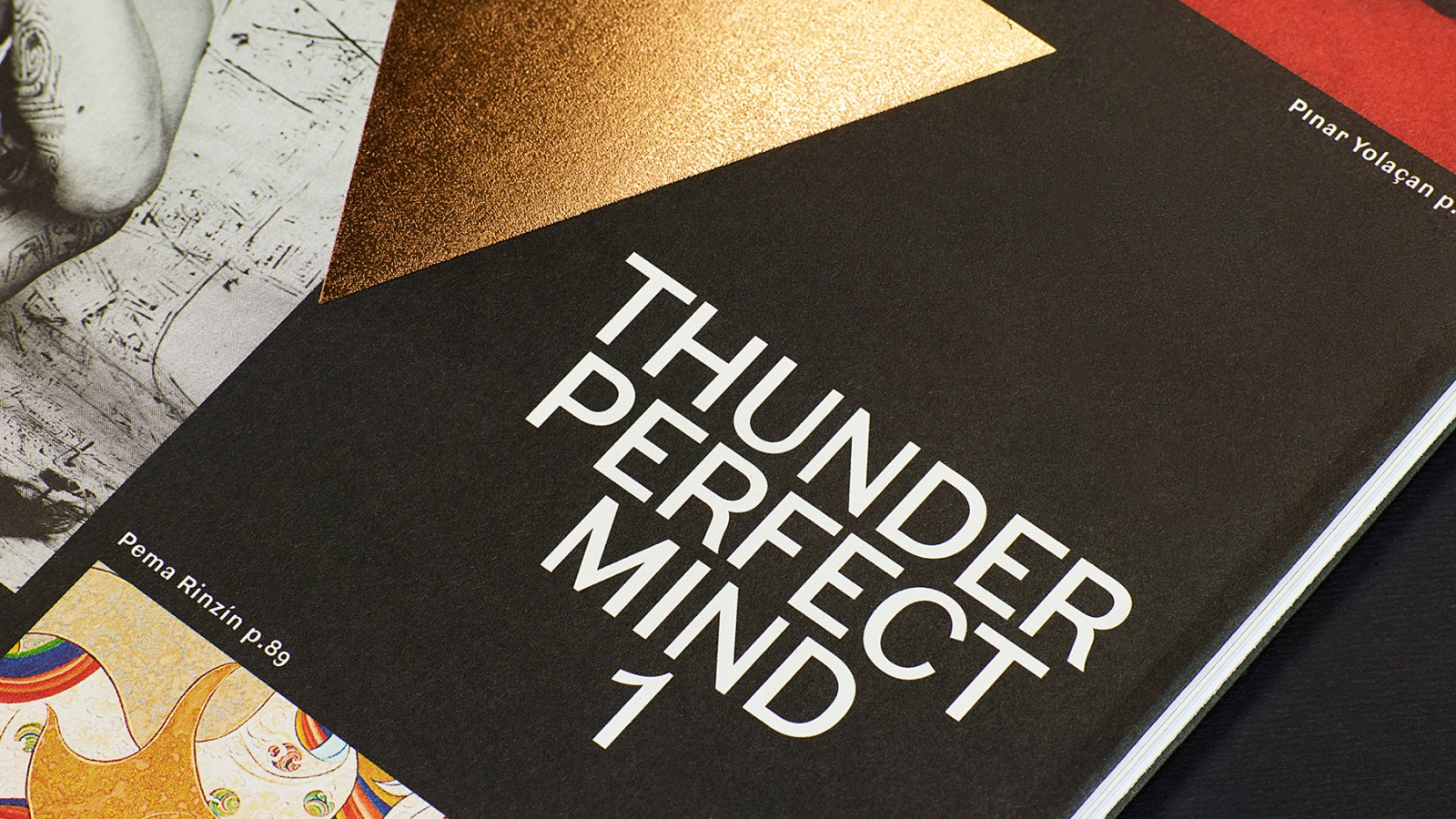
Thunder Perfect Mind, from longtime Rolling Stone contributor Cassady Rosenblum, explores the spiritual world all around us The Goddess came to Cassady Rosenblum “gorgeous, and terrifying, like a multiheaded dragon who could birth a planet or destroy a galaxy, simply by licking her numerous lips.” It was 2022, and Rosenblum was in Utah reporting a story for Rolling Stone about a group of Mormons who had left the Church of Latter-Day Saints and were using psilocybin as a sacrament. As an embedded journalist, Rosenblum joined an all-women’s mushroom ceremony. In the visions that came to her that evening, she saw a “lush, benevolent, intricate universe, one woven entirely of sacredness.” The Mother of All Creation showed her three things. “First, it was babies being born,” Rosenblum tells me. “Like all babies, throughout all time.” Then, it was seeds sprouting and plants growing, followed by rivers and waterfalls, “and I was made to understand that she is the dynamic energy that animates the universe.” Rosenblum says she had two realizations with these visions. “One was, ‘This is who the patriarchy has been afraid of this whole time,’ and I felt for the first time that I, as a woman, was batting on the stronger team.” Four years later, she considers herself “a small part of a several-millennia baton pass” as the founder and editor-in-chief of Thunder Perfect Mind, a new print publication dedicated to the Great Mother. The magazine’s manifesto describes itself as being “devoted to the Goddess… [by which] we do not mean a deity so much as the intelligent, pulsing power of life itself.” It calls for greater ecological awareness as Silicon Valley bets big on AI and data centers in spite of massive public pushback. It recognizes feminine rage, as women openly discuss the life-altering experience of perimenopause and menopause that generations of our foremothers dealt with in near-silence. It calls us back to our ancestors with reverence for “the sacred feminine — the portal through which all life enters and is reabsorbed,” as Rosenblum writes in her editor’s note. Editor’s picks And for the lady, perhaps a collective awakening? Animism — the concept that non-human organisms, landforms, natural phenomena, and inanimate objects possess a spiritual essence or consciousness — is shifting from a marginalized worldview into mainstream discourse. Psychedelics are no longer considered taboo as millions of Americans are using them for the first time. The time seems ripe for “the return of the Goddess.” Thunder Perfect Mind reflects this stirring through a curated assemblage of art, essays, and interviews. Rosenblum, a longtime Rolling Stone contributor, traces the beginnings of her “magazine-shaped altar” to that 2022 assignment in Utah. Before the mushroom ceremony, she was a self-described atheist. “I thought spirituality was really for weak-minded people,” she admits, “and it was all a Santa Claus bedtime story.” Post-ceremony, her life “swerved,” as she puts it. Her other realization during that mushroom trip was that the Goddess — Gaia, in Greek mythology — is the entity through which everything is connected, her fertility and beauty matched by her power and ferocity. That spiritual understanding felt like a new version of feminism to Rosenblum. “The aspect of femininity as ferocious is something we’ve been divorced from, at least in Western society,” she says. “She gave me that back.” A week after the mushroom ceremony, Rosenblum heard from the women she had tripped with that the Church of Latter-Day Saints had suddenly issued a proclamation banning prayers to the Heavenly Mother, redacting a line from the Book of Mormon that LDS women had “clung to for centuries.” Had the group somehow awakened something that unsettled the church elders? The timing of the doctrinal crackdown felt like “outrageous synchronicity,” Rosenblum says. “It was a feeling that something in the realms that we were in is connected to this realm.” Related Content Jessica Hundley, Ekin Balcioglu, Cassady Rosenblum, and Lysa Cooper at the Thunder Perfect Mind opening party. Sasha Bianca* Rosenblum, 35, studied international relations and political science at Wellesley College before getting her degree in journalism from UC Berkeley. After her experience in Utah, “I ordered every book I could get my hands on,” she says. She learned about the Goddess movement of the 1960s and 1970s, when second-wave feminist scholars studied how early human societies venerated a supreme female creator, long before the rise of patriarchal monotheism; the history of Mother religion can be traced all the way back to the Paleolithic era. That history is what she wants to carry forward with Thunder Perfect Mind. In the years following her first experience with the Mother, Rosenblum’s research kept leading her to people who described having the same atheist-to-believer trajectory after a psychedelic experience. “I’d ask them, ‘How did the divine appear to you?’ And I just started collecting dozens and dozens of stories about how they experienced God as a woman.” One of them was a Massachusetts police lieutenant, Sarko Gergerian, whom she heard speak last year at a psychedelic conference in Santa Fe. Gergerian told the audience that the first time he tried magic mushrooms as therapy for PTSD, he saw Gaia in chains. “He realized that his oath to protect and serve is to protect and serve Gaia and all of her creations,” Rosenblum recalls. She also points to a Johns Hopkins study in which dozens of religious leaders took mushrooms; many of them, men and women alike, reported experiencing the divine as a feminine presence. “This isn’t my personal little observation or manifesto,” she says. “I’m just the one that’s planting a flag of significance.” The Hopkins clergy study is the topic of an article in the inaugural issue of Thunder Perfect Mind. “Trip Report” is an interview with Sughra Ahmed, a Muslim chaplain, about how her trip showed her the womb as God. “In the simplest terms, this is why the Goddess is important,” Rosenblum says of Ahmed’s interview. “To recognize ourselves in the divine is critical for our own sense of power and preciousness, probably even beyond having a female president.” Rosenblum believes that the psychedelic renaissance has been sidelined by the medical establishment framing plant medicine as just another drug. “The God part makes a lot of people squeamish,” she says. “I think it’s actually been a disservice to mute that aspect, which I think is fundamental.” People try plant medicine for depression expecting it to be “like the newest, latest SSRI, and instead, they’re having totally unexpected encounters of the divine. And there’s really nothing to hold them on the other side of that.” Thunder Perfect Mind is her answer to that nothing. The first issue, funded through Kickstarter and private donations, cost about $80,000 to produce, with an initial run of 3,000 copies. The magazine’s striking design is the work of creative director Ekin Balcıoğlu and designer Cem Eskinazi. Rosenblum knows it sounds a little nuts to launch a print magazine in 2026. “A lot of people have thought that I’m delusional,” she laughs. “Everywhere I’ve gotten in life is zigging to the zag.” TPM’s core readers are women, but sales through independent publisher Ayin Press skew about 60/40; the biggest donors to the launch were men, some of whom may want to steady themselves to read the mag’s story about anasyrma, Greek for “raising one’s clothes.” Science journalist C.A. Blackledge chronicles the historical practice of women repelling rapists and invading armies with vulvar displays, i.e., showing off their bare yonis: “Like a golden umbilical cord stretching back through time, anasyrma illuminated a different female history, where to be a woman was to be revered and respected.” Trending Stories The Goddess movement sometimes faces criticism that it is gender essentialist, but “the divine is beyond all gender,” Rosenblum says. “We choose to focus on the Mother because it’s the feminine that is being excluded and brutalized.” Ultimately, the Goddess is life itself, beyond all binaries of human and non-human. Inherent in that inclusiveness is a duty to protect all living things, as outlined in the magazine’s interview with Rosa Vásquez Espinoza, a Peruvian Indigenous scientist who helped win legal rights for stingless bees, which are key Amazonian pollinators. The name of the magazine stems from “The Thunder, Perfect Mind,” a Gnostic poem discovered at Nag Hammadi, Egypt, in 1945, in which a feminine divine voice declares, “For I am the first and the last. I am the honored one and the scorned one. I am the whore and the holy one… I am the utterance of my name.” The perfect mind of the title “is not our ego mind,” Rosenblum says. “It’s the greater intelligence that every artist hopes to channel, if she can be small enough to be a hollow bone, so to speak.”
Inside the New Magazine About Psychedelics — And the Goddess
Full Article
Original Source
Read the full article at Rollingstone →KhanList aggregates and links to publicly available news content. We do not host full articles from third-party sources. Always verify important information with original sources.