
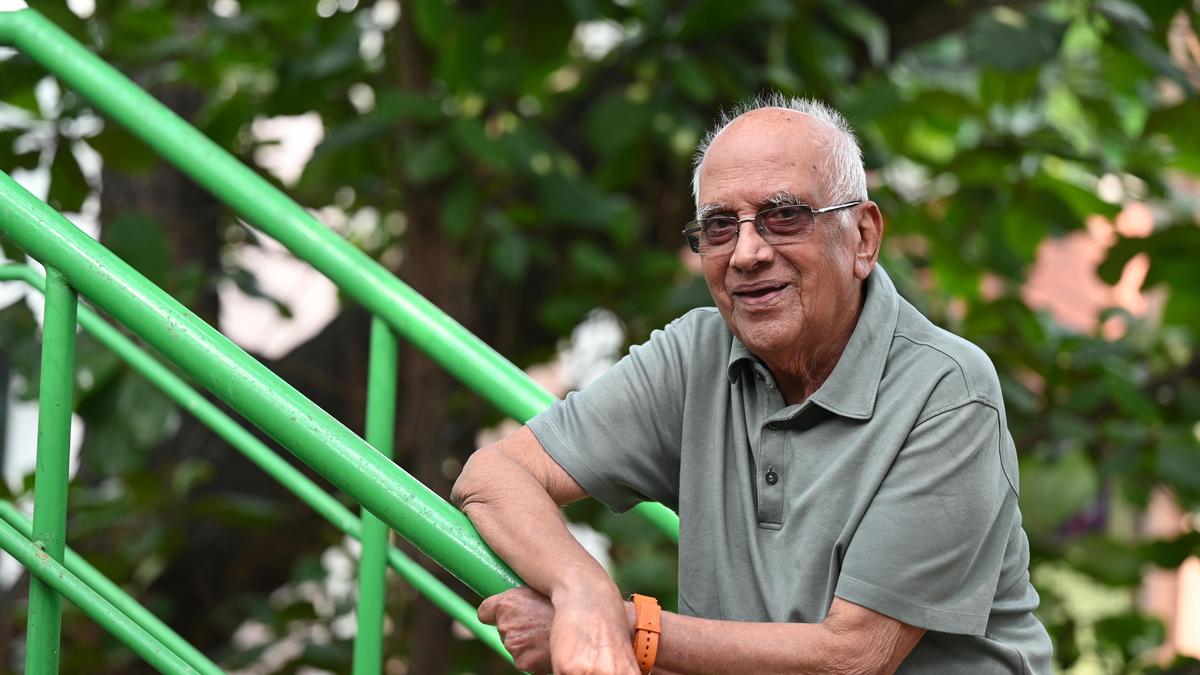
Kamal Haasan once told me that every storyteller has one story and they just find different ways to say it. “One man in another man’s shoes,” he winked, talking about his oldest living collaborator Singeetham Srinivasa Rao.Seemed like the perfect icebreaker for an interview with the 95-year-old legendary storyteller.For a lot of his films begin by disturbing someone’s identity or place in the world — Shekhar and Ranga in Sommokadidhi Sokokadidhi, Kamal in Pushpak, Apoorva Sagodharargal and Michael Madana Kama Rajan. Does putting a character in a situation where they don’t belong, inspire the story, I ask the legend over a Zoom call on a Wednesday morning.“Yes, though there are a lot of these common elements, the starting point is always an idea. Let me give you some examples: Sing Geetham was an idea that I got many years ago from a conversation with Balamurali Krishna when he said there’s music in everyday life. And I wanted to explore how to capture that music from life.”He demonstrates with an example from Sing Geetham where a random line spoken blends two notes. Pushpak, he says, was born out of a desire to pay tribute to the era of silent films and Chaplin.And Aditya 369 was a film that was inspired not just by H.G. Wells and the Back to the Future films but by Mark Twain’s A Connecticut Yankee in King Arthur’s Court.Twain’s book, one of his early influences, might offer a clue on where Rao got hooked to the concept of one man in another man’s world.Entering the caveThere were simply no screenwriting books or textbooks when he started filmmaking. One of the first lessons his mentor K.V. Reddy gave him was that every detail on paper is sacred.“If you write cave, the production and camera departments will not know automatically that it has to be dark. You have to write dark cave.” And that’s how Rao learnt on set, as young writers figure out, the significance of the scene header INT./EXT. LOCATION - DAY/NIGHT.Rao is a writer with instinct — when he starts to write a story, he never tries to guess if it is working or not. “You have to go with your conviction. Nobody will know whether it’s working or not until people watch it and tell you,” he laughs. So, it is a bit of shooting in the dark, sticking to the conviction, which is why it helps that he is always thinking of the little details to flesh out the scene.Music and spark in the detailI prod him on Pushpak — the way the audio of the Finance Minister’s speech on radio on the need to respect retired officers, is in sharp contrast to the behaviour of an old man checking out a maid, or even that scene with scatological humour without resorting to the sounds of toilet humour. “Yes, contrast is always the best way to find comedy in the scene. What if the place where he got the drunk man tied up is next door to a dance school?” And that’s how the sound of the classical dance instructor in the background provides the score for a scene that could have potentially grossed out audiences. But with the contrast, they laugh with him instead.As an instinctive writer, Rao understands that not everything needs to be said through dialogue, a skill he has excelled in since his early days as a writer, from Sommokadidhi Sokokadidhi, where we get a peek into conman Ranga’s mind when he watches Shekhar at work. There are a lot of Chaplinesque silent movie devices he employs in it that he carried forward to Pushpak, where one suspects his love for finding the music in life led him to think of two ideas — the silent film and the musical film where everyone sings out their lines.It took decades before he could get from the first to the second, but he continued using musical narration to achieve great economy in storytelling.You might remember the narrator singing the fable of Michael Madana Kama Rajan. By the time the opening credits end, we know how they were separated at birth.Resolving conflict through laughsHow does Rao negotiate writer-star conflicts during the writing process, I wonder, especially since he has collaborated most with Kamal Haasan, who is often credited on screenplays of his films. “There’s no negotiation. Only collaboration. Because without a star, there’s no film,” he laughs.How did he learn the art of comedy? Larry David, for example, found his voice by subverting social interactions. Garry Shandling struggled with self-doubt and decided that if he is funny in real life, he doesn’t have to learn to be funny on stage.Rao says he does not know about any of that theory. “I think I have always had a sense of humour. That’s probably the secret of my health. I am hale and hearty because I laugh a lot.”He narrates a story from many decades ago, when he and his friend Ananthu had to travel by train from Madras to Bombay, pretending to be siblings to match with the identities on the ticket. So, they wore dark glasses, pretending to have conjunctivitis. “But throughout the journey, I could not stop laughing. I could not keep a straight face.”That anecdote does offer an insight into how Rao discovered the comedy of the average Joe in an otherworldly situation.Finally, I ask him for a writing exercise that might help young filmmakers discover their own voice. “Take any proverb you like. Any old saying. And turn it into a modern story,” he suggests.Traditional wisdom and universal truths explored through an everyday lens might just help a young writer or two discover who they are as writers.Also, Rao has never stopped watching films. From the days he and Balu Mahendra went film-hopping at international film festivals, to discussing Pather Panchali with Satyajit Ray and deconstructing Manmohan Desai’s lost-and-found tropes.“In one scene, three guys are giving blood to each other. People just didn’t care that it’s not realistic,” he recalls of that iconic scene from Amar Akbar Anthony.Even recently, he reached out to this writer after watching his film Culture Vulture on YouTube and sought to reach out to Ravish Kumar to share his words of appreciation for ‘While You Were Watching’.It was a year ago when this writer had approached Rao for an interview on his writing process. Between then and now Rao has already had a highly acclaimed release in Sing Geetham, serves as a story consultant on Kalki 2898 AD and is sharp enough to get working on the next — a historical spy thriller currently in the early stages of writing — yet another twist to one man’s adventure in another man’s world?At 95, the incredible true story of a young man who couldn’t stop laughing, finding himself in many adventures with Kamal Haasan, is far from over. He is still finding new worlds to put his men into — and new ways to make us laugh.
Inside the mind of Singeetham Srinivasa Rao: a masterclass in storytelling
Full Article
Original Source
Read the full article at Thehindu →KhanList aggregates and links to publicly available news content. We do not host full articles from third-party sources. Always verify important information with original sources.