
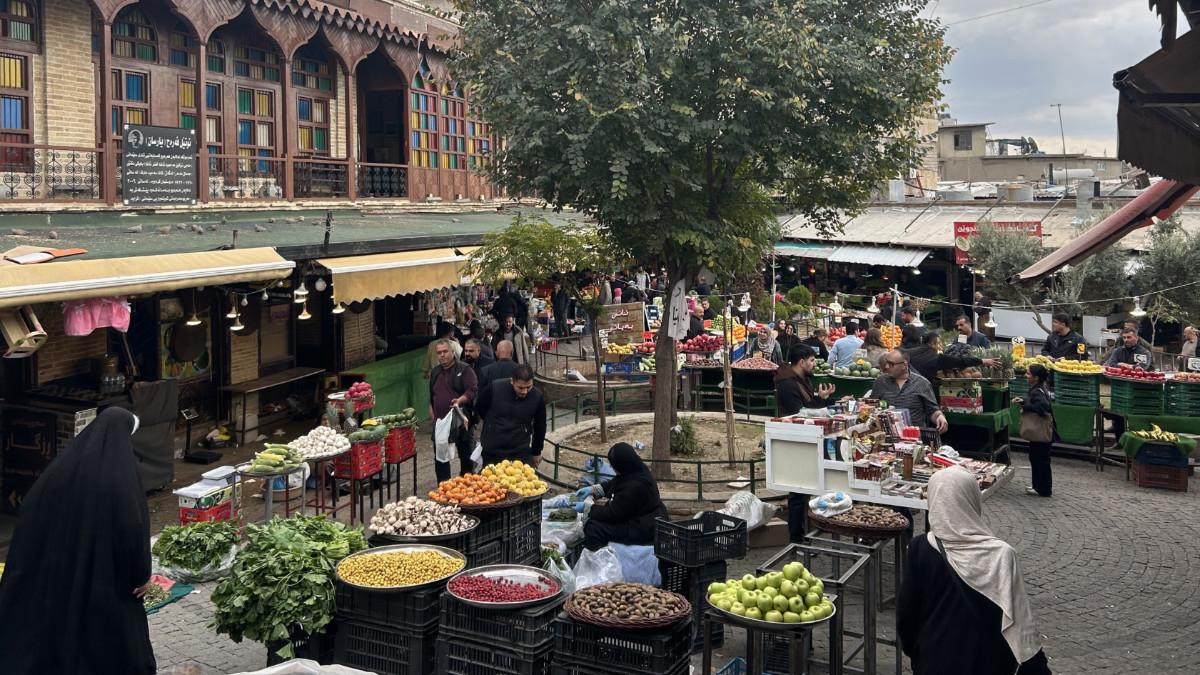
If US President Donald Trump has his way, Baran* will be out of business. The thirty-year-old Kurd is a trader who buys diesel in Iraq and sells it in Afghanistan. It’s a stressful gig, but one that can generate a tidy profit in a place like Iraqi Kurdistan. A truck laden with $20,000 worth of diesel in Iraq can sell in Kabul for around $24,000, leaving around $2,000 for the trader once expenses are paid. But it has to make it through Iran first. “The journey is more dangerous now. It’s harder to find drivers. The border isn’t as reliable. The price of diesel has also shot up,” Baran, whose name has been changed to protect his identity, told Middle East Eye. Trump says instead of restarting strikes on Iran, he wants to choke its economy. In addition to a naval blockade, the US is pressing countries like Turkey, Iraq and Pakistan to seal their borders with Iran. Earlier this month, the US announced a task force to blockade trade across Iran’s land borders and the Caspian Sea. Baran has no political beef with the US. On the contrary, he says, “George W. Bush overthrew Saddam Hussein. He helped Kurdistan. I don’t prefer Iran to the US,” he said over a glass of anise-flavoured Arak and hookahs at a restaurant in Sulaymaniyah. New MEE newsletter: Jerusalem Dispatch Sign up to get the latest insights and analysis on Israel-Palestine, alongside Turkey Unpacked and other MEE newsletters “But this war has not been good for business or our economy.” Baran is a microcosm of the city he calls home. Sulaymaniyah Nestled in the Zagros Mountains, Sulaymaniyah is Iraqi Kurdistan’s second largest city. Its beating heart is a sprawling bazaar where locals boast that any item a shopper desires can be procured. November is pomegranate season, and the fruit was plentiful. The label “Made In Iran” on packages and wrappings was also ubiquitous. Sulaymaniyah prides itself on being more libertine than its rival Erbil. In the bazaar, more women go without a headscarf than with one. “If people have $50 in their pockets, they will spend it to go out here,” Baran said. Bazaar merchants flick the city’s famed prayer beads, made of pistachio tree seeds, and tea boys run around keeping everyone well caffeinated. On the surface, the vibrant bazaar gives an impression of prosperity, but the opposite is true. “The price of food is unbearable for most people now. For some products, the increase is 200 percent,” Evin*, a 28-year-old shopper, complained to MEE. “We used to import so much from Iran, but now they aren’t exporting.” Another young professional said they had to delay purchasing a new laptop computer because the price had shot up from $600 to $800 since the war started. Because of taxes and logistics, Sulaymaniyah’s most competitive trade corridor to China runs through Iran. The region has a plethora of border posts that are more convenient than the Iraqi port of Basra - which feels a world away from here - or Turkey. Goods coming from the latter are also subject to higher taxes from Turkey and Erbil. “In Iraqi Kurdistan, trade with Iran is a major part of the local economy,” Dlawer Ala’Aldeen, the president of the Middle East Research Institute, a Kurdish think-tank in Erbil, told MEE. The US-Israeli war on Iran is taking a toll across the region. The economies of all the Arabian Gulf states are expected to shrink this year. Their pitches as tourism and business hubs are in jeopardy. This month alone, Saudi Arabia’s Public Investment Fund headquarters and the tower housing state-oil company Aramco in Riyadh came under attack from the Houthis. But Iraqi Kurdistan is a unique case. 'Living on a thin margin' The region is convulsed by an internal political fissure that experts say could increase the sway of outside powers, particularly Turkey and Iran. This semiautonomous region of Iraq also lacks the deep pockets of Arab Gulf states to cushion geopolitical blows. The Kurdistan Regional Government (KRG) has been plagued by financial difficulties for years. The region is supposed to receive around 15 percent of Iraq’s federal budget, more than 90 percent of which comes from oil revenue. Despite the war on Iran, Iraq exported more oil this month than at any time since 2019, but payments to the KRG are late. Government employees are receiving their salaries months behind schedule. The rising costs of the Iran war have only compounded the pain. Vehicles drive at the Iraq-Iran border crossing of Bashmagh near Sulaimaniyah in Iraq's autonomous Kurdistan region, on 11 March 2026 (AFP) Iran has deep trade ties across Iraq and the Kurdistan Region. But Sulaymaniyah is particularly close to its eastern neighbour. The city was founded in 1784 under the Baban Emirate, which controlled parts of modern-day Iraq and Iran. Many founding Kurdish families hail from across the border. “Slemani was already living on a thin margin,” Ala’Aldeen said, adding that the local economy depends on “cross-border trade, business, daily labour, and goods” from Iran. “The war did not create that fragility; it exposed it: when Hormuz closed and when the United States pressed Iraq to close all but two crossings with Iran, Slemani felt it in prices and availability of goods,” he said. “Cutting Iran off will leave Slemani without many alternatives.” Those trade ties are more interesting when one considers the pressure Iraq’s Kurdistan Region came under to join in the US-Israeli war on Iran earlier this year. An estimated 40 million Kurds live between Syria, Iraq, Turkey and Iran. Although they never got a country when the Middle East was carved up by European colonial powers, Iraqi Kurdistan gained a high degree of autonomy in the 21st century because of the support it received from the US after the US invasion of Iraq. For more than 20 years, Peshmerga fighters have been key American allies, most recently against the Islamic State militant group. The KRG also hosts some Iranian-Kurdish opposition groups who are backed by the US and Israel. When the Trump administration and Israel decided to attack Iran, they turned to Iraq’s Kurds to support opposition groups and fight across the border, but that plan never fully materialised. 'Impossible position to be in' The KRG is dominated by two family dynasties, the Barzani family in Erbil, which leads the Kurdistan Democratic Party (KDP), and the Talabani family in Sulaymaniyah, which leads the Patriotic Union of Kurdistan (PUK). In the 1990s, Iraq’s Kurds fought a civil war which saw the PUK receive support from Iran, and the KDP from Turkey. Because of its geography and economy, Sulaymaniyah continues to be viewed as closer to Iran, so much so that Bafel Talabani, the PUK leader, denied a reporter's question at a conference earlier this month in Sulaymaniyah, put to him that he was in Iran’s “pocket”. In reality, both the PUK and KDP are closely aligned with the US. Female members of the Iranian Kurdish opposition Komala party carry the body of a Peshmerga fighter in the autonomous Kurdistan region, on 16 April 2026 (AFP) Among American officials, Bafel Talabani is known to enjoy hanging out with former American Joint Special Operations Command fighters, better known as “JSOC guys”. His brother, Qubad, the deputy prime minister of Iraqi Kurdistan, is married to a former State Department official. A former US intelligence official told MEE that the PUK was actually seen by members of the Trump administration as more receptive to plans to support Kurdish opposition groups in Iran because it was lobbying for greater attention in Washington. The PUK's territory in the KRG also shares a longer border with Iran. The PUK was courting the Trump administration in part over frustration that its rival, the KDP, had greater access in Washington as a result of controlling the Kurdistan region’s presidency. The tensions between the two parties have erupted into a major political rift that experts say risks splitting the KRG. Talabani withdrew the PUK from the region's parliament in November and told a forum in Sulaymaniyah that the KRG was already living “the reality of two governments and two administrations”. In the end, neither the PUK nor KDP joined the US war effort. A decision that many Kurds welcomed. "Kurdistan was right to refuse to be embroiled in this war. A collapse in Tehran would not arrive as a clean handover. It would arrive as chaos on Kurdistan's longest border: refugees, armed factions, a power vacuum, and a fight over who controls Iranian Kurdistan," Ala’Aldeen at the Middle East Research Institute, told MEE. Internal politics are at play now, too. Bafel Talabani is courting members of Baghdad’s ruling Shia Coordination Framework for an upper hand against the KDP. The Shia Coordination Framework is aligned with Tehran. The Kurdistan Region is also militarily exposed. It lacks proper air defence systems. The last US troops left Erbil, the region's capital, in September, completing a full US withdrawal from Iraq. The region faced hundreds of Iranian missile and drone strikes during the war. “Bafel Talabani is an ambitious guy. He speaks with everyone, too. He’s pragmatic. But he faces a very difficult position. He is seeking US support, but Iran sees Sulaymaniyah as its backyard. It’s an impossible position to be in,” Oral Toga, a senior researcher at the Centre for Iranian Studies in Ankara, told MEE. 'Iran has the upper hand' At a strategic forum hosted in Sulaymaniyah earlier this month, PUK officials emphasised their desire for dialogue and partnership with Iran. Bafel Talabani himself said that Iran had emerged “stronger but different” from the US-Israeli war and criticised those who characterise the country as being run by “mad mullahs”. Recounting a recent trip he made to Iran, he offered a very different assessment to that proposed by members of the Trump administration who have characterised Iran as on the verge of economic collapse. "I thought I was in London," Talabani said, noting that "less than 50 percent of ladies and girls had scarves" and that restaurants were filled with young people dancing. This overview shows Iraq's northeastern city of Sulaymaniyah in the autonomous Kurdistan region at sunset, on 18 October 2024 (AFP) Tehran is now pressuring Iraqi Kurdistan to clamp down on Kurdish opposition groups. In a meeting in September with Iranian Foreign Minister Abbas Araghchi, Bafal Talabani promised not to allow Iraqi Kurdistan to become "a haven for harming or threatening" the Islamic Republic. "As an ally of Mr Trump and, strangely, an ally of the Iranians [I say] the mighty US can [talk to Iran],” he said at the forum. “The region feels Iran has a strategic upper hand at the moment. It’s not just Iraqi Kurdistan, but the Gulf states too. They all want to avoid Iran’s wrath," Sarhang Hamasaeed, an independent Middle East analyst, told MEE. “But Iran has shown that in this fight it isn’t factoring those relations in. Iraq has been the economic lungs of Iran, but Iran didn’t spare their exports through Hormuz," he added. Given its land border with Iran, Sulaymaniyah is even more vulnerable to reprisals should the war resume. "The Kurds in Iraq were Iran's target practice in prior years, well before Iran's war with the US and Israel. They know, and don't want to be on the receiving end of Iranian strikes," Hamasaeed said. “Between the US and Iran, they have to appease Iran more, because Trump won’t strike them with drones and missiles - Iran will,” he said. The US will not fire missiles at Iraqi Kurdistan like Iran, but America's foreign policy could endanger the region. Many in Sulaymaniyah believe the US will not be content until it collapses the Iranian government. Trump himself said as much on a radio show this month. When asked by a radio host whether he would consider it a “defeat” for him if the Islamic Republic was still in power at the end of his term, Trump said “absolutely”. "The worst thing for Sulaymaniyah and Iraqi Kurdistan would be a failed state across the border. We need stability," a Kurdish official in the city told MEE.
Inside the Iraqi Kurdish city caught between the US and Iran
Full Article
Original Source
Read the full article at Middleeasteye →KhanList aggregates and links to publicly available news content. We do not host full articles from third-party sources. Always verify important information with original sources.