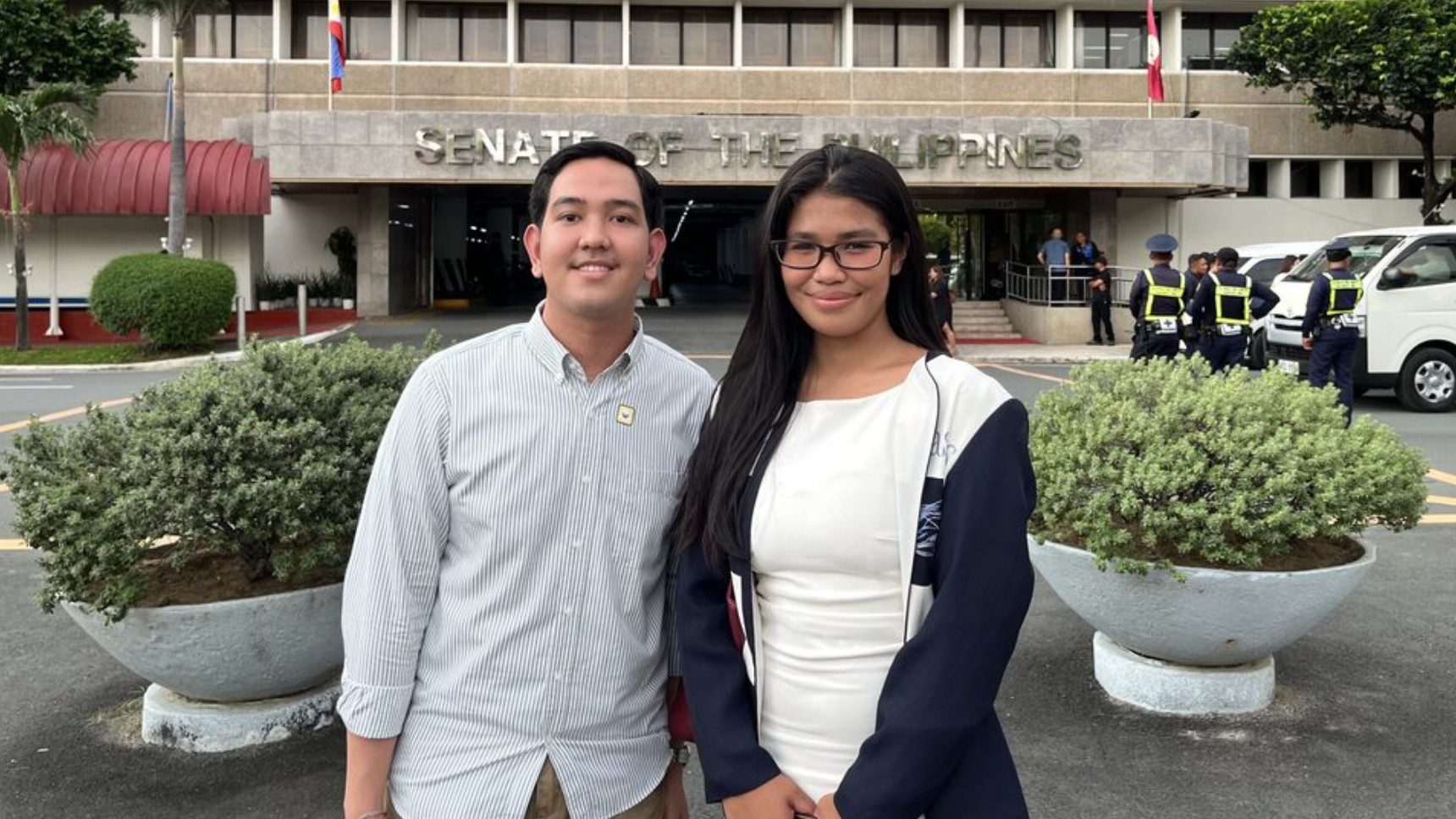
MANILA, Philippines – Sandara Villon and Renz Carl Bayanay, both 21-year-old students, are familiar with the atmosphere of the Senate. The two currently study public administration and belong to a student-led parliamentary organization that is active in lobbying bills to senators. They have seen the Senate halls, have listened to committee hearings. But now, they also got the chance to watch the plenary hall turned into a court, where senators conduct the impeachment trial of Vice President Sara Duterte. At the impeachment court, members of the House of Representatives put on their prosecution hats for the trial. Senators wear their red robes to transform themselves as senator-judges. Duterte, who has not shown up in court, is represented by lawyers mostly from the prominent law firm Fortun, Narvasa and Salazar. But the plenary hall is not just for these three groups and their respective staff. Every trial day, some 61 seats are reserved at the gallery for the Filipino public. “We are very super excited to come here,” Villon told Rappler in Filipino after the trial on Wednesday, July 22. “I mean, even if it’s already our third time coming for the impeachment trial, the excitement was not lost on us.” Their excitement was rooted in learning how impeachment as a constitutional process works, and seeing in person, the personalities of the political body. But Bayanay also said he is disappointed. While the impeachment process may be fascinating, Bayanay expressed how he feels let down that the country has to see an impeachment trial in the first place. “[There is] some mix of disappointment,” he said, seeing a top elected leader having to be tested for the allegations pointing towards the betrayal of public trust. Sara Duterte, who has been impeached twice, is facing charges of culpable violation of the Constitution, bribery, graft, corruption, betrayal of public trust, and other high crimes. ‘History in the making’ To attend the trial, the public can register online through the Senate Visitor Management System a day before their preferred date. For the past three weeks, the trial was scheduled from Monday to Wednesday afternoons. It’s on a first-come first-serve basis, with individuals filling out their details, including submitting a copy of their government ID. And it fills up fast, according to the four people interviewed by Rappler. Agatha Apostol, 20, failed to secure a slot last week, so she attempted a walk-in to the Senate building. That was a no-go. So the environment science student tried again for Wednesday’s trial day. Her registration a success, she came in, wearing a black coat, burnt orange top, and black slacks. Curiosity in the impeachment process led Apostol to the Senate plenary hall. She felt honored to be in the presence of senators, and to witness the rare opportunity that is an impeachment trial. “There’s some intimidation but I find it really amusing, regarding their interactions with each other,” she said of all parties involved in the trial. “I’ve been kind of studying law because we have a subject regarding the Constitution. So there’s some kind of familiarity within it but also it’s something new to me as well,” she said in a mix of English and Filipino. Apostol was not alone, she was with her brother, 27-year-old law student Kyle Orsos, during their Senate visit. TRIAL ATTENDANCE. Siblings Agatha Apostol and Kyle Orsos talk with Rappler along the Senate’s “legacy wall” after attending the impeachment trial of Vice President Sara Duterte on July 22, 2026. Photo by Jelo Ritzhie Mantaring/Rappler “This is history, history in the making. And also as a law student, it’s a big help to watch how our Constitution and laws really work in action,” Orsos said in a mix of English and Filipino. The trial’s political side In the past three weeks, the impeachment court was filled with objections, legal jargon, and arguments as the prosecution presented witnesses and documents to present their first case — the grave threats Duterte made against President Ferdinand Marcos Jr. The complexity of impeachment was not lost on Orsos, who is a second-year law student. “Since impeachment [is also] political, so sometimes the judges, they cannot help but be political,” he said, noting that the court rules he learned from law school were not strictly followed in the exercise. Villon expressed disappointment with some senator-judges for, in her mind, seemingly showing bias. She said maybe Filipinos could reach out to senators, even through social media, to compel them to do their duty and remain impartial. And for her, attending the trial in-person would help many Filipinos to know which senator-judges are genuinely working. “Everything can be manipulated on the internet. But when you’re there physically, you can feel everything, you can see everything. You can judge [on] your own,” she added. Will they go back? With her curiosity already quenched, Apostol is inclined to monitor the trial through the livestream instead. Her brother is slightly hesitant to return. “One thing that might push me to come back here would be the evidence that they will prepare,” Orsos said. Prosecutors will bare their pieces of evidence for the remaining articles of impeachment, which tackle allegations of confidential funds misuse, unexplained wealth, and monetary gifts. Public administration students Bayanay and Villon are eager to maximize their half-day on-the-job training during Wednesdays. For Bayanay, their presence at the Senate gallery is their way to say that the trial “should also be a conversation of the people.” They actually post their experiences on their social media accounts. “We go to the Senate to post awareness to the people that we can observe the impeachment trial, we can see how the senators as senator-judges act, and that it’s also a test to our democracy, to the integrity of our institution,” he said in Filipino. However, they have observed that the trial becomes more technical as the weeks go by. The 61 seats for the public at the gallery seem to be unfilled as well. And they saw that it’s usually law students who are there at the Senate. It has been only nine days out of the 92-day trial schedule. According to a poll by Momentum Research, only 13% of Filipinos are closely monitoring Duterte’s impeachment trial. “Nagiging malayo po siya sa mga normal na ordinaryong Pilipino. Hindi na po maintindihan, minsan po nalilihis. Kaya hindi natin masisi [ang] mga Pilipino kung bakit nagbabase sila sa mga memes, sa mga kung sino may malaking makinarya na Facebook social media page diyan,” Villon said. (The trial has become distant to ordinary Filipinos. It has become more difficult to understand, sometimes it’s being sidetracked. That’s why we cannot blame Filipinos for basing on memes and on Facebook pages with huge machinery.) She suggested the chamber try to reach out to local government units to invite ordinary people to watch and provide free transportation if they have to. The student made this appeal to the Senate: “Try to diminish the huge gap between the Senate being seen as a place for the elites, and try to bridge that gap and try to welcome normal Filipino people so that they will join in here.” – Rappler.com Some quotes are translated to English for brevity.
Inside the impeachment court, students watch the testing of democracy
Full Article
Original Source
Read the full article at Rappler →KhanList aggregates and links to publicly available news content. We do not host full articles from third-party sources. Always verify important information with original sources.