
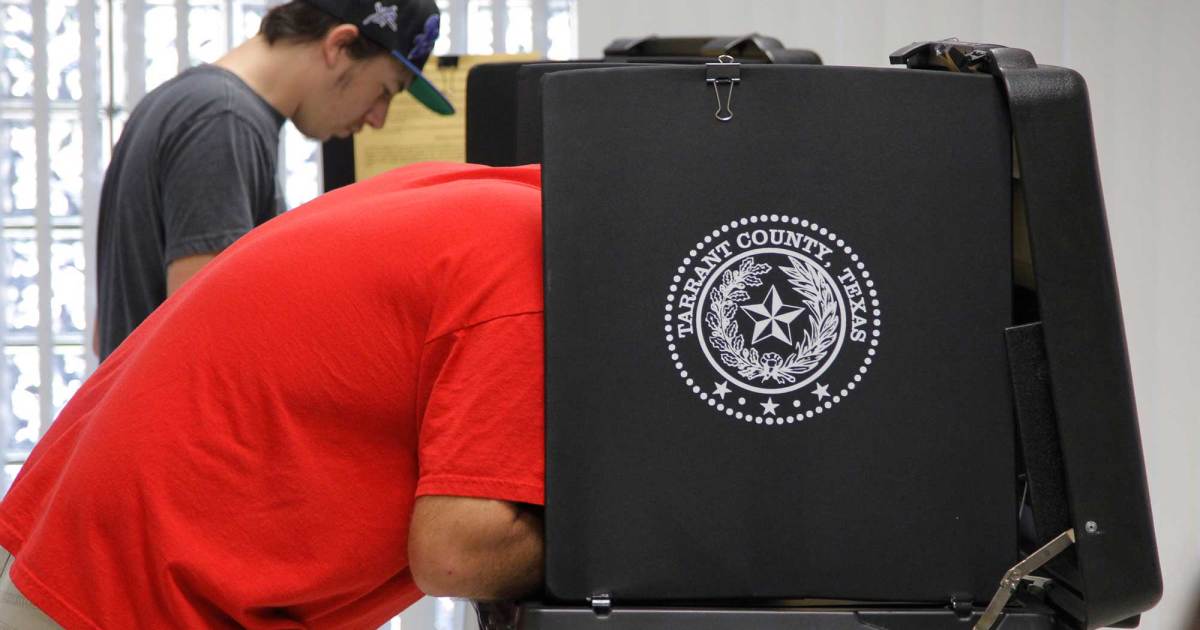
Rodger Mallison/Getty Images Get your news from a source that’s not owned and controlled by oligarchs. Sign up for the free Mother Jones Daily. I met up with Crystal Mason in mid-October, in a hilly neighborhood south of downtown Fort Worth. She was easy enough to recognize—she wore a black t-shirt with a pair of bright red boxing gloves on the front, and a single word in big block letters, “STILL ACQUITTED.” Eight years ago, amid a push by Texas Republican officials to find and prosecute instances of voter fraud, the Fort Worth resident was sentenced to five years in prison for voting in the 2016 presidential election while on supervised release for a felony conviction. Mason argued that she had never been informed she couldn’t vote, and that she cast only a provisional ballot, which was never counted. In 2024, a court agreed and threw out the conviction, but Tarrant County’s Republican district attorney appealed that decision. She finally beat the case for good this September—and then got right back to work. When I met her, she was checking a voter list on her phone and rattling off instructions to a group of volunteers—two daughters, a son, and one grandkid—who had accompanied her to knock doors and check in with residents on a 94-degree afternoon. These days, when she’s not driving a box truck for her day job, she runs a voting rights group called Crystal Mason: The Fight. In recent weeks she’d participated in registration drives, hit the doors, and stopped by a senior center on karaoke night to make sure voters there had a plan to get to the polls. The kind of organizing Mason and others have been doing has taken on a new urgency ahead of the November election. In September, the Republican-led county commission eliminated 92 Election Day voting sites—nearly a third of its 2024 total. Advocates argued the reductions would disproportionately affect Black and Hispanic areas. Mason calls the closures “unreal.” This would be a big deal anywhere, but Tarrant is not just any county; it’s the state’s ultimate battleground. The area has narrowly backed Democrats at the top of the ticket in some recent cycles, but it’s the last of the state’s big urban counties still run by Republicans—including the district attorney who tried to reinstate Mason’s conviction. And the conservative enclaves of Tarrant have played an outsized role in shaping the recent trajectory of the Texas Republican Party. This year’s Conservative Political Action Conference took place in the Fort Worth suburb of Grapevine. Bo French, the racist nominee for Texas Railroad Commission who wants to remove all Muslims from the United States, is a former Tarrant GOP chair. The True Texas Project, formerly known as the Northeast Tarrant Tea Party, celebrated its 15th anniversary by hosting a conversation on “the war on white America”; this fall, it’s held screenings of a new documentary called Don’t Sharia My Texas, at chapters around the state. In light of the stakes and the preeminence of Tarrant County, the local Democratic Party headquarters in an office park on the edge of Fort Worth had been bustling with volunteers and candidates, as well as ink-stained wretches like me. When I spent a little too long admiring the political paraphernalia at the front of the office—including Kamala Harris-branded beer cans and a wine glass for Wendy Davis—Reyne Telles, the Tarrant County Democratic Party’s executive director, wistfully quoted the Boston Globe’s recent description of the space: “The Tarrant County Democratic Party office is a shrine to great hopes past.” Telles says that every statewide candidate on his side of the ledger has a number in mind for how much they need to win the county by in order to win the state—generally somewhere between three and eight percentage points. But there are some indications Democrats have made inroads, including with residents who traditionally support the other side. In a special election earlier this year, a Democratic union leader named Taylor Rehmet stunned political observers by flipping a state Senate district that had voted for Trump by 17 points. The data suggested he owed much of his success to persuasion, not turnout. While the official county Republican organization carries the flag for the far right, Fort Worth’s moderate Republican mayor, Mattie Parker, has endorsed Democratic candidates for two statewide offices—railroad commissioner (against French) and attorney general. Glen Whitley, who served for 16 years as Tarrant County judge (it’s the equivalent of county executive) cut an ad endorsing Democratic state Rep. James Talarico over Republican Attorney General Ken Paxton in the race for US Senate. While Talarico and gubernatorial nominee Gina Hinojosa have captured most of the headlines (guilty), the stakes are high in Tarrant County’s local races, where Democrats have not won a countywide race in decades. Alisa Simmons, a Democratic county commissioner, is in a tight race against the incumbent county judge Tim O’Hare—a conservative Bo French ally who pushed the reduction in polling locations. “He’s a really interesting person—I’m not sure why he even wanted to serve because he’s not serving,” Simmons told me, before a fundraiser at a private home in Colleyville. Good governance has been a major feature of the campaign. In 2025, even before Republicans in the state legislature redrew the state’s congressional maps, O’Hare embarked on an unusual attempt to gerrymander the county commissioner districts, in order to secure what Republicans hope will be a 4–1 majority. The commission has cut its meeting schedule in half, all guest speakers are limited to one minute, and attendees have been hauled out by sheriffs deputies for clapping. (In one notable case, a local activist who used the word “bullshit” in his testimony was charged, one week later, with disorderly conduct.) In our short conversation, Simmons took aim at the county’s Republican leaders for cutting taxes meant to fund the county hospital, and highlighted the rising death toll at Tarrant County jails. “We almost rival Harris County, and Harris County is double the population,” she said, referring to the jurisdiction that includes Houston. Democrats in Tarrant believe the county is there for the taking this year—that the apathy and resignation that have kept turnout lower than other large urban counties is changing, and that the Republicans on the ballot aren’t cut out for swing-state realities. Telles told me he hoped flipping the countywide races would send a signal to other corners of the state, that if a historically Republican metro famous for its cattle drives and western culture can vote blue, they can too. Republicans have pushed voter-fraud narratives and ruthless gerrymandering to preserve their grip on power. But in doing so, they also reminded voters what was really at stake. As we walked through Fort Worth, I suggested to Mason that the kind of ordeal she went through might have easily turned her away from politics. “I realized that’s exactly what they wanted me to do,” she said. “And that was to stand on display and tell them how I would never vote again to discourage the black and the brown from coming to the polls.” She had an obligation, she said, “to make sure that I let them know that these same people that did this to me are elected officials.” Mason’s door-knocking was a strictly nonpartisan operation. She congratulated a young woman who was preparing to vote for the first time, and double-checked that she knew which precinct to stop by. But not long after, voters in select Texas ZIP codes began seeing a new ad in which James Talarico sits at a kitchen table with a familiar voting-rights activist. “Crystal didn’t back down,” he says.“And you shouldn’t either,” Mason tells the audience.
Inside the Fight to Flip the Biggest Battleground in Texas
Full Article
Original Source
Read the full article at Motherjones →KhanList aggregates and links to publicly available news content. We do not host full articles from third-party sources. Always verify important information with original sources.