
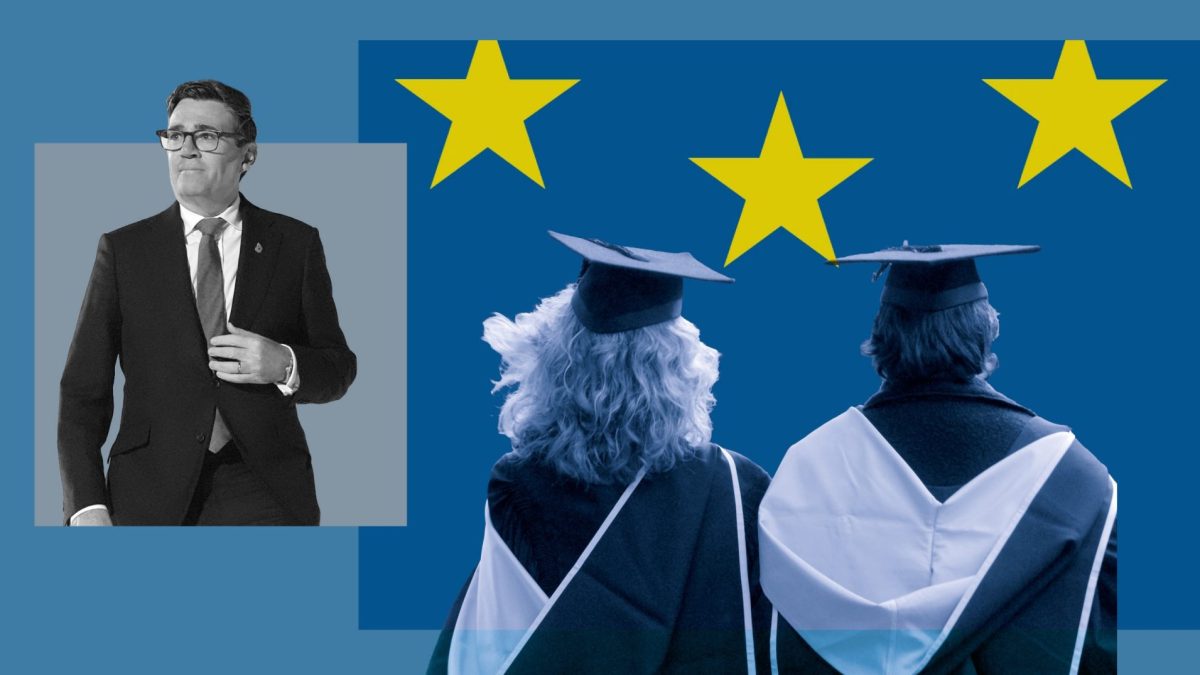
Andy Burnham is about to find out what every Prime Minister since Margaret Thatcher has found out – the issue of Europe does not go away. He is facing a make-or-break week which could end in triumph with a historic new deal with the EU to trumpet on Friday, or humiliation after the optimistic talk of closer ties with our biggest trading partner ends in failure. With a deal said to be “95 per cent there”, Burnham himself has said No 10’s negotiators face some “long nights ahead” to get that agreement over the line. To do that, Burnham is hinting he is ready to make some big concessions. But with closer ties comes greater opposition, and already there are grumblings among his MPs and Cabinet that have forced him to put the brakes on his rejoin rhetoric, while big beasts, such as David Cameron, dust up for a fight. Clocking up the airmiles When Burnham arrived in Downing Street in July he did so with the firm intention of pouring his energies into domestic affairs. By focusing on bread-and-butter issues such as the cost of living, the Prime Minister wanted to strike a contrast with his predecessor, Sir Keir Starmer, whom some detractors dubbed “never here Keir” for his globetrotting activities. But Burnham’s decision to prioritise closer ties with the EU – and the grand language of arguing “everything is on the table” including rejoin – has let a genie out of the bottle that will be very difficult to put back in.It also means Burnham is clocking up those airmiles. After flying to the COP31 climate summit in Antalya, Turkey, for a blink-and-you’ll miss it appearance on Thursday, the Prime Minister travelled directly to the European Political Community summit in Dublin for last-minute talks aimed at smoothing the way for next week’s summit in Brussels where the much-vaunted deal is expected to be signed. In Dublin – where the conference venue was illuminated with shamrock green lights – Burnham greased the wheels for Friday’s summit by holding talks with leaders including European Commission President Ursula von der Leyen and Italian Prime Minister Georgia Meloni. Nursing an Irish Barry’s tea on Thursday evening – a beverage which he declared the perfect tonic after a long day – a travel-weary Prime Minister told journalists that he was “hopeful” of getting a deal. Burnham prepared to give ground The biggest sticking points are the EU’s demand for the UK to reduce its tuition fees for European students and the UK’s demand to be part of the new EU Made in Europe scheme to protect its manufacturers from foreign competition – ie China. Burnham signalled that he is prepared to give ground on both. On tuition fees, he said that it was in the UK’s “interest” to have “more young people coming from Europe again to study at our universities”. On Made in Europe, he said: “Europe’s issue is Britain’s issue, which is obviously particularly imports from China causing the problem.” These are significant concessions. A former government insider said the Treasury had previously worried about the impact on universities’ income if European fees were cut. “There was nervousness about the impact it would have on university finances,” they said. “His Majesty’s Treasury were alive to that.” Hiking tariffs on Chinese imports would meanwhile strain relations with the superpower and go against the grain of the Government’s ambition to increase electric vehicle take-up, An EU source said that the key to the negotiations would be finding the right balance between the two issues. The two sides are “working towards lower tuition fees while also working on not unnecessarily ‘penalising’ the UK” in Made In Europe, they said. Backtracking on talk of rejoining A deal will most likely be struck on Friday – even if implementing any measures is kicked down the road pending other agreements – but Burnham then faces a much bigger challenge about what to do about Britain’s long-term relationship with the EU. In his Labour conference speech in September, Burnham promised to use the time “around” the summit to set out “the different options” for the relationship, making clear in subsequent interviews that he was not ruling out pushing to fully rejoin the EU. However, in recent days there has been a subtle change in the language used by Burnham and No 10 about the timescale for these options. In Dublin, Burnham said that after the Brussels summit “we’ll take a decision as a Cabinet on what, if anything, comes next.” On Friday, a Downing Street spokeswoman refused to say the options would come before the end of this year. A No 10 source said the Prime Minister would set out next steps after the summit, but added that whether there will be a detailed explanation of the alternatives as suggested in the conference speech would depend on “how the summit goes”. As The i Paper reported last week, the potential for delay reflects both splits in Labour on Europe, but also concern that the shape of the EU could be radically transformed if Marine Le Pen scores a victory for the far-right in the French presidential election next spring. Cabinet disagreements and Red Wall worries Differences of opinion on what the future relationship should be cut across Cabinet and the wider Parliamentary Labour Party. In the Cabinet, departmental priorities make certain ministers wary of rejoining. The Home Secretary Shabana Mahmood has been trying to reduce net migration, so is sceptical about anything which would require embracing freedom of movement. A government source claimed that another sceptic, Business Secretary Jonathan Reynolds, is opposed to rejoining partly because his department acts “like a production line” for trade deals with other parts of the world, with agreements with Switzerland and the Gulf Cooperation Council due to be finalised in the coming months. While most Labour MPs are instinctively Europhile, there are vocal individuals in Leave-voting seats who strongly oppose a return to the EU fold. A pro-EU Labour MP said that some colleagues representing Red Wall seats had already complained to the Cabinet Office about Burnham’s tilt towards Brussels. The MP called for a staged process rather than anything that risked reopening the divisions of the Brexit referendum. “We cannot win this if we get Balkanised again,” they said. “The Prime Minister himself has got to make some more meaty arguments than just ‘that’s a mess’.” No longer a risk-free course for Burnham The MP was relaxed about a delay to the options, suggesting Burnham would not want to fight on multiple fronts as he prepares to outline plans to cut benefits for young people in response to the Alan Milburn review of youth inactivity. “I’d be surprised [if he set out the EU options now] given the amount of shit they are going to get over Milburn, immigration and the Budget,” they said. “It doesn’t mean it’s not happening.” Having decided to reopen the Europe question, there is no longer any risk-free course of action for Burnham. Professor Anand Menon of King’s College London, a Brexit expert, warned that if “he backs off now” the Greens, Liberal Democrats and and SNP “will make hay”. Green Party leader Zack Polanski already appears resolved to do so. “This is now becoming a repeated pattern with Andy Burnham,” he told The i Paper. “Signal one thing, take the praise and the comments on his leadership and courage and then frequently do nothing or often the opposite.” In Dublin, the ghosts of Brexit past seemed to hang over the Prime Minister. Burnham said Friday’s summit was partly about removing the defects of the 2019 Brexit agreement, which was “much harder than Theresa May’s deal when she was trying to come up with an arrangement”. Burnham was also forced to respond to a warning from Cameron against starting another “long and painful” debate about the merits of Brexit (Burnham said Cameron’s comments were more about the “unity” of the Conservative Party than “fighting for the British interests”). Part of Burnham’s appeal over Starmer for the Labour faithful was that they believed he was better at the politics and better at communicating. His rise in the polls would suggest some truth to that. But he may find his breezy style does not suit the cockpit of European debate. If Burnham is to avoid Europe destroying his premiership as it did with his recent Tory predecessors, he will have to use all that political skill in the coming weeks and months.
Inside the Brexit deal endgame as Burnham retreats on rejoining the EU
Full Article
Original Source
Read the full article at Inews →KhanList aggregates and links to publicly available news content. We do not host full articles from third-party sources. Always verify important information with original sources.