
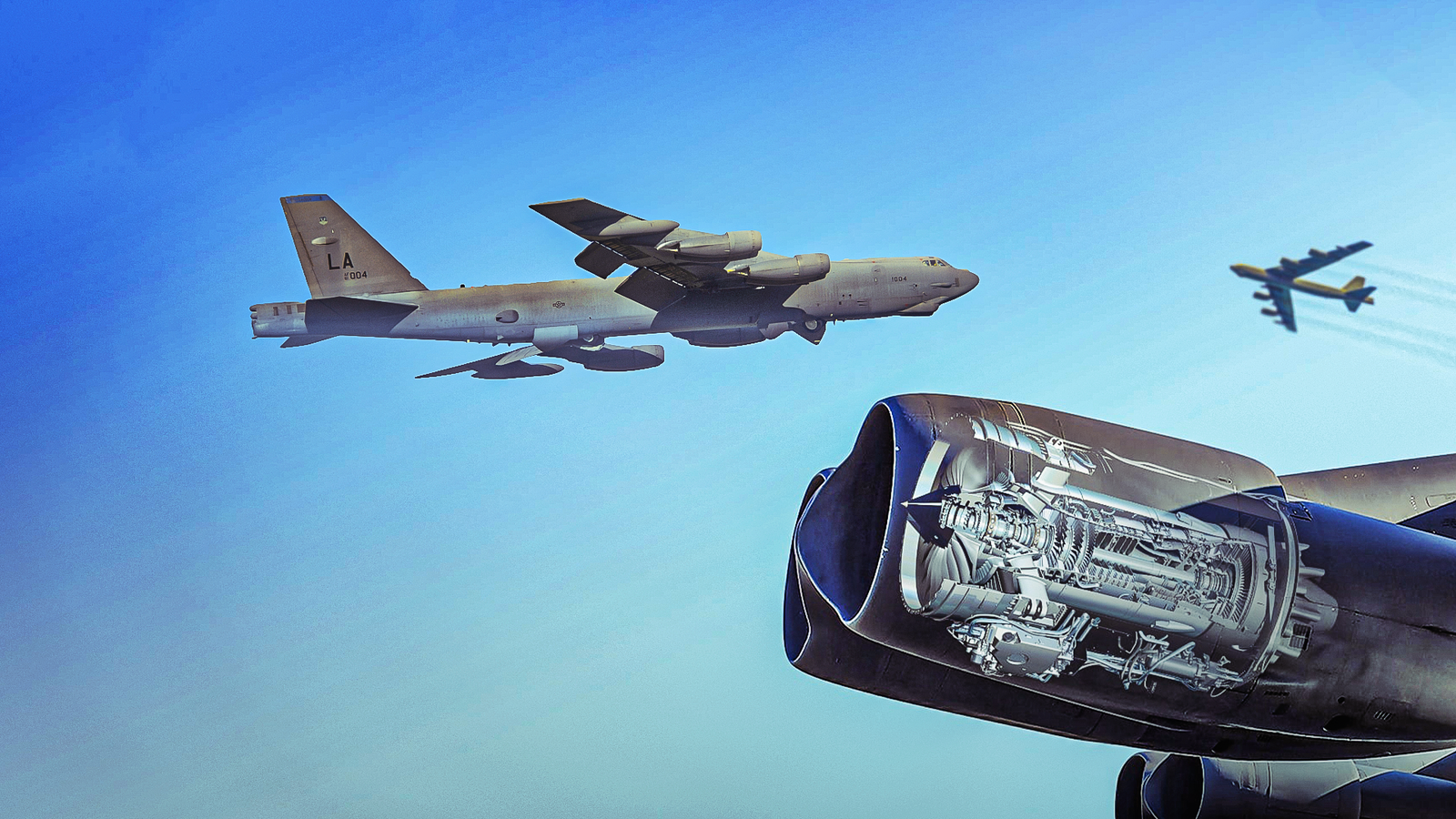
Published Sep 23, 2026, 4:00 AM EDT Aaron is an aviation enthusiast and world traveler with a deep interest in aerospace history and technology. He has traveled around the world numerous times, often incorporating visits to aviation museums and historic aircraft collections into his journeys. A native of New Zealand, he is an expert in aviation and maintains a broad interest in a variety of other subjects. Rolls-Royce has been selected as the engine supplier for a range of important US military aircraft platforms. To support these programs, it has made investments in aero-engine test infrastructure, expanding its ability to perform its development work domestically. The engines Rolls-Royce is currently contracted to supply are mature engine designs or modern iterations of modern designs. The investment better positions Rolls-Royce for future high-performance engines, including where difficult problems increasingly involve thermal management and integration more than just producing shaft horsepower. In particular, this may help lay the groundwork for Rolls-Royce to win future Increment 2 contracts for the USAF's Collaborative Combat Aircraft (CCA) program. BAE Systems has already reportedly complained that Rolls-Royce's engine is too expensive for the British BAE Brontanax CCA, with Rolls-Royce previously saying it was targeting high-performance Increment 2 USAF CCAs. Here is what to know about the importance of its $1 billion investment in its Indiana facilities. Rolls-Royce's Massive Indianapolis Military Engine Complex Credit: DVIDS In August 2026, Rolls-Royce announced it had completed a $1 billion decade-long project in its Indiana manufacturing, assembly, and test facilities. The effort is intended to support the US Air Force's B-52 and C-130J, the Army's MV-75, and the Navy's MQ-25 programs. Rolls-Royce stated, "The investment — the largest the company has made in the United States — modernized advanced manufacturing across the Indianapolis campus and added full engine-test capability." This includes new ground test facilities and an altitude test facility in West Lafayette. Even though Rolls-Royce is a British company, it notes that more Rolls-Royce defense products are built in Indianapolis than anywhere else in the world. The campus is responsible for testing and building engines for a range of defense and commercial platforms, including the future engines of the upcoming B-52J bomber and the US Army's incoming MV-75 Cheyenne II tiltrotor (which partially replaces the Black Hawk). It is also responsible for the engines currently powering the V-22 Osprey, the MQ-25A Stingray tanker drone, and the C-130J Super Hercules. Since 2001, the campus has delivered over 14,000 engines. Rolls-Royce employs around 3,500 people in Indianapolis, which in turn helps to support a larger Indiana supply chain. This is Rolls-Royce's flagship project in the United States; it has spent more than $1.5 billion in US facilities over the last decade. Investing In Current & Future US Engines Credit: DVIDS The $1 billion project splits into roughly $600 million in advanced manufacturing and around $400 million in new engine-testing infrastructure. The advanced manufacturing work was mostly completed in 2021. The new test cells are calibrated to support the current fleets and to provide for future upgrades. Indiana Gov. Mike Braun said, "Rolls-Royce has called Indiana home for three decades, and this billion-dollar investment is a vote of confidence in Hoosier workers and our state. Advanced manufacturing like this is exactly what keeps Indiana’s economy strong and growing. We are proud that Indiana is home to Rolls-Royce in the U.S., and we look forward to their continued success for generations to come." Select Rolls-Royce US programs Engine (per Rolls-Royce) Engines already supplied Estimated total to be supplied V-22 Osprey AE 1107C 1,090+ 1,100+ B-52J Stratofortress F130 None Approx. 650 MQ-25A Stingray AE 3007N Single digits 76+ MV-75 Cheyenne II AE 1107F Prototype/test engines Potentially 1,000-2,000+ C-130J Super Hercules AE 2100D3 2,300+ At least hundreds Increment 2 CCAs (planned) Variant of AE 3007/Orpheus None Potential for at least hundreds At the heart of the facility is the Allison-derived AE family of engines powering multiple US-origin aircraft. These include the AE 2100 powering the C-130J Super Hercules, the AE 3007 powering the MQ-25 Stingray, the AE 1107 family on the current V-22 Osprey and upcoming MV-75 Cheyenne II tiltrotors, as well as RQ-4/MQ-4 drone applications and others. The B-52J's F-130 (discussed below) is a completely different lineage of engines. The F130 Engines For B-52J Stratofortress Credit: DVIDS In September 2021, Rolls-Royce received a contract to replace the aging engines on the Air Force's fleet of B-52H Stratofortress bombers with the Rolls-Royce F-130 engine under the Commercial Engine Replacement Program (CERP). The engine is based on the Rolls-Royce BR700 family of turbofan engines that powers commercial regional and corporate jets like the Bombardier Global Express, the Boeing 717, and the Gulfstream V. Variants of the engine are already in service with the United States Air Force, powering the C-37 VIP transport and the E-11 BACN aircraft. While the number of aircraft to be upgraded with the new engine is relatively modest (76 bombers), these bombers have eight engines each. The CERP program has demand for around 650 F-130 engines (with spares). While commercial variants of the engine are built in Germany, these military engines are built in Indiana. The contract is valued at around $2.6 billion for 608 engines plus spare engines, associated support equipment, and commercial engineering data. The first B-52J aircraft is expected to enter service in 2033. A B-52 testbed aircraft that was part of the CERP program crashed in 2026; it is unclear if this will have an impact on the timeline. The MV-75 Cheyenne II Engines Credit: DVIDS Rolls-Royce will also be supplying the engines for the new MV-75 Cheyenne II fast assault tiltrotor for the United States Army. The type is currently a priority for the US Army and is under an accelerated development timetable. It is expected to enter initial service around 2030. The tiltrotor's engine, the AE 1107F, is related to the Rolls-Royce T406 engine (company designation AE 1107C-Liberty) powering the V-22 Osprey tiltrotor. In 2025, Rolls-Royce announced it had begun AE 1107 engine testing to support prototype delivery for the MV-75 (FLRAA). Rolls-Royce says the AE engine lineage has over 90 million flight hours across 16 commercial and military platforms. These AE engines share a common core with around 80% commonality across the engine family. The Army accepted slightly less optimization than a clean-sheet design in exchange for a much lower development risk and faster production. The V-280 Valor demonstrator was powered by the General Electric T64-GE-419, but production aircraft will be powered by the AE 1107F. This is one of Rolls-Royce's most strategically important US military wins since its F-130 B-52J win. Rolls-Royce is to be the exclusive propulsion supplier, proving the engines and much of the integrated propulsion system for each aircraft. The company is expecting production ramp-up in 2028 with two engines per aircraft. The C-130J, V-22, & MQ-25 Engines Credit: DVIDS With well over 500 examples delivered and many more on order, the Lockheed Martin C-130J Super Hercules is the most popular tactical airlifter on the market. It is powered by four AE 2100 engines and offers a significant leap in capabilities compared with the Allison T56-A-15 turboprop engine-powered legacy C-130H. While most Super Hercules have likely already been built, it is expected to remain in production into the 2040s. As stated, the AE 1107 family already powers the V-22 Osprey tiltrotor, mostly developed for the Marines, but also in service with the Air Force, Navy, and Japanese forces. The program is mature and is currently winding down. The Air Force received its final CV-22 in July 2025, while the Marine Corps closed out its program of record, receiving the 359th example in July 2026. 11 more Ospreys remain on order with the Navy. The contract for MQ-25 Stingray tanker drones is important, although the number to be supplied is comparatively limited. The MQ-25 is powered by the AE 3007N, an existing common core engine adapted for autonomous carrier aviation. The US Navy currently plans to purchase 76 of the aircraft across three squadrons. These aircraft are powered by a single turbofan providing more than 10,000 lbf. This means Rolls-Royce will only provide 76 engines plus an unknown number of spares. Rolls-Royce's CCA Increment 2 Ambitions Credit: DVIDS As stated, all of these aircraft programs leverage existing mature Rolls-Royce designs, but the investment into testing facilities in Indiana points to the company's CCA Increment 2 ambitions. Rolls-Royce says, "As the US Air Force accelerates development of Collaborative Combat Aircraft (CCA), propulsion is no longer a supporting function, but a strategic enabler of range, survivability, mission flexibility, and operational scale." While much of the conversation about CCAs is low-cost and dispensability, Rolls-Royce believes the USAF will need high-end platforms for its requirements operating across the vast and contested environments of the Indo-Pacific. Here, range, electrical power, payload, and embedded installations all matter. It says that the AE 3007 is "already doing the kinds of mission CCA will demand," while its new clean-sheet Orpheus engine offers a "scalable engine family concept designed to enable affordable propulsion capabilities across multiple autonomous missions." It believes Orpheus provides flexibility to respond quickly as CCA requirements mature without restarting development cycles from scratch. With these engines, the company says a customer can have 90% of the capability "tomorrow instead of waiting seven or eight years for perfection." It should be noted that CCAs will likely span a range of low-end and high-end systems and that requirements for those designed for the European theater will be considerably different from those intended for the Indo-Pacific.
Inside The $400 Million Test Cells Rolls-Royce Built To Keep The B-52, V-22, & C-130J Flying
Full Article
Original Source
Read the full article at Simpleflying →KhanList aggregates and links to publicly available news content. We do not host full articles from third-party sources. Always verify important information with original sources.