
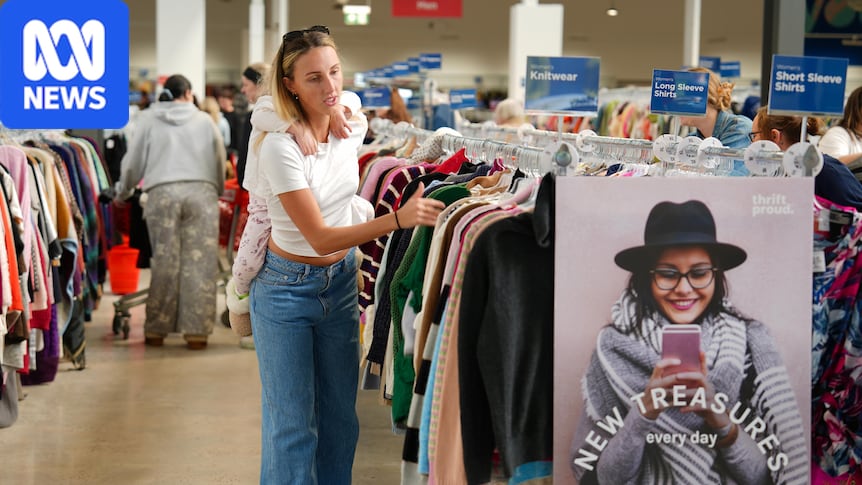
The buzz was palpable at the latest Savers store opening in Geelong.Some people had driven hours to line up on August 27 outside the retailer's newest big red box, with one heavily pregnant woman right at the front of the 100-metre queue."I have two babies in here, so I need a lot of clothes," she laughed.The regional Victorian site is the company's 19th store in Australia.But what is not commonly known is that Savers Australia is the subsidiary of a much larger US company.The parent company, Savers Value Village (SVV), is worth $2.2 billion, has shares which trade on the New York Stock Exhange and is majority owned by American private equity firm Ares Management.Customers queue for the new Savers store. (ABC News: Billy Draper)SVV is also North America's largest for-profit second-hand retailer with 185 stores in the US and 172 in Canada.Its 50 per cent gross profit margin is well above the industry average and the company earned more than $300 million last year, according to Refinitiv data."Larger retailers like Cash Converters, Savers and Vinnies have consistently outperformed their smaller, non-employing counterparts," analytics firm IBISWorld noted recently of its place in the Australian second-hand retail market."Primarily owing to their capacity to harness economies of scale."Why is Savers controversial?In Australia, its for-profit mission makes Savers an outlier.It competes directly with non-profit, second-hand retailers Vinnies and Salvos, and smaller charity op shops that rely on selling donated goods to fund community programs.Esther Koning-Oakes is worried about what the arrival of Savers means. (ABC News: Billy Draper)Some of them are not happy about Savers' expansion."We should be keeping as much as what we can in Australia," Esther Koning-Oakes, the boss of one charity near Savers' new store in Geelong, told ABC News.Ms Koning-Oakes's charity, Norlane Community House, operates an op shop in Geelong called Treasures, which helps fund its drop-in centre.Unlike Savers, it is small, manned by volunteers and relies heavily on direct community donations.She is worried Treasures will get fewer customers and donations with its new competitor on the scene."I think a lot of people, when they donate things, they want to donate it for a good cause," she said."Having it for a for-profit company means that that is going into shareholders or upper management, and it doesn't actually go back into community."Volunteers keep Norlane Community Op Shop running. (ABC News: Billy Draper)How does Savers' charity partnership work?Responding to the concerns from local charities, Savers' American head office told ABC News it gave its Australian non-profit partners $5.6 million last year, which works out to about $310,000 per local store."I'm sorry to hear those concerns because [at] Savers, it's important to us to make sure that we grow in the circular economy," local boss Michael Fisher said."In Australia and globally, we partner with not-for-profit organisations."They go and solicit donations from the general public, they bring them to the stores, and we pay them for those donations.Savers Australia boss Michael Fisher (left) with CEO Mark Walsh (right). (ABC News: Billy Draper)"So if you donate to us at the store, you're actually donating to the not-for-profit, and we pay them for that."Diabetes Victoria boss Glen Noonan was at Savers' recent Geelong launch, where big green bins with his non-profit's logo were on proud display for people to donate into.Mr Noonan would not disclose what Diabetes Victoria was paid to collect goods for Savers, describing it as confidential.Yet he said the millions it received last year from Savers was beneficial, and allowed Diabetes Victoria to revenue raise from second-hand donations without the grunt work of running shops themselves."From the revenue that we generate, we provide much-needed services to Victorians," he said.Savers is clearly aware of the space it is operating in and the public perceptions around second-hand retailing.Savers is the biggest for-profit thrift retailer in the US and is expanding across Australia. (ABC News: Billy Draper)At its latest Geelong launch, one woman who was excitedly waiting in line to buy Savers goods had some reservations about donating her own belongings to the organisation."I will not be donating my clothes here," she said."I would rather give back to the Salvation Army or the Geelong Animal Welfare Society."Those who decide to donate, however, get a 20 per cent off voucher for their next shop at Savers.Where does the unsold merchandise go?Savers' financial filings do not break down its overheads in great detail. Michael Lasser, a retail analyst from investment bank UBS, which has done work for Savers, said its biggest overheads would be staff wages, store overheads, and the undisclosed cost of buying used items. Clothes and goods are donated to Diabetes Victoria which has a contract with for-profit thrift store chain Savers. (ABC News: Billy Draper)"This is a business that is aimed at more effectively monetising the donated goods for charities," he said.Like op shops and non-profit second-hand retailers, Savers also needs to deal with all of the donations from charity partners that it cannot sell in Australian stores. It does not disclose how much stock ends up in landfill, gets sent overseas to the rag trade, or is recycled.Savers, however, emphasises that it offers a solution to waste, with Australia among the largest per-capita consumers of clothing.Pricing decisions with help of AIIn North America, the company has been using a program backed by artificial intelligence, ThriftIQ, that helps speed up its decision-making on how much to charge for goods."It's just in the process of rolling out," Mr Lasser said.The company known to Australians as Savers started in the United States in the 1950s. (Supplied: Savers)"But it leads to better pricing of products, more productive use of labour, and faster sell-through of the goods."Savers would not reveal whether it would expand the use of ThriftIQ to its Australian stores.On a recent analyst call for its quarterly financials, its top executives talked up the technology, as well as the growth the company was experiencing.The global resale of fashion alone is projected to be worth $444 billion ($US317b) by 2027, according to research by consulting firm McKinsey & Company."Younger and more affluent consumer cohorts are still our fastest-growing demographics, which speaks to the power of our model and its ability to resonate with all shoppers," attendees of the Savers' analyst call were told."For 2026, our plan remains to open around 25 new stores, more than 20 of which will be in the US in 11 states."Savers opened its first Australian store on Melbourne's Sydney Rd in Brunswick in 1997. (Supplied: Savers)The company is more tight-lipped on its plans for Australia, where it employs 1,250 staff across its stores in NSW, Victoria and South Australia.However, its local boss Michael Fisher was evidently preparing for more openings with long lines and gigantic ribbon cuttings."It's fair to say that we'll open another store next year," he said."We're really excited with the growth of second-hand across Australia and we're happy to participate in that."
Inside the $2 billion thrift store expanding in Australia
Full Article
Original Source
Read the full article at Abc →KhanList aggregates and links to publicly available news content. We do not host full articles from third-party sources. Always verify important information with original sources.