
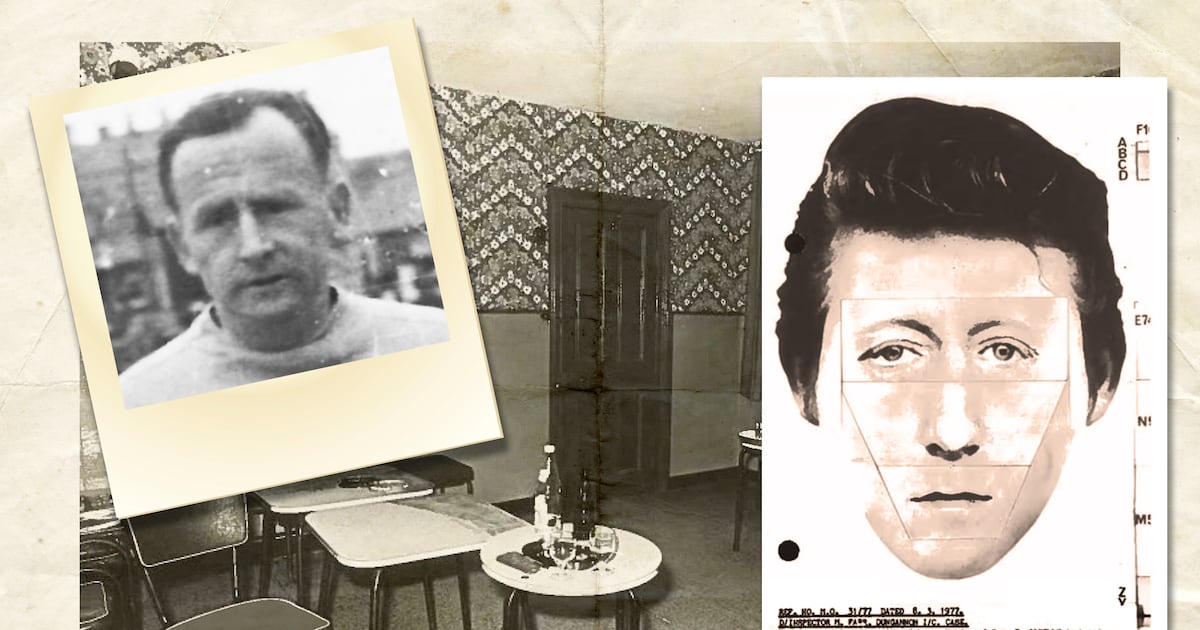
The three representatives of the legacy body set up to investigate deaths during Northern Ireland’s Troubles knew the significance of their meeting with Roger O’Kelly.They passed the “Fáilte” welcome sign at the entrance late last September and signed their names into the visitors’ book at the Birmingham hospice.Decades on from the murder of O’Kelly’s father, one of the three Independent Commission for Reconciliation and Information Recovery (ICRIR) representatives, Fleur Holve, says they were “quietly hesitant and profoundly aware” of the importance of their meeting with O’Kelly, who was by then dying of pancreatic cancer, to tell him what they had learned of his father’s killing.Fleur Holve signed her name in the Birmingham Hospice’s visitors’ book late September moments after she, Declan Morgan and Keith Surtees had passed a “Fáilte” welcome sign as they walked in.READ MORERoger’s father Rory O’Kelly was shot and killed by the IRA as he sat having a drink in Lyttle’s pub in Coalisland, Co Tyrone, on March 4th, 1977. He was back in his hometown for the funeral of the mother of a close friend.Inside the hospice, the three ICRIR representatives met Roger’s sister, Anne – “a woman of great tenderness and grace”, Holve says – and Roger’s wife Geri, whose warmth, Holve remembers, “belied the emotion of the encounter”.“I saw Roger lying on a bed; the sterile space seemed to fold around his ailing frame. He greeted us with a gentle and welcoming smile. ‘I would get up,’” he joked, of his inability to.Rory O’Kelly, who was murdered by the IRA on March 4th, 1977. His killing is the subject of an investigation by the Independent Commission for Reconciliation and Information Recovery. “We were there to answer questions about his father’s killing. Roger was himself close to death. One death belonged in history, preserved through memory; the other death lay ahead,” writes Holve in the ICRIR report into the 1977 killing, published today.This is the first report of the ICRIR, established in December 2023, into a murder carried out during Northern Ireland’s three-decade long conflict.‘By the end, Roger and I had moved into a space of serenity and light, all anger taken away. I would never have expected to know this sort of release’— Anne O'Kelly For decades, Roger O’Kelly had wanted to know the truth about the killing of his father, a Catholic, a solicitor, a founder member of the SDLP and an election agent for one of its MPs, Austin Currie.Not every family member had agreed about going to the legacy body, but they had all been haunted by their father’s last moments, by how long it had taken him to die and by how much he had suffered.Sitting by his bedside, Sir Declan Morgan, the ICRIR chief commissioner, – accompanied by fellow commission representative Keith Surtees – pieced together his father’s last days.“I had no idea of what was in store for us. I soon became aware that something sacred and transformative was happening,” says Anne, in a statement accompanying the publication of the ICRIR report on the murder.An innocuous-looking scene: inside Lyttle's pub in Coalisland, Co Tyrone, shortly after the killing of Catholic solicitor Rory O'Kelly, with the drinks still sitting on the table. Everyone present was taken back to “the hour and place”, she says. “By the end, Roger and I had moved into a space of serenity and light, all anger taken away. I would never have expected to know this sort of release.”[ Troubles legacy body claims Government has ‘not bought into’ telling truth about conflictOpens in new window ]Rory O’Kelly, who had studied at UCD and spent seven years training for the priesthood, was targeted by the IRA because he had joined Northern Ireland’s Office of the Director of Public Prosecutions.Deeply nonsectarian, Rory, according to Dungannon priest Fr Denis Faul, had “rendered great service” to civil rights campaigners “by courageously defending them” between 1968 and 1970.Having given up his local solicitor’s practice, Rory, for security reasons, moved his family from his strongly republican hometown to Bangor, Co Down, though he did feel safe on returning to Coalisland. He was “irresistibly drawn to the conviviality and exceptional conversation” of the town, the ICRIR report says, though “his profession and convivial demeanour” would have marked him out “for anyone wishing to do him harm”.Early on Wednesday, March 2nd, 1977, Rory left Bangor to return to Coalisland for the funeral of Catherine Canning, mother of local SDLP councillor Jim Canning, and staying with his close friend, John Malachy Quinn.Having spent time in Lyttle’s pub on the Thursday night, Rory returned there shortly before noon on Friday to pick up his car, which had been left there “to be on the safe side”, and to recover some belongings. It is likely, the ICRIR found, that he had been watched for days, and that his Rover 2000 – “considerably rarer” than, for instance, the more commonly seen Ford Cortina – would have helped his killers track him down.An identikit picture released by the RUC of a man suspected of killing Rory O'Kelly in Coalisland in March 1977. Sitting by the fire in the pub, he fell into conversation with two locals, Patrick McGahan and Patrick Barkley, while barman Charles McCook moved between the front and back bars, serving drinks.McCook saw a young man sitting at a table by the door who asked for “a Bush and a stout”. Told he would be served in a minute, the young man impatiently said he was in a hurry.“The next thing Patrick McGahan remembered was talking to Rory and hearing a shot. (He) described Rory falling into the corner,” a Royal Ulster Constabulary note of a later interview with McGahan records.‘I could never talk about my father’s killing, certainly not to anyone in the family. We didn’t “cope”. We just ignored it’— Anne O'Kelly O’Kelly had been shot once in the chest. The “Bush and a stout” killer unhurriedly left by the back door as the 1pm news headlines were heard on the radio, barman Hugh Pat O’Neill remembered later.Described as “19 or 20 years old, 5’8” in height, of thin build, with short black hair, wearing a blue denim jacket, brown trousers and a shirt and tie, speaking softly and a local accent”, he has never been identified.[ Ex-SAS commander in North: ‘The idea that we played hard and fast with the law is nonsense’Opens in new window ]Days later, the IRA claimed responsibility for killing the DPP prosecutor, saying it was part of its campaign against “British imperialism’s judiciary and administration” in Northern Ireland. A .45 calibre bullet had entered the front of O’Kelly’s upper arm at its junction with his chest, passing left to right, causing “massive internal bleeding”, the postmortem showed. The Colt .45 had been used in multiple shootings over the previous year, and would be used again within weeks to kill 38-year-old part-time Ulster Defence Regiment soldier, David Graham, at a Coalisland cement factory.It was seized in July 1984 by the British Army’s Special Air Service after soldiers killed IRA member William Price as he and others planned an attack on a factory in Ardboe, Co Tyrone.Intelligence held in Police Service of Northern Ireland (PSNI) files discovered by the ICRIR show that the local IRA in Coalisland did not agree with the attack on Rory, who was well-liked, and had not known the solicitor was going to be killed.Instead, the killing was carried out by “outsiders”, the ICRIR found, illustrated by the fact the killer had been confident that he could sit in the bar and not be identified in the minutes before he shot Rory. The RUC investigation made “an early effort” to trace Rory’s killers, but this ran out of steam within days, short of leads and swamped by violence in Coalisland and Dungannon, especially against the RUC itself.Reflecting on “my little brother’s” campaign to learn about his father’s killing, Anne talks of the “deep feeling of irrecoverable loss and distress” that the episode left behind.“I could never talk about my father’s killing, certainly not to anyone in the family. We didn’t ‘cope’. We just ignored it,” she says. [ ‘I would do it again in a heartbeat’: former RUC officer consigned to a wheelchair by the IRA on serving in the TroublesOpens in new window ]“Victims often feel a sort of shame, wanting to cover up.”She could not thank the ICRIR “enough for working so hard to piece together the facts”, she says, praising “the three lovely people who came over to England to tell us what they had found; all done just in time.”Her father’s killer will “probably” never be identified, she says.“Not more than 20; my age then. He must have been nervous as he pushed open the door,” she says.“Was he told afterwards: ‘You did well, son’?”
Inside story of IRA’s 1977 killing of Rory O’Kelly, and the first report of Troubles-era investigative body
Full Article
Original Source
Read the full article at Irishtimes →KhanList aggregates and links to publicly available news content. We do not host full articles from third-party sources. Always verify important information with original sources.