
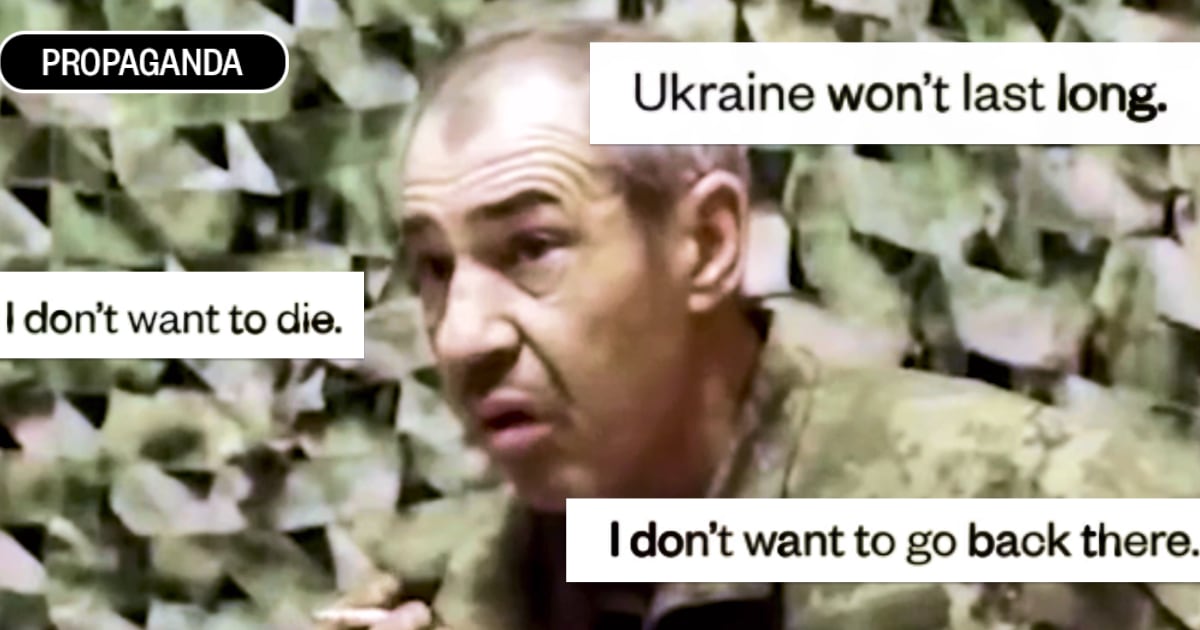
Sept. 22, 2026, 5:00 AM EDTKARPYLIVKA, Ukraine — Volodymyr Srebrodolskyy, a Ukrainian soldier with gray hair and deep wrinkles, smoked a cigarette while speaking to his Russian captor behind the camera. “I don’t want to go back there,” Srebrodolskyy said, appearing to have turned against his country. “It would be good if all of this ended quickly.”The video was Russian propaganda. Weeks before it was posted on Telegram, Srebrodolskyy was fighting for Ukraine on the eastern front line against the men who captured him. Now, he was following their script.The propaganda worked. Arguments over whether Srebrodolskyy betrayed his country tore apart his hometown of Karpylivka, a village of 500 nestled in the golden wheat fields of Ukraine’s Chernihiv region. Some labeled him a traitor.“He’s smoking a cigarette, saying he won’t return to Ukraine,” said Nina Bedko, 68, who stopped to chat with other women along Karpylivka’s main street. “That’s why people got that impression.”Volodymyr Srebrodolskyy, a Ukrainian prisoner of war, in a Russian propaganda video released in 2024. Obtained by NBC News Srebrodolskyy died in captivity weeks after the video was shared. When his body was ready for burial this spring, some of his neighbors — believing the propaganda — threatened violence against the village mayor if he allowed Srebrodolskyy to be placed in the town’s cemetery. Others defended him, saying he went to war willingly, without trying to evade the draft. “Maybe they promised him mountains of gold,” said his cousin, Lidia Kovalenko, a short 82-year-old woman with a bright smile. “At least they could have buried him near his mother.”The arguments put the fate of his body in limbo. Thousands of such videos have been posted to Russian social media channels, some of them airing on state-run television. They follow a formula: Ukrainian prisoners decry their commanders, decline to return home, denounce corruption and say they hope for the war to end soon. The message has been repeated since the beginning of Russia’s full-scale invasion in 2022 with few variations, reinforcing Russian narratives about the country it invaded and seeding distrust toward the army in Ukrainian communities.Thousands of Russian propaganda videos of Ukrainian prisoners have been posted to Russian social media channels. Obtained by NBC News A system of abuseHuman rights organizations have called on Russia to stop broadcasting videos of prisoners of war since the early days of the full-scale invasion. “The obligation under the Geneva Conventions is to protect POWs from being objects of public curiosity, as well as from intimidation or humiliation,” Aisling Reidy, senior legal adviser at Human Rights Watch, said in a statement at the time.The videos are recorded inside a detention system the United Nations Human Rights Monitoring Mission to Ukraine has found to be systematically abusive — sustained in part by “dehumanizing language in state-owned media.” In interviews with more than 850 Ukrainian prisoners of war conducted by the U.N., 96% said they endured torture or mistreatment, including beatings, electric shocks to the genitals, sleep deprivation and mock executions. The abuse can last for years, the report says. Over half of Russian prisoners of war have also reported mistreatment to U.N. investigators, saying it took place at the point of capture. Russian prisoners have been made to film similar videos, which the U.N. has condemned. However, unlike Russia, Ukraine allows monitoring groups unhindered access to the facilities holding the prisoners, which the U.N. says are compliant with the Geneva Conventions.The Media Initiative for Human Rights, a Ukrainian nonprofit, has documented 240 detention facilities holding Ukrainians on occupied and Russian territory. “The more of these videos they record, the more they will give power to their ideas,” said Olena Belyachkova, whose work at MIHR focuses on the imprisoned and the missing. Her own husband endured Russian captivity from 2015 to 2017. In some cases, Russia has used propaganda videos as evidence to prosecute Ukrainian prisoners. Belyachkova said that in the absence of an official Russian accounting, the videos can serve as proof of a soldier’s status as a prisoner of war. Because they are frequently deleted from social media, the exact number of such videos cannot be quantified, but they number in the thousands, she said.The industryWhen Vasylyna Duman saw a video online of her husband, Yevhen Shybalov, from Russian captivity, her first reaction was to keep it secret. She worried that a media storm would raise the price Russia would ask to exchange him.Vasylyna Duman (left) and her husband Yevhen Shybalov (right).Ted Turner / NBC NewsThis was the first time she saw his face in months. Shybalov volunteered to fight on the first day of the invasion. Russians captured him in May 2022. In the video, he was thin and bore signs of beatings, she said. She filed a police report using the video as evidence of his captivity. She wanted it on record that he was forced to speak against his will. “To get a video is a big happiness, even if the person says something weird on it,” she said. It meant he was alive.Shybalov, a tall man with pronounced cheekbones, watched the Russian occupation unfold in Donetsk city as Russian operatives and their collaborators poured into Ukraine’s east in 2014. The Ukrainian government was in disarray after the Revolution of Dignity overthrew a pro-Russian president, limiting its ability to respond.“It gave Russian propaganda a free space without competitors,” he said of the chaos of that time. “It made people very disoriented about what’s happening.”Yevhen Shybalov in his home in Mykolaiv, Lviv region. Ted Turner / NBC NewsPreviously a journalist, Shybalov quit to launch an aid organization with an office in a Donetsk hotel that provided them free space. One day, he saw a Russian television crew of about 50 move into the same hotel. Shybalov watched them learn lines for the roles of local residents. “They just drank coffee, smoked cigarettes on the veranda and learned to say, ‘I’m from Horlivka,’” Shybalov said. Then they would wonder, “What the f—k is Horlivka?” Some of the civilians Shybalov delivered aid to believed the Russian propaganda. He did not argue with them. “They were just victims,” he said. “They were hostages.”As Russians installed their own officials and laws on occupied territories, operating an aid organization became untenable. After being ejected from Donetsk, Shybalov relocated to Kyiv.At 6 a.m. on Feb. 24, 2022, Shybalov woke up to a call from a friend. The full-scale invasion had begun. He heard fighter jets and explosions. For the next two hours, he watched the news, drank coffee and smoked one cigarette after another. By 10:30 a.m., Shybalov enlisted to fight. His sergeant handed him a rocket-propelled grenade launcher. “Congrats,” the sergeant said, “now you are our grenadier.”After helping push the Russian army back from the outskirts of Kyiv, he was deployed to the border between the Donetsk and Luhansk regions. Another Ukrainian brigade nearby withdrew, but Shybalov and his unit were not informed. It was four of them against a battalion of Russian paratroopers, he said. They were encircled after a week. After being bound, interrogated and shifted among holding facilities, Shybalov landed in a prison in Luhansk. He said he was beaten and tortured. Shybalov did not see the sun for six months and shed over 30 pounds during his captivity. “We had porridge with worms for breakfast and porridge with sand for supper,” he said. Shybalov said he was a high-value prisoner for the Russians because he was from the east, had been a journalist and worked with international organizations. They were keen to present him as an American spy, he said — a charge that carries a sentence of up to 20 years. One day, a Russian intelligence officer told Shybalov he was recording an interview with Russia Today, the government-controlled media outlet.Shybalov was forced to record a propaganda video while in captivity.Ted Turner / NBC News“Prepare yourself,” the Russian said. “They will come here in five minutes.” Shybalov was invited into a comfortable room with a sofa. The crew had two iPhones. One of the men treated him cordially, offering tea and cigarettes. He spoke as if they were having a friendly chat. “Like two mates having their Friday beer and softly discussing global matters,” Shybalov said. It was different from a local crew that had come earlier and given prisoners scripts to read. The RT crew was more sophisticated.“They really manipulated you to make you say something understood as a pro-Russian position or anti-Ukrainian, but these are words said by you,” he said. “They’re just trying to manipulate you to catch you on that hook.”The intelligence officer, meanwhile, implicitly threatened to return him to his interrogators, who waited outside the door. Shybalov tried to control his gestures and his breathing during the two-hour interview. “Talking to them, I even prohibited myself from feeling something,” he said. When he returned to his cell, he did not discuss the video much. He shared the half a pack of cigarettes the Russian intelligence officer gave him with his cellmates. Back home, the video helped place him on an exchange list by adding to the evidence that he was captive rather than missing in action. His wife, Duman, filed reports with all the authorities she could think of. Unable to sleep in their shared bed while he was imprisoned, she rested on a sleeping bag on the floor and kept herself busy delivering aid to soldiers on the front line. She and her friend used to drive out onto a bridge in Kyiv, roll down their windows and scream. “That was our method to de-stress,” she said. Shybalov was not told where he was going before he was exchanged in December 2022. A Russian guard told him he was about to be executed, then said it was a joke. He arrived on Ukrainian soil and sang the Ukrainian anthem on the bus home with other prisoners. “This is what could never happen in a Russian cell, even in a dream,” he said, “that you could sing the Ukrainian anthem and not be beaten for that.” After seven months of captivity, he came home on New Year’s Eve. “I did not cry; I screamed very loudly,” Duman said of the moment she found out that he was coming home. “I think I woke up half the building.” Vasylyna Duman delivered aid to soldiers on the front line while her husband was imprisoned.Ted Turner / NBC NewsSince his return, Shybalov and Duman relocated from Kyiv to the small town of Mykolaiv in Ukraine’s western Lviv region, where Duman is from. The couple keeps to themselves.Shybalov had heard about Volodymyr Srebrodolskyy, whose village denied him a final resting place on the land where he was born. It enraged him. “Russian propaganda — it’s an industry,” he said. “They facilitate this as an industry with the needed volume of basic raw materials, which are interrogations and interviews with prisoners of war.” All of the former prisoners Shybalov keeps in touch with have had to film them, he said. “They really perceive media as a weapon, culture as a weapon, language as a weapon and religion as a weapon,” he said. “Thus, they treat it as a proper weapon. They invest big resources to produce it. They design sophisticated and smart tactics how to use it. And they have thousands of people engaged in it.” A cell in DonetskVolodymyr Srebrodolskyy’s captors placed him in a detention facility in Chystiakove, a city known as Torez until 2016, occupied by the Russian army since 2014. Located behind a double fence, the prison complex was built to hold 1,200 prisoners. Among them was Mykola Shustrov, an army medic captured in the southern city of Mariupol while Russia brutally besieged it in the spring of 2022. Shustrov spent nearly three years in Russian captivity being moved between holding facilities.“They came to our cell,” Shustrov remembered of one prison, “they hung up Putin’s portrait, the anthem of the Russian Federation and told us to learn it.”After forcing the prisoners to learn the words from the anthem lyrics posted in the cell, their captors told them to sing individual couplets and questioned them about how many lines it contained. If they could not answer, the prisoners would be beaten.By the time he got to Chystiakove, Shustrov’s teeth had been knocked out from repeated beatings and interrogations, and he lost a lot of weight because of the meager food rations.About a year into his captivity, a video crew arrived. Shustrov and others were brought to a room where one man questioned him while another sat off camera in a balaclava and military gear. When he entered the room, Shustrov was punched in the gut. “If you don’t want that repeated,” his captors said, “answer.”Shustrov’s interviewers were looking for compromising information on the Ukrainian army. Shustrov sat at the table, looking down, stuttering and trying to respond as neutrally as he could. The chance to show their families they’re alive was the main motivation for prisoners to cooperate with the propagandists, Shustrov said. “You will say anything to show yourself,” he said. Srebrodolskyy arrived in Shustrov’s cell in late 2024, in agony. He was badly beaten after failing to recite the Russian anthem, he told Shustrov and other cellmates. Srebrodolskyy’s stomach was swollen and tender from the assault, Shustrov remembered. His medical training made it clear how acute the situation was. “I can’t even drink water,” Srebrodolskyy told him.The men asked for a doctor, but the guards said he would have to wait until morning. Shustrov spent all night speaking with the 55-year-old to distract him from the pain. “I could not help him,” Shustrov said. “In our barracks, all I had was two hands and cold water from the tap. That’s it.” An ambulance took him away in the morning, but it was too late to save Srebrodolskyy’s life. He was not the first man Shustrov watched die in captivity.“He was in prison for the rest of his life,” Shustrov said, “and you begin to think, ‘Why am I enduring all of this?’” Shustrov, who was released in a February 2025 exchange, was indignant about the village’s reaction to Srebrodolskyy’s video. The only fact to be taken from it, he said, was that the person was alive at the time of filming. Nobody can know what the captive endured, he said. “You’re a prisoner there,” Shustrov said. “You’re not a person.” A photo of Vlodymyr Srebrodolsky as a child (left) and his childhood home (right).Ted Turner / NBC NewsSixty miles from homeFollowing months of uncertainty, Srebrodolskyy was buried at the edge of a city cemetery some 60 miles from his home, away from a section housing the bodies of other service members. After his body was repatriated in April 2025, Ukraine’s Donetsk prosecutor’s office opened a criminal investigation into Srebrodolskyy’s death. An autopsy concluded he died of a stab wound to the stomach, a spokesperson said. The investigation is ongoing. The mayor of Karpylivka, Srebrodolskyy’s home village, said he saw the video but denied responsibility for the lack of local burial, declining to speak further on the topic. The plaque on Srebrodolskyy’s grave bears no date of death. A photo of his face with cavernous wrinkles sits in the center of a cross. Those who heard about his story have come by to place candles, flowers, kind notes and a Ukrainian flag that unfurls when the steppe winds blow. Srebrodolsky’s grave decorated by those who heard about his story.Ted Turner / NBC News“I am only 55. I just want for God to give me a couple more years,” Srebrodolskyy said in his video. “To live quietly and peacefully.”
Inside Russia’s industry of forced POW videos
Full Article
Original Source
Read the full article at Nbcnews →KhanList aggregates and links to publicly available news content. We do not host full articles from third-party sources. Always verify important information with original sources.