
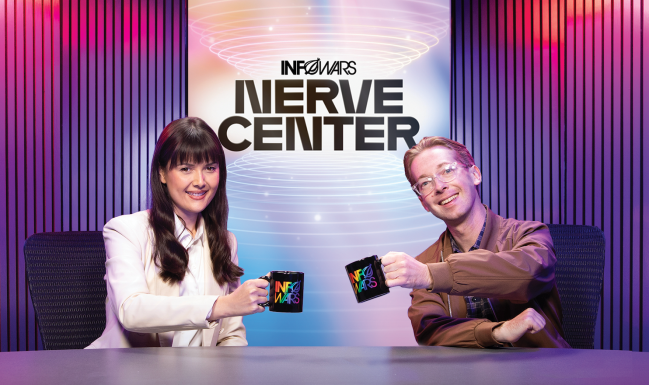
Once upon a time, a man named Alex Jones just wanted to fight a war against information. A few things happened you might have heard about, and now Tim Heidecker and The Onion run the company he founded. A quarter century’s worth of hate speech and misinformation has led us to a new set of offices in Burbank, where a team of veteran Onion and Clickhole writers have mapped out the next iteration of InfoWars content. The comedy is intentional this time around, even if it’s significantly less stupid than the dreck InfoWars churned out when it branded itself as a real news source. Even though The Onion doesn’t technically own InfoWars yet (the deal is still tied up in Texas bankruptcy courts), the company is forging ahead with its vision to remake the conspiracy site in its own image. After a summer of parody streams, the explicit Alex Jones references are now gone. In their place is a broader vision of internet silliness that can mock everything from tech bros and political extremists to new age spirituality grifters and how-to videos. It’s all tied together under the thesis that the internet is now a place where everybody acts insane all the time. The centerpiece of InfoWars 2.0 is “Nerve Center,” a new weekly show that IndieWire can exclusively announce. The talk show is hosted by the fictional Morgan Kerrigan (Patti Harrison) and Camden X (David Brown), two “thought leaders” who are so excruciatingly open-minded that they’re incapable of pushing back on anyone who happens to be talking to them in a given moment. The show will serve as a platform for countless lunatics within the InfoWars universe and a platform for larger announcements about the company’s fictional exploits. During a recent break from filming the season finale, IndieWire sat down with Harrison, Brown, and series director Alan Resnick in a writers room covered in sticky notes with fake conspiracy ideas. (This reporter couldn’t help but note that one of them simply said “Ribs.”) They explained the feelings that “Nerve Center” is designed to provoke, which should be immediately recognizable to anyone who has watched the internet gradually shift into its current abyss. “It’s a distillation of what being on the internet feels like. It’s what all content is like: it’s just people talking, and everyone likes to hear themselves talk because everyone deserves to have a platform,” Resnick said of the show. “Because all ideas are valid. There are no wrong ideas; these guys just believe everything that every guest says.” Rather than the downright nefariousness of Heidecker’s thinly veiled Alex Jones impression that InfoWars rolled out over the summer, these hosts are blank canvases who simply reflect back anything a guest says. They might not even be evil; they just shouldn’t have these jobs, where they’re held up as arbiters of information. “What attracted me to doing this was that it wasn’t just a parody of extreme alt-right InfoWars existing culture,” Harrison said. “They were excited to take it steps further and explore unexpected places with the tone and the character. This character has no discernible moral center, who has every opinion that you can have, but in that moment she really believes whatever she’s saying, even if a minute later she doesn’t remember talking about it.” “Nerve Center” was designed as a vessel that’s broad enough to mock any corner of the internet on a given week. But the show is partly rooted in the idea that the democratization of production value has led some viewers to trust unqualified sources too much because they look like a news broadcast. “In the writers room, we were talking about Lex Friedman types, Silicon Valley people who all have ‘thought leader’ in their titles. People who proclaim not to take a political side, but get taken in by whoever they bring in. And they just happen to only bring in people who have a lot of money and an agenda,” Resnick said. “These people get so much authority from wearing nice clothes and talking in a professional way on a professional set with professional lighting. Even the original InfoWars with Alex Jones, it started as just a crazy person screaming, but by the end it was a crazy person screaming with nice lighting. It had the presentational quality of news.” Brown explained that these characters go to places that would only be possible in 2026, because “Nerve Center” is far past the point of just being a parody of the internet. More precisely, it’s a parody of people whose lives have been so deeply shaped by internet culture and the scams it creates that they don’t recognize anything else. You don’t achieve the levels of emptiness and delusion that Morgan and Cam radiate without being shaped by multiple waves of online nonsense. “It just feels like a new kind of person that’s developing,” he said. “Someone who has been so taken and had their life and financial life destroyed by grifts, and they see that as a lesson. And they form the basis of a new personality that’s like ‘Yeah, I got tricked, and that taught me how the world works.’” “And it’s based on the false understanding that me getting tricked is over and it won’t happen again,” Harrison added with a laugh, prompting Brown to summarize the show’s thesis in ten simple words: “I got tricked, but now I’m sitting behind a desk!” “Nerve Center” premieres on the InfoWars YouTube channel on Thursday, October 15 at 8pm ET. Watch the first trailer, an IndieWire exclusive, below.
Inside ‘Nerve Center,’ InfoWars’ New Flagship Show That Wants to Hold Every Possible Opinion at Once
Full Article
Original Source
Read the full article at Indiewire →KhanList aggregates and links to publicly available news content. We do not host full articles from third-party sources. Always verify important information with original sources.