
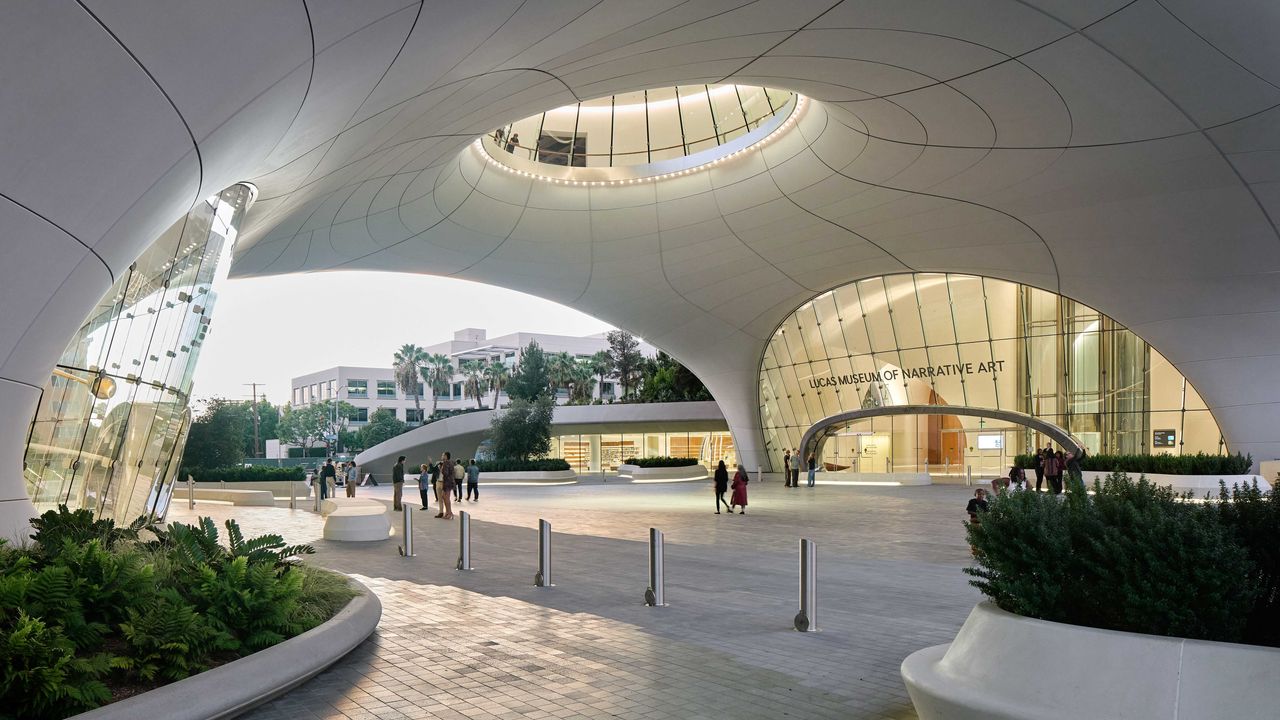
The George Lucas Museum of Narrative Art opens its doors in Los Angeles on September 22, following over a decade of planning, construction, and anticipation from fans worldwide. Showcasing over 30 art galleries, a sculpture garden, 13 acres of expansive green space, and a free research library amongst its campus offerings, George Lucas and Mellody Hobson have transformed the former asphalt parking lot in LA’s Exposition Park into an institution that redefines what belongs on a gallery wall.The George Lucas Museum of Narrative Art sits on a sprawling 13-acre campus in LA's Exposition Park. Iwan BaanThe museum's three-story research library is free and open to the public. Iwan BaanLucas is best known as the mind behind Star Wars and Indiana Jones, but he sought to create a museum that could cater to more than just movie buffs. The California native has been collecting art since he was a college student over 50 years ago. What started as a few comic pieces has since grown into a diverse collection of more than 40,000 works, all of which tell a story.“A picture is very powerful, and stories are very powerful,” Lucas said at a media preview for the museum on September 2, “those two elements create a society.”Hobson, who has been married to Lucas since 2013, is also no stranger to the narrative arts. The CEO and businesswoman was once chairman of DreamWorks Animation, spearheading the company during the release of blockbusters including installments to The Penguins of Madagascar and How to Train Your Dragon.Lucas and Hobson’s combined collection spans different cultures and generations, with each piece being curated in a way that attempts to dissipate hierarchies that have become the norm of typical art museums. Along with sizable paintings from iconic American artists such as Norman Rockwell and Frida Kahlo, the museum features galleries with comic books, manga, and other illustrations that have historically been viewed only between paper pages. Notable artists include Robert Crumb, or R.Crumb, a legend in the gritty underground comix scene of the '60s; Jim Davis, who created Garfield; and Charles Schulz, the cartoonist behind Peanuts. Galleries span different storytellers, themes, and mediums of art, featuring titles centered on motifs such as “Motherhood” and “Sports.”In the “The History of Native Art: Heroes, Myth, The Sacred” exhibition, visitors can see recreations of ancient masterpieces such as Trajan's Column. Paul Salveson“Every gallery, every program, every corner of this museum was built with our visitors in mind,” said Lucas Museum CEO Tracey Bates.Lucas calls the pieces that he’s chosen to display the “people's art.” Along with displaying a diversity of mediums, he wanted the museum to be accessible to everyone and highlight art forms that have been historically overlooked due to race and gender. One of the most heavily featured artists is the late Ernie Barnes, an African American artist known for his fluid, dynamic paintings that depict sports and daily life. A former offensive guard in the NFL, Barnes is noted for being the first American athlete to become a painter later in his career. Nicknamed “Rembrandt of the Broncos” by his teammates, Barnes's artistic talents were well-known in his lifetime but largely ignored by the mainstream fine art world despite landing high-profile commissions such as painting the album cover for Marvin Gaye's I Want You and serving as the official artist of the 1984 LA Olympics.An exhibition displaying Robert Colescott's depiction of Washington Crossing the Delaware: Page from an American History Textbook Paul SalvesonWhen you first walk into the building on the first floor, you’re directed to begin your visit with an exhibition titled “The History of Native Art: Heroes, Myth, The Sacred.” The exhibit combines pieces from the museum with unique recreations of some of the most powerful narrative storytelling images from around the world, from the ceiling of the Sistine Chapel to the interior of the Hagia Sophia, before you head upstairs for the main collection.The fifth-floor gallery is dedicated to large-scale storytelling through mural arts. Featured artists include the Mexican modernist painter Diego Rivera and the French Contemporary artist JR. Some of the most iconic pieces by elusive street artist Banksy, like Girl with Balloon, are also on display, along with never-before-seen work made especially for the collection.However, the creators behind the museum wanted to ensure that they began storytelling before you even step foot into the “floating” 300,000-square-foot building.Lead architect Ma Yansong sought to create a structure with no straight lines. Hufton CrowThe intention behind the museum's design was to feel as “light and free as a cloud.” Hufton CrowMa Yansong, the architect of the futuristic white building that houses the museum, said that he envisioned a structure that was “light and free as a cloud.” He took inspiration from the large trees of Exposition Park and sought to create a fluid structure that’s shaped without a single straight line. Inaugural exhibitions at the museum feature Ma’s drawing and other preparatory works for the museum, highlighting the storytelling that is literally built into the walls.Museum parking is kept below the ground in Exposition Park, and making the trek up from your vehicle feels like ascending into an entirely new universe from the crowded streets of DTLA you've just departed. The lush landscape surrounding the building was created to reflect the diverse topography of Los Angeles, with contoured green hills and striking views around each corner.“There is no single route through the gardens,” said landscape architect Mia Lehrer. “Paths climb, descend, cross bridges, and embrace sculptures.”The art viewing extends beyond the walls as the campus also includes 10 outdoor sculptures. Iwan BaanThe park features 10 outdoor sculptures on the campus, including a bronze statue reminiscent of a Renaissance Madonna titled Maternity by Colombian sculptor and painter Fernando Botero that guests view immediately as they enter the park.Beyond the galleries, there will be an inaugural film program in the museum’s two theaters. The Robert Flaherty Theater is dedicated to documentary filmmaking, and the Slavko Vorkapich Theater showcases an experimental short film program that pushes the boundaries of cinematic editing. There is also a restaurant, Skywalker Grill, and a three-story research library that houses an extensive archive of research materials that run the gamut of narrative art history.Though again, this is not a museum concentrated on George Lucas's own oeuvre, there are still spaces for his fans. Should you count yourself among them, be sure to check out the “Star Wars in Motion” gallery in the “Cinema” section that highlights vehicles seen in the first six Star Wars films. There are also recreations and props from the Indiana Jones franchise.Young Anakin Skywalker's N-1 starfighter from Star Wars: Episode I – The Phantom Menace Iwan BaanBeyond the mantle of any single artist, the mission of the museum honors the fact that narrative art has always been a collective inheritance. “Narrative art creates a group of people with common belief systems, and that common belief system allows them to work together,” Lucas said, “and there’s very few things in this world you can do all by yourself.”
Inside Los Angeles’s Groundbreaking George Lucas Museum of Narrative Art
Full Article
Original Source
Read the full article at Cntraveler →KhanList aggregates and links to publicly available news content. We do not host full articles from third-party sources. Always verify important information with original sources.