
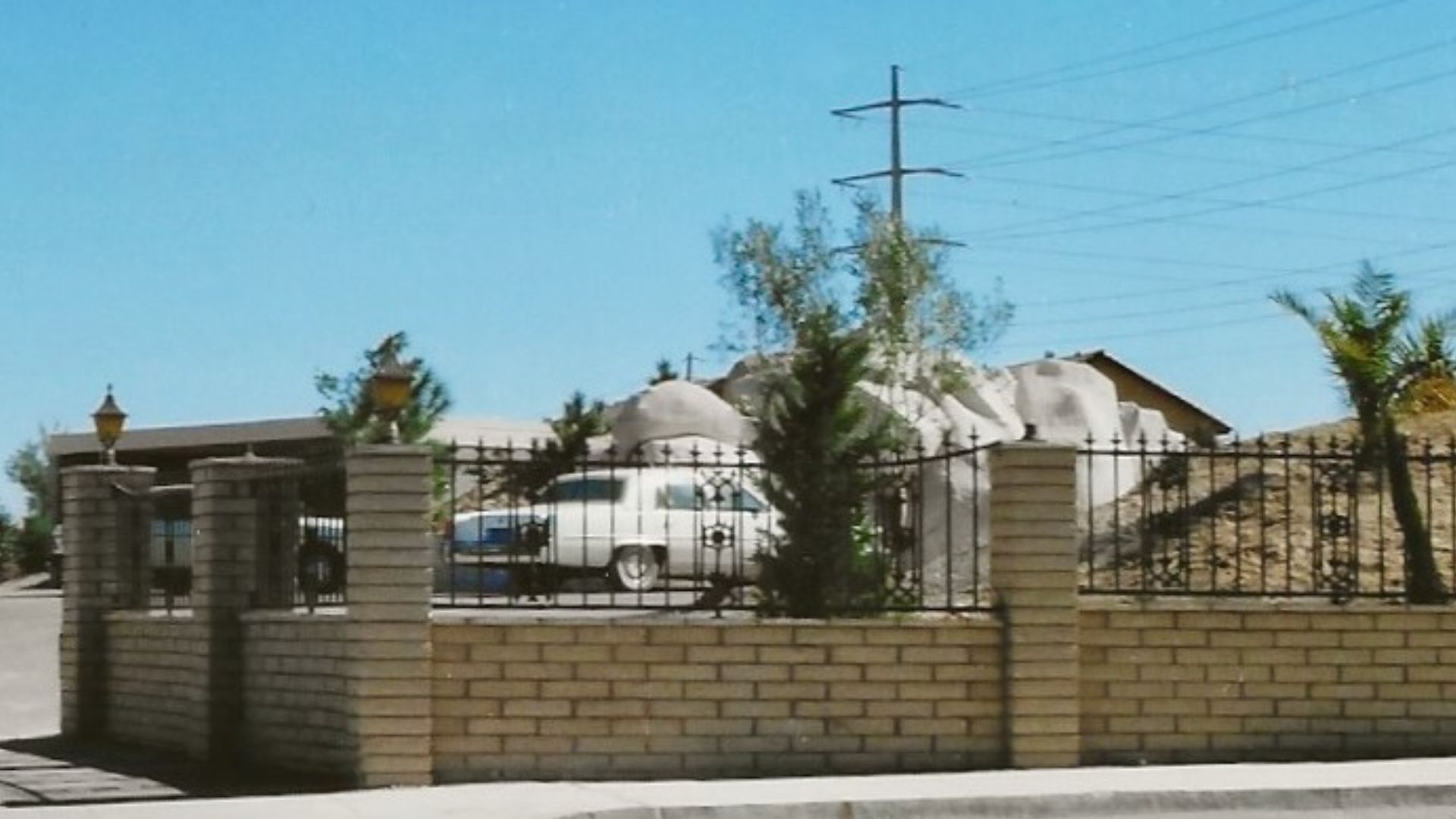
From the street, the property at 3970 Spencer Street in Las Vegas looks much like another upscale home in the neighborhood. But beneath the desert surface lies one of America’s most unusual Cold War-era residences: a vast underground home built for businessman and philanthropist Girard B. “Jerry” Henderson. The subterranean complex was designed not as a cramped emergency shelter, but as a place where its owners could continue living underground in extraordinary comfort. Spanning more than 16,000 square feet when combined with the above-ground residence, the property includes a roughly 14,620-square-foot underground estate located about 26 feet below the surface. According to 8 News Now, Henderson believed nuclear war was a serious possibility and set out to create a protected home without abandoning the lifestyle his family enjoyed. The result became known as the Underground House. A Cold War home built beneath the desert Henderson’s interest in underground living began years before the Las Vegas project. The University of Nevada, Las Vegas’ Special Collections documents Henderson’s involvement with the World Underground Homes Corporation, a company associated with underground-living pioneer Jay Swayze. Henderson had also previously commissioned an underground residence near Boulder, Colorado. He commissioned the Las Vegas project in 1971, with planning beginning in 1973. The underground residence was completed in 1978, according to UNLV’s archival records. Henderson and his wife, Mary, lived in the underground home full-time until his death in 1983. Mary later had a conventional residence built above the underground complex and remained on the property for several more years. What Henderson created was effectively a full-scale home placed inside a much larger underground enclosure. An artificial world beneath Las Vegas The most remarkable feature of the Underground House may be its attempt to recreate life above ground. The subterranean residence was surrounded by an artificial landscape featuring faux greenery, sculpted trees, decorative rocks and hand-painted murals. The environment was designed to create the illusion of being outdoors rather than inside a sealed underground structure. Lighting played a major role in maintaining that illusion. Nearly 1,000 lights were reportedly used throughout the complex to simulate daylight and changing outdoor conditions. The estate was also equipped with amenities rarely associated with a conventional fallout shelter. Property descriptions have included a swimming pool, putting green, theater, bar, dance floor and saunas, turning the underground residence into something closer to a self-contained luxury estate than a basic survival bunker. More than a conventional fallout shelter The Underground House emerged during an era when fears of nuclear conflict had become deeply embedded in American culture. During the Cold War, governments and private companies promoted fallout shelters as a way to protect civilians from radioactive fallout. Most of these shelters were designed around basic survival, with food, water, and emergency supplies intended to sustain occupants for a limited period. Henderson’s project took a dramatically different approach. Rather than simply constructing a place to wait out a disaster, he sought to create an environment where his family could continue living with many of the comforts of life above ground. The property has frequently been described in media and real-estate accounts as a nuclear bunker capable of withstanding extreme events. However, publicly available sources do not provide enough detailed engineering documentation to independently determine exactly how the structure would perform against a specific nuclear blast, weapon yield or earthquake. That distinction is important. The survival capability of any underground shelter would depend on numerous factors, including its distance from a detonation, blast pressure, radiation exposure, structural design, ventilation, power and access to food and water. A Cold War time capsule Nearly half a century after its completion, Henderson’s underground home remains one of Las Vegas’ most unusual architectural landmarks. UNLV’s Special Collections has preserved archival material documenting the Underground House and its place in the history of underground architecture. The property itself has changed hands and appeared on the real-estate market multiple times. As of August 2026, it was listed at around $5.9 million, although recent property records indicated that a transaction was pending. Today, the Underground House is perhaps less significant as a realistic model for surviving nuclear war than as a remarkable piece of Cold War history. Built at a time when the threat of global nuclear conflict felt increasingly real, it represents an extraordinary attempt to engineer an alternative world beneath the surface. Above ground, Las Vegas has changed almost beyond recognition since Henderson began planning the project in the early 1970s. Below it, however, a carefully constructed version of that era remains, complete with an artificial sky, indoor landscape and a luxury home designed for a world that, fortunately, never arrived. Get the latest in engineering, tech, space & science - delivered daily to your inbox.Kaif Shaikh is a journalist and writer passionate about turning complex information into clear, impactful stories. His writing covers technology, sustainability, geopolitics, and occasionally fiction. A graduate in Journalism and Mass Communication, his work has appeared in the Times of India and beyond. After a near-fatal experience, Kaif began seeing both stories and silences differently. Outside work, he juggles far too many projects and passions, but always makes time to read, reflect, and hold onto the thread of wonder.
Inside Las Vegas’ secret 16,000-square-foot underground nuclear bunker
Full Article
Original Source
Read the full article at Interestingengineering →KhanList aggregates and links to publicly available news content. We do not host full articles from third-party sources. Always verify important information with original sources.