
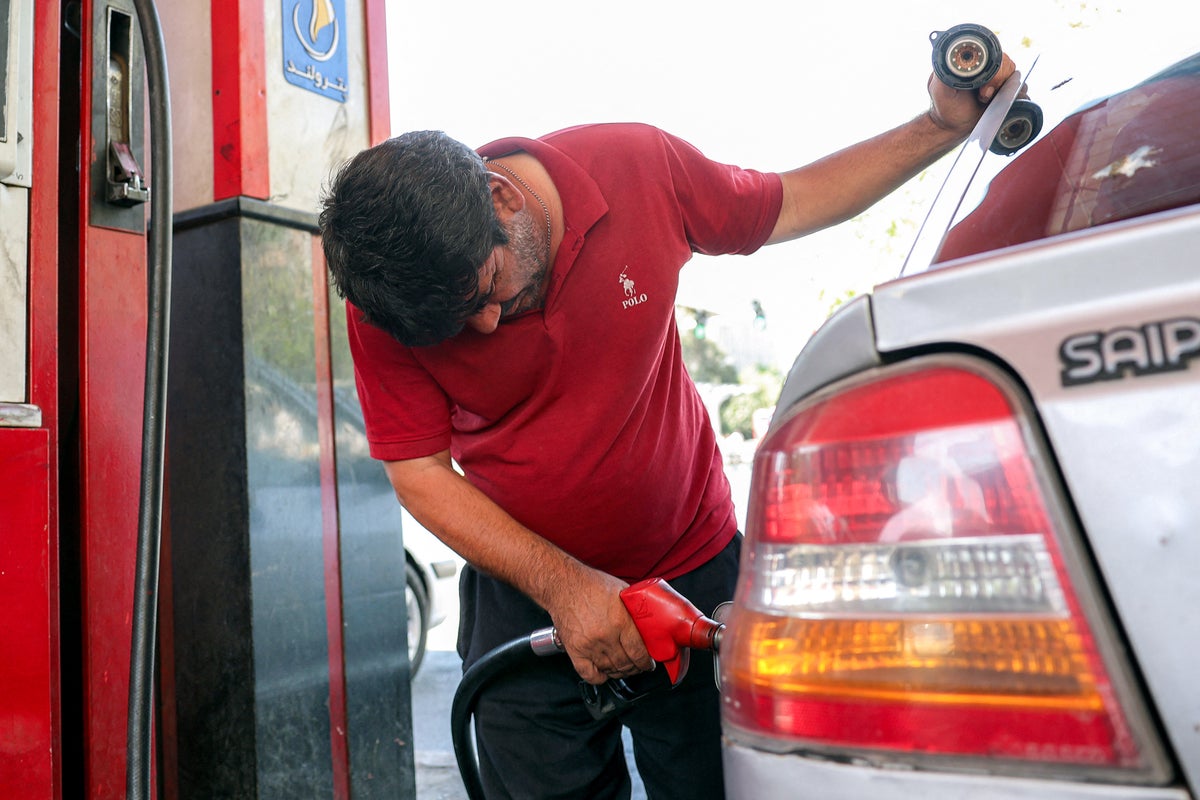
This article first appeared on our partner site, Independent Persian As government officials in Iran announce plans for a 100 per cent increase in petrol prices, reports from cities across the country suggest the main problem is no longer simply the price - access to good-quality fuel is also becoming increasingly difficult.Jafar Ghaderi, a member of the Iranian parliament’s Economic Commission, said last week that the Islamic Republic of Iran faces a daily petrol shortfall of 15 to 20 million litres and that importing petrol costs around $1 (75p) per litre. He confirmed the US naval blockade had disrupted the flow of imports into Iran. According to Ghaderi, around 83% of imports had previously entered the country through southern maritime routes, and restrictions on these routes have affected the supply of both goods and fuel.Footage from Tehran’s affluent Velenjak neighbourhood shows a long queue of cars outside a petrol station that residents say was normally quiet. Another source told Independent Persian they had visited several petrol stations in Farmanieh and Pasdaran, two of the capital’s upmarket neighbourhoods, but had been unable to find petrol.Motorists across Iran report long queues to fill up their cars as the war takes its toll (AFP/Getty)Further videos received from Mashhad and Rasht also show long queues forming outside petrol stations. One Mashhad resident said: “I went to five different petrol stations, but they wouldn’t give me even a litre of petrol without a fuel card.”Meanwhile, a video received from the southern city of Saravan shows a long queue of vehicles outside the Pak Gohar petrol station. Residents say they had been queuing since early morning to receive their petrol allocation, with some forced to wait for hours in the intense heat of Sistan and Baluchestan. Other footage from the port city of Chabahar shows queues stretching for several kilometres outside petrol stations that remain operational, while several other stations in the city have closed after running out of fuel.Similar accounts continue to emerge from other parts of the country. One resident in South Khorasan reported that two of the city’s three petrol stations were closed, with staff saying they had no fuel to sell. Another person in Mazandaran wrote: “I went out to get petrol at 2:20am. Of three petrol stations, only one was open, and even that had just one pump lane operating. It took nearly three hours to fill up.”Good quality fuel has become increasingly hard to come by (AFP/Getty)The crisis is not limited to shortages. Concerns about petrol quality are also mounting. Over the past week, large numbers of residents in Tehran and other cities have told Independent Persian that after filling up their vehicles, they experienced rough-running engines, warning lights coming on, loss of acceleration, and rising engine temperatures.Recently published footage from Shahr-e Rey also shows a number of vehicles developing mechanical problems and breaking down one after another after refuelling. In Rafsanjan, dozens of cars and motorcycles have similarly experienced mechanical problems after filling up.In response to the crisis, some local officials have raised the possibility that water entered petrol storage tanks via fuel tankers. However, the recurrence of similar incidents in different parts of Iran has raised broader questions about the quality of the fuel being supplied, particularly as reports emerge regarding the use of compounds such as methanol in Iran’s petrol production process.Experts have warned that using these substances above permitted levels damages fuel systems, injectors and engines. Officials from the Ministry of Oil, however, insist that the use of methanol is limited and complies with relevant standards.Against this backdrop, officials in Masoud Pezeshkian’s government have increasingly spoken about the need to raise petrol prices. Mohammad Jafar Ghaempanah, the executive vice-president, told ISNA: “No reasonable person would accept selling petrol that costs 70,000 tomans for 1,500 tomans.” (Tomans are one of two units of currency used in Iran, along with the rial. 70,000 tomans is roughly equivalent to $0.51).At the same time, he acknowledged that economic conditions were difficult and that ordinary people were bearing the brunt of the pressure.President Pezeshkian has also said in his latest remarks that the third-tier petrol price will rise from 5,000 to 10,000 tomans. (roughly $0.036 to $0.073).Many Iranians fear that higher petrol prices will trigger a fresh wave of inflation. One Independent Persian reader said: “If petrol goes up to 10,000 tomans, we should expect the price of every product and service to rise.”Another motorist in Tehran wrote, “Petrol stations are crowded, people are fighting with each other over their place in the queue, food gets more expensive every day, and everyone is angry.”Some believe the effects of the fuel crisis are gradually becoming visible in people’s everyday lives. One reader said: “Tehran’s streets are quieter than they used to be. There is less petrol, cars are breaking down more often, and repair costs are astronomical. A lot of people now leave home only when they really have to.”While the government attributes the petrol shortage to war, sanctions and the high cost of imports, critics argue that the current crisis is the result of years of neglect in expanding refinery capacity, an ageing transport fleet, the production of fuel-inefficient vehicles, and the state's extensive investment in its military, missile and nuclear programmes.For many Iranians, fuel shortages, declining petrol quality and rising prices have created a situation in which petrol is no longer simply a matter of filling up a car. The fuel crisis has for them become a symbol of mounting economic pressure, declining quality of life and the growing difficulty of managing everyday survival.Reviewed by Tooba Khokhar and Celine Assaf
Inside Iran’s petrol crisis: How war with the US has taken its toll
Full Article
Original Source
Read the full article at Independent →KhanList aggregates and links to publicly available news content. We do not host full articles from third-party sources. Always verify important information with original sources.