
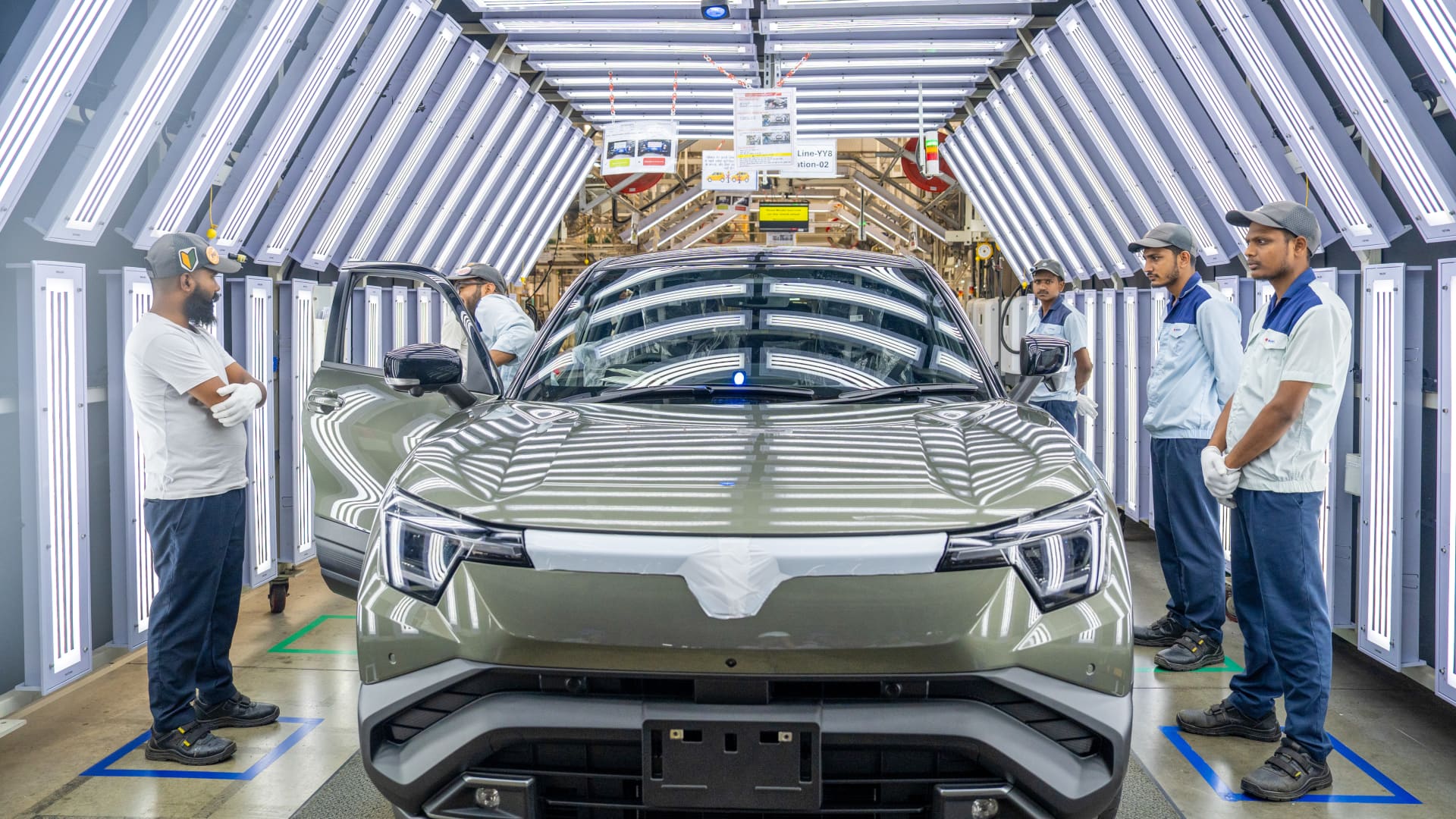
Hello, this is Priyanka Salve, writing to you from Singapore. Welcome to the latest edition of "Inside India" — your one-stop destination for stories and developments from the world's fastest-growing large economy.Despite 2026 being a challenging year with high global energy prices and supply chain disruptions, the Indian economy has fared surprisingly well. The auto industry, a key pillar of manufacturing and employment, has breached several records this year and is poised to report its best-ever sales.This week, I spoke to experts to decode what this stellar performance means for one of the world's most promising consumer markets.Any thoughts on today's newsletter? Share them with the team. The big storyIndia's economy expanded at 7.8% in the June quarter, beating expectations, even as growth in several major economies cooled. Foreign portfolio investors who had been exiting Indian markets in droves for most of the year have also started returning in historic numbers.And now, the world's third-largest auto market is set to for a record this year as better road connectivity, tax cuts, and easier financing options have fueled bumper sales over the last several months. That comes at a time when major auto markets across the world, from China to the U.S. have been seeing a slump in sales."10 years ago, despite having the money, people did not buy cars, but now even if they don't have the money, they take financing and buy," Amar Sheth, vice president of the Federation of Automobile Dealers Associations, told CNBC, pointing to the shift in consumer mindset.They are becoming "more optimistic" about the future and, rather than waiting, consumers are willing to take a loan and purchase something useful to them now, he adds.The industry body that Sheth represents said on Monday that automakers in India were poised to sell more than 30 million vehicles in the financial year ending March 2027, dubbing the sector as a "reflection of the wider India growth story." From April to October, total vehicle retail sales in India reached 18.7 million units, up 10% from a year earlier, with car, tractor and commercial vehicle sales growing more than 15%, as per FADA data.The optimism of the industry body is also shared by major automakers; several of whom have announced capacity expansion plans this year to meet the growing consumer demand.Japanese automakers Maruti Suzuki and Toyota plan to raise capacity by 1.2 million units and 200,000 units, while Korea's Hyundai Motors will add capacity for 150,000 units, as per data shared by automotive industry intelligence provider Mobility Global. Leading Indian companies Tata Motors, Mahindra & Mahindra and JSW have also announced capacity addition plans, the data showed.A vehicles undergoes final inspection on the production line at the Maruti Suzuki India Ltd. manufacturing plant in Hansalpur, Gujarat, India, on Wednesday, May 20, 2026. Bloomberg | Bloomberg | Getty ImagesIndia is the only big auto market in the world that is growing while most others such as France, Germany, and Korea are "either declining or are flat," Puneet Gupta, director India and ASEAN at Mobility Global, told CNBC, explaining the reason behind car companies investing in the country.Gupta said that the Chinese automotive market hit an inflection point in 2007, when the GDP per capita crossed $2,500, and now India is "at a similar point." He added that government support for the auto industry would be crucial in replicating the boom seen in the Chinese auto industry. Proxy for consumptionThe catalyst for India's auto sector boom traces back to last September, when the government announced a wide range of tax cuts to spur domestic consumption. The auto industry contributes 7.1% to the country's gross domestic product, 49% to manufacturing GDP, 15% to goods and services tax collection, and supports 30 million jobs, as per government data.While the tailwinds from the tax cuts have faded, experts now believe that replacement demand and the growing reach of financing options to smaller cities will unlock the next phase of growth.Consumption has been strong this year as the government has partly shielded people from rising energy costs while corporates, with their strong balance sheets, have been slow to pass on price hikes, Gaura Sengupta, chief economist at India's IDFC First Bank, said.So far this year, wage growth has been good, the labor market has held up equity markets haven't corrected sharply, keeping the wealth effect intact, she said, underscoring the reasons driving consumption along with easy access to credit.Despite the economy facing external shocks, producers are also "feeling confident to add capacity" as they have seen domestic demand sustain, Sengupta added. However, experts said that the central bank's recent tightening of monetary policy and price hikes by automakers could slightly take the edge off the auto sales boom in the last few months of the financial year. While urban demand is unlikely to get affected, rural sales growth could moderate, they added."Overall retail should close FY27 in high single digits," Diwakar Murugan, senior automotive analyst at Omdia, told CNBC, adding that this year's record sales are not a one-time spike but a "structural reset."Need to knowChina has changed tactics but is still thwarting India's rise, a U.S. panel saysChina is "actively working to suppress India's rise," even as the relationship between the two major Asian powers has thawed in the past year, according to a U.S. panel that sees an opening for greater outreach to India. U.K.-India trade deal faces a stiff test over Scotch whisky import taxesWithin months of taking effect, the India-U.K. trade deal is facing an early test, as New Delhi resists extending preferential tariffs to bulk Scotch whisky imports.Investors give a thumbs down to Tata Steel-APL Apollo $1.67 billion deal, plunging sharesTata Steel, one of the world's leading steel producers, on Monday said it will buy a 26.4% stake in India's largest structural steel pipe and tube maker, APL Apollo, for 155.1 billion rupees ($1.67 billion). However, investors reacted negatively to the deal.Coming up Nov. 27: Mahanadi Coalfields IPO listing. Nov. 30: GDP data for July-September 2026.
Inside India newsletter: Roaring economy, foreign investors’ return and now record auto sales
Full Article
Original Source
Read the full article at Cnbc →KhanList aggregates and links to publicly available news content. We do not host full articles from third-party sources. Always verify important information with original sources.