
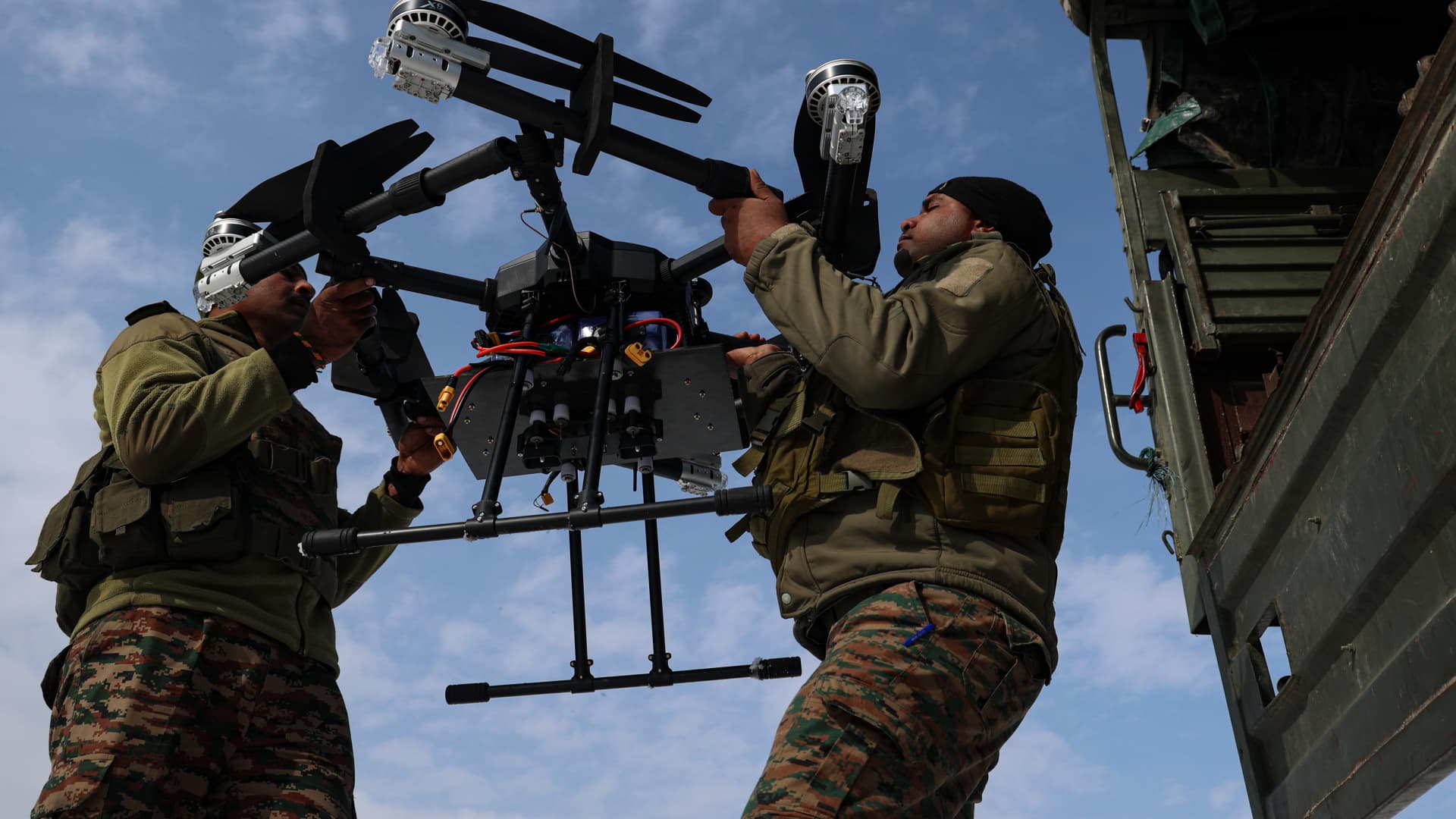
Hello, this is Priyanka Salve, writing to you from Singapore. Welcome to the latest edition of "Inside India" — your one-stop destination for stories and developments from the world's fastest-growing large economy.India, the world's fifth-largest military spender, shares a contentious relationship with two of its nuclear-armed neighbors — China and Pakistan. Last year, New Delhi carried out military strikes against alleged terrorist infrastructure in Pakistan, and last week an Indian official confirmed some border clashes with China. As tensions at its borders simmer, India this week announced plans to spend billions of dollars on procuring modern warfare equipment. From whom will it get the goods?Any thoughts on today's newsletter? Share them with the team. The big storyThe world's second-largest arms importer, India, is pouring billions of dollars into modernizing its military as it seeks to counter the technological advancements of neighboring China, with whom it shares an uneasy peace.Last week, an Indian military official said that confrontations with Chinese soldiers were ongoing across several locations along the country's north-eastern border. Shatrujeet Singh Kapoor, the director general of a division of India's central armed forces, the Indo-Tibetan Border Police, also called China the "biggest adversary" and urged for modernization of defense equipment. "It will be difficult to compete with China using traditional methods," Kapoor said.Following Kapoor's comments, India approved spending 2.12 trillion rupees ($22 billion) to modernize its defense equipment on Monday. The country plans to spend on long-range kamikaze drones, surveillance and strike systems, counter-drone technologies, short-range air defense, artillery, helicopters and naval platforms.Indian army soldiers carry drones after a display of weapons and drones used during ''Operation Sindoor'' during the Know Your Army program ahead of Republic Day in Baramulla, Jammu and Kashmir, India, on January 25, 2026. Nurphoto | Nurphoto | Getty ImagesExperts told CNBC that New Delhi increasingly views Beijing as a threat, especially given the Sino-Pakistan military ties, and the latest purchases were aimed at bridging the technological gap with China. A spokesperson for India's foreign ministry said on Friday that "the situation in the India-China border areas gets disturbed from time to time when Chinese forces diverge from established patrolling patterns." Beijing responded, saying it "strictly abides by the relevant agreements and common understandings reached between the two countries."India's military policies are largely driven by its long-standing conflict with Pakistan, and an "increasing perception of China as a threat," Pieter Wezeman, senior researcher at the Stockholm International Peace Research Institute, told CNBC. According to a SIPRI report earlier this year, 61% of Chinese arms exports were supplied to Pakistan between 2021 and 2025. India's latest weapons purchases will involve importing components and technology from South Korea for the artillery, engines and avionics from France for the helicopters, and drones from the U.S. and Israel, Wezeman said.Collaboration with Russia and Japan could also be on the cards, given India's need for a technological upgrade.Foreign partnershipsSince April, India has greenlighted military spending totaling 3.7 trillion rupees, which is more than 50% of the 6.73 trillion rupee worth of approvals — a 10-year high — in the financial year ended March 2026, Citi said in a report on Tuesday. While New Delhi has said it plans to procure 82% of the defense equipment from local industries, foreign companies are likely to play a key role in providing technology crucial for military modernization. Foreign partnerships remain important for technologies that India does not yet produce independently, Arpit Chaturvedi, South Asia advisor at strategic advisory firm Teneo, told CNBC. India relies on imported technologies for specialized components such as aircraft engines, propulsion systems, sensors and electronic subsystems, he explained."American, Israeli, and Russian defense manufacturers are likely to find substantial opportunities in India's expanding defense market," through joint ventures, co-production and technology partnerships with Indian companies, Chaturvedi said.India was the world's second-largest importer of major arms in 2021–25 with an 8.2% share of total global imports, even as its reliance on overseas suppliers dropped by 4% during the same time due to growing local design and production abilities, according to SIPRI. New Delhi is also the world's fifth-largest military spender, with $92 billion, but this is less than 30% of Chinese military expenditure and around a 10th of America's, Wezeman of SIPRI pointed out.India faces some practical challenges in matching China's scale of military modernization, but the conflicts in the Middle East and Ukraine have shown that mass-produced systems like drones can address asymmetry, Collin Koh Swee Lean, a senior fellow at Singapore's Nanyang Technological University, said.Need to knowIndian investors rush to Nvidia, SpaceX, Apple as local trading apps roll out access to U.S. stocksMajor Indian online investment platforms are unlocking access to U.S. stocks for millions of retail investors eager to diversify into global assets as the country's markets continue to underperform.Meta- and Google-backed Jio Platforms' shares soar over 21% on trading debut after record IPOJio Platforms' shares rose 21.4% on their trading debut Wednesday after a record initial public offering that was lapped up by retail as well as institutional investors. Coming up Oct. 30: India fiscal deficit at September endNov. 2: HSBC manufacturing PMI for October
Inside India newsletter: New Delhi approves $22 billion in military spending amid China border tensions
Full Article
Original Source
Read the full article at Cnbc →KhanList aggregates and links to publicly available news content. We do not host full articles from third-party sources. Always verify important information with original sources.