
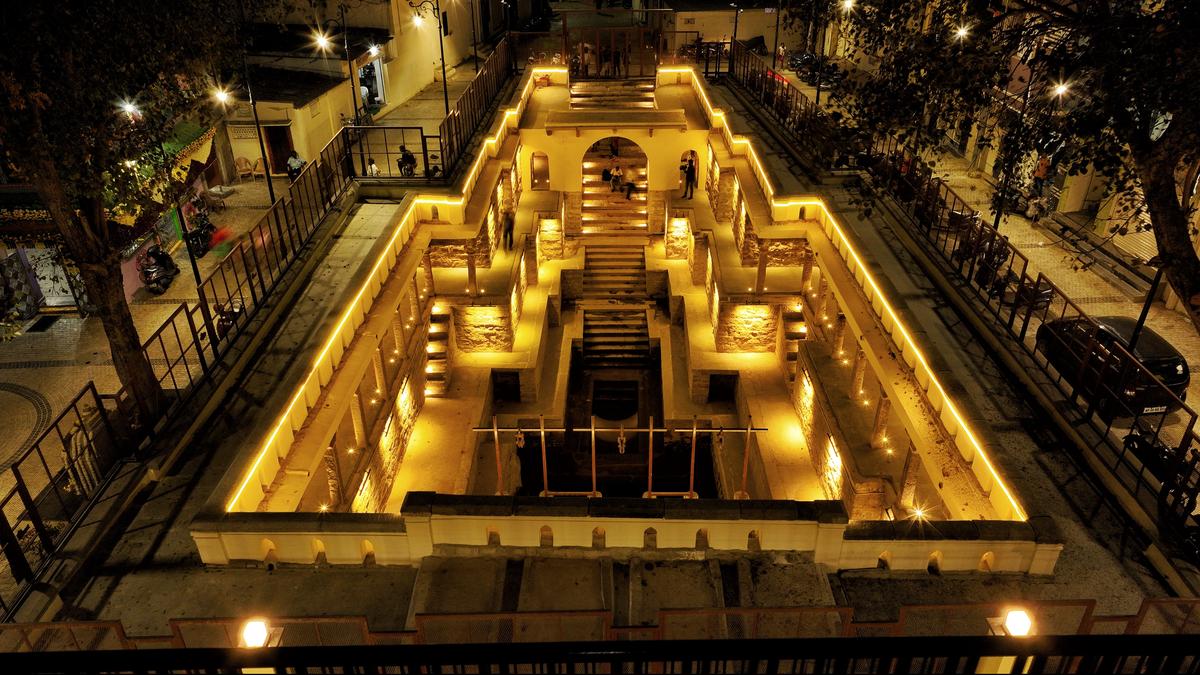
Baoli Art Sangam (BAS) will bring art, water heritage and community experiences into focus in Hyderabad. Billed as the first stepwell-based art biennale, the festival opens on December 1, with events across 12 venues in the city, offering visitors a fresh way to engage with its past.“The debut edition will run for 40 days, turning Hyderabad into a cultural canvas where communities can come together and participate,” says artistic director Annapurna Madipadiga, founder of EkChitra Art Gallery. The programme will bring together 200 artists, including six international participants, through curated exhibitions and site-specific installations at heritage locations. It will also feature weekend performances, curatorial walkthroughs, workshops, heritage walks, talks and culinary experiences.“Food in Hyderabad is not just about biryani and haleem. There is an entire culinary lineage, from Telangana to Rayalaseema, alongside the many influences that make up the city,” she says. Kalpana Ramesh | Photo Credit: Special Arrangement Annapurna had long envisioned a biennale for Hyderabad. The idea took shape after a conversation with architect Kalpana Ramesh at an event at Bansilalpet Stepwell. BAS brings together Annapurna’s vision of art tourism and Kalpana’s ambition to revive stepwells as community spaces. The initiative is also supported by Sairam Reddy, Harish Madhukurri and Attri Chetan.Journey with stepwells A work by Ratna Gupta | Photo Credit: Special Arrangement For architect Kalpana Ramesh, BAS is a moment of joy. Her journey with stepwells began a decade ago, when she was documenting the structures for the Hyderabad Design Forum. As she travelled to different sites, she found many stepwells buried under garbage. “I kept asking why we weren't restoring them, learning from them and bringing them back into our public consciousness,” she recalls.But restoring a stepwell is only half the challenge. The bigger task is keeping it relevant to contemporary communities. “The way people connected with these wells in the past is gone. We have taps and tankers now. The rituals, temples, gardens and community activities associated with them have disappeared. The original context is gone. So the question is: how do we create a new context that helps people connect with them today?” she says, explaining how art, heritage and culture can help rebuild that connection. Annapurna Madipadiga | Photo Credit: Special Arrangement The restored 17th-century, six-level Bansilalpet Stepwell in Secunderabad, one of the festival's venues, is an example. It now functions as a heritage and cultural space, particularly on weekends. “Recreating the same relationship people once had with these wells may not be relevant. But we can make them relevant in parts. Communities have always gathered around wells, and people still connect with heritage, history and culture. But when I say ‘water’, there aren't many takers.”For Kalpana, who has restored around 25 stepwells across Telangana as part of the The Rainwater Project, the restoration of Bansilalpet is proof that heritage conservation and water resilience can go hand in hand. “When a well is restored and reconnected to the aquifers through rainwater, it strengthens the local water ecosystem. At Bansilalpet, groundwater is visible again.”The festival, she says, is as much about storytelling as it is about art. “Every well has a story. We want these narratives to emerge and become part of our collective memory.”Connect to roots Subodh Kerkar’s site-specific installation | Photo Credit: Special Arrangement For Annapurna, BAS is an opportunity for communities to reconnect with their water heritage and roots. “I have visited Golconda so many times, but never knew the historic complex had six stepwells. The festival brings water heritage to the forefront in a way that hasn't been done before,” she says. “With the El Niño effect deepening the crisis, everyone is talking about water. Kalpanaji often says, ‘Our ancestors had a plan for water and then a plan for living. Now we plan our lives and then search for water.’”Kalpana hopes BAS will eventually expand beyond Hyderabad. “India has nearly one lakh stepwells. Maharashtra alone has around 18,000 mapped stepwells, with many more yet to be documented. Telangana has around 600. We want to build an art biennale that can travel to places where baolis exist.”While the biennale is planned as a biennial event, engagement will continue between editions through conversations, murals, artistic interventions and community programmes. “More wells will be added with each edition. That way, we create a sense of circularity in heritage.”Baoli Arts Sangam to start on December 1; For events, check their social media page
Inside Hyderabad’s first stepwell-based art biennale
Full Article
Original Source
Read the full article at Thehindu →KhanList aggregates and links to publicly available news content. We do not host full articles from third-party sources. Always verify important information with original sources.