
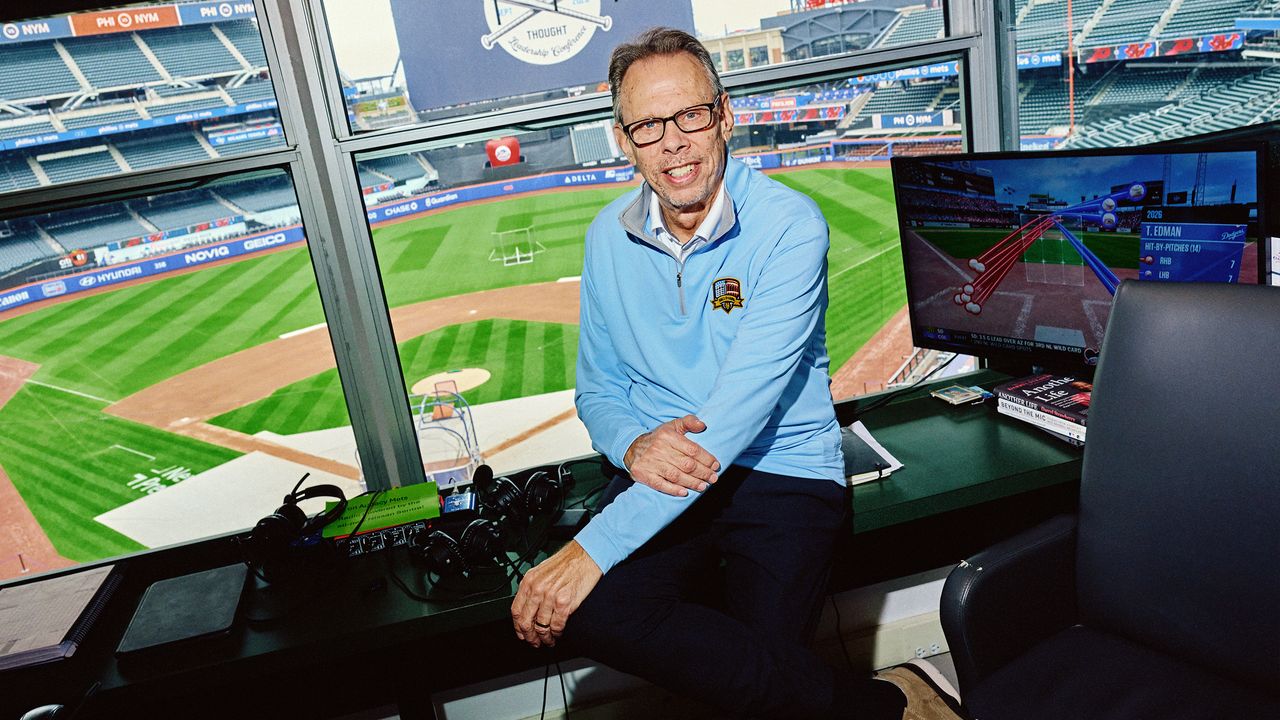
“If you choose to stay a Mets fan through the down years, that's loyalty,” said the beloved broadcaster as he prepared to call the final game of his 40th season with the team.Shortly before the start of the 2026 baseball season, Howie Rose announced his retirement. After 22 years as radio voice of the New York Mets, the job had become too taxing. He was ready to pass the torch, retire to South Florida, and work on his golf game. He’d spend more quality time with his wife Barbara, too, “whether she likes it or not!”Following a humiliating end to the previous season, and the winter disappearance of much of the team’s beloved core, it should have felt like a crushing blow to a fanbase for whom Rose’s Queens-accented play-by-play has long been a primary antidote to the affliction of rooting for the Mets.But to rewatch the announcement now—just after witnessing the team’s elimination from playoff contention at the hands of prodigal Pete Alonso’s Orioles in one of the most gruesome weeks of Mets baseball I can remember—is to feel that, somehow, the best is yet to come. “You know, I’m always honored to start the season by emceeing at Citi Field,” Rose said with genial gravitas, improbably bouncing between sincere positivity and patent New York sarcasm. “But this year in particular, I would like nothing better than to bookend that by serving as master of ceremonies on the steps of City Hall after a trip down the Canyon of Heroes immediately following the season. That would make this dream I’ve lived complete.”This past season, we could at least be grateful to have him on our lifeboat as we watched the highest-paid team in baseball history sink to last place faster than the Titanic. But we wondered how disappointed Howie must be, and how we would survive without him.I talked to Rose this past week in the Bob Murphy Broadcast Booth at Citi Field, while he prepared to call the first game of the final series of his 40th season with the team. At first, he was confused. Why does GQ want to interview Howie Rose? Not for fashion tips, I assured him. Instead, I was there to hear his philosophy of Mets fandom, to find out how us fans can endure or even enjoy the team the way he seems to.“You have a choice in this town,” Rose declared. “To root for the Mets, to root for the Yankees... And because you have that choice here in New York, if you choose to stay a Mets fan through down years, when the Yankees are playing in October every year—well, that's loyalty. And that loyalty is tested by the refusal to jump ship.” He paused, considering it further: “I mean, any idiot could root for a team that is playing for championships most years.”Rose made that choice at age seven, a year before the Mets even existed. His father, Robert, had attempted to indoctrinate him into Yankees fandom, but it didn’t stick. When he learned a new team was coming to Flushing, Queens, right near the Bayside neighborhood where the family was planning to move, he believed they’d been created just for him.In a way, he was right. The franchise, knowing its expansion-drafted squad would be losers for some time, marketed itself to young baby-boomers as the jovial, technicolor alternative to grayscale Yankee severity. “Everything about [them] appealed to me,” Rose remembers. “First of all, blue and orange are kind of my colors anyway. I don't know why, but maybe somebody who's better versed at GQ could tell me.”What kept him and so many other “New Breed” fans loyal once faced with the realization that they’d hitched their wagons to the worst team in baseball history? The answer was in the name of the booth in which we were sitting.It was the original Mets broadcaster Bob Murphy who had shown young Howie Rose, first on the airwaves in the ‘60s, and later in the ’90s as his colleague and mentor, how a crafty announcer could turn trophy-less gutter-dwellers into a storied franchise. “He was able to make you feel good about the Mets regardless of the game or their place in the standings,” Rose says. “Maybe it wasn't good tonight, but man, there's a chance it's going to be great tomorrow.”I asked Rose when he decided to follow in Murph’s footsteps, and he takes me back to an otherwise forgotten game in the summer of 1966.The surging Giants were playing the second-to-last-place Mets. San Francisco took a 5-0 lead into the bottom of the seventh. The Mets battled back to a tie, and eventually won on a walk-off homer from Ron Swoboda. Rose told me: “I went home on the Q27 bus that day thinking not only is this the greatest game I've ever seen or will see, but I wonder how Lindsay Nelson called it, I wonder how Bob Murphy called it. And all the way home I was thinking, Man, I'm sure it was great to hit the game winning home run, but it must have been almost as great just making that call.’”That afternoon, Rose had discovered a strange phenomenon of modern baseball. Without the familiar commentary, one can leave the ballpark feeling like they hadn’t truly seen the game at all. By setting the tone through which the sport becomes visible, the broadcaster’s voice becomes the fanbase’s collective spirit, structuring what we are seeing, endowing it with meaning and direction.He engraved the game’s date—August 4th, 1966—into the foundation of his archival sports memory. Going forward, he’d picture himself during little league games not as Tom Seaver on the mound, nor Swoboda at the plate, but in the lofty position of Bob Murphy, hovering above the sandlot, calling his squad towards glory like a godly director.The next summer he organized a fan club for Marv Albert, announcer for the resurgent New York Rangers. He mailed the club's mimeographed newsletter to Albert at WHN and received a litany of critiques in return, also gaining a lifelong friend and mentor.10 years later, WHN hired him as a reporter. And 10 years after that, he began hosting the pre and postgame show “Mets Extra.” His Albertine mix of partisanship and objectivity earned him the ire of the front office, but the trust of fans and players. Filling in for Albert in 1994, his “MATTEAU! MATTEAU! MATTEAU!” call of the Rangers' 1994 Eastern Conference victory made him an instant star. The Islanders hired Rose as their lead broadcaster the next year, and the Mets put him on TV shortly thereafter. In 2004, when Rose got Bob Murphy's job, his plan was complete—except for one difference between them.“Unfortunately, I'll not have gotten a chance to call a world championship for the Mets,” he sighs. “I don't have many, but that will be my biggest regret.”On the wall behind us, I notice the words “HE DID IT!” spelled out in thumbtacks. It's a reference to his call of Alonso’s three-run homer to clinch the Wild Card series in 2024, now likely to become his most memorable for the Mets. I imagined him putting it there shortly after the game, hoping to add a few more tacks so it would eventually read, “THEY DID IT!”But as the Mets made their final outs at Dodger Stadium that October, Rose urged fans not to despair. The Mets, he said, had “made this 70-year-old feel 15 all over again,” invoking the 1969 miracle, when the young and progressive team embodied the rebellious spirit of their time by surging towards an unexpected championship.My generation of Mets fans, born after 1986, feels similarly: 2024 was our 1969. Remembering the story in Rose’s memoir, Put It In the Book!: A Half-Century of Mets Mania, about storming the field with 20,000 other fans when they clinched the playoffs that year, I asked if he, like me, perceived Mets fandom to be an extension of the counterculture.“The Mets were the counterculture,” he said. “I go back to the Bob Dylan song, The Times They Are A’ Changin’... I thought he wrote that about the ‘69 Mets, even though that song was about five years before." He trails off, trying to remember one of the song’s lines.I bring up his call from earlier that month of one of rookie right fielder Carson Benge’s gutsy diving catches, which Rose immediately compared to Swoboda’s in game four of the 1969 World Series. So I ask if his frequent references to that era indicated that he felt the Mets of today still share the countercultural spirit of their miraculous ancestors.“It can never be the ‘60s," he says, clarifying that Benge’s play simply looked similar to Swoboda’s. "They were a brand new team that was somehow lovable despite all the losses they incurred in the first few years.” I tried one last time, suggesting that perhaps something about that decade’s Dylanesque arc—"the loser now will be later to win," goes a line from the song—has impressed upon the fanbase’s self-perception.Rose doesn’t think so. He reminds me how the Mets transformed into a “powerhouse” in the mid-80s.“The fanbase now is young to a point that they don't even know about the ‘69 Mets,” he says, noting that the younger Mets faithful don’t applaud that team’s players like they once did when they make honorary appearances at Mets games. “It's unfortunate, but it's the circle of life.”Finally, I reveal what I’m getting at: when Rose calls his final game on September 20th, the team’s voice of '60s messianism will go silent. He’s promised, however, to come back to emcee major ceremonies at Citi, and hinted openness to filling-in for his preferred successor, Keith Raad, if invited to do so. And what if such an invite comes in October?“I'd be honored to come back,” he says, “but I'm not going to push anybody aside so I can muscle my way into the big moment.”He is trying to be humble, to manage our expectations. But all I hear is another Metsian prophecy of redemption. With that, I left the Bob Murphy Broadcasting Booth convinced that its door, and Howie’s books, will always be open for one more miracle.Not a subscriber? Join GQ to receive full access to GQ.com.A.M. Gittlitz is a contributor for GQ and the author of Metropolitans: New York Baseball, Class Struggle, and the People's Team. ... Read More
Inside Howie Rose’s Final Days With the New York Mets
Full Article
Original Source
Read the full article at Gq →KhanList aggregates and links to publicly available news content. We do not host full articles from third-party sources. Always verify important information with original sources.