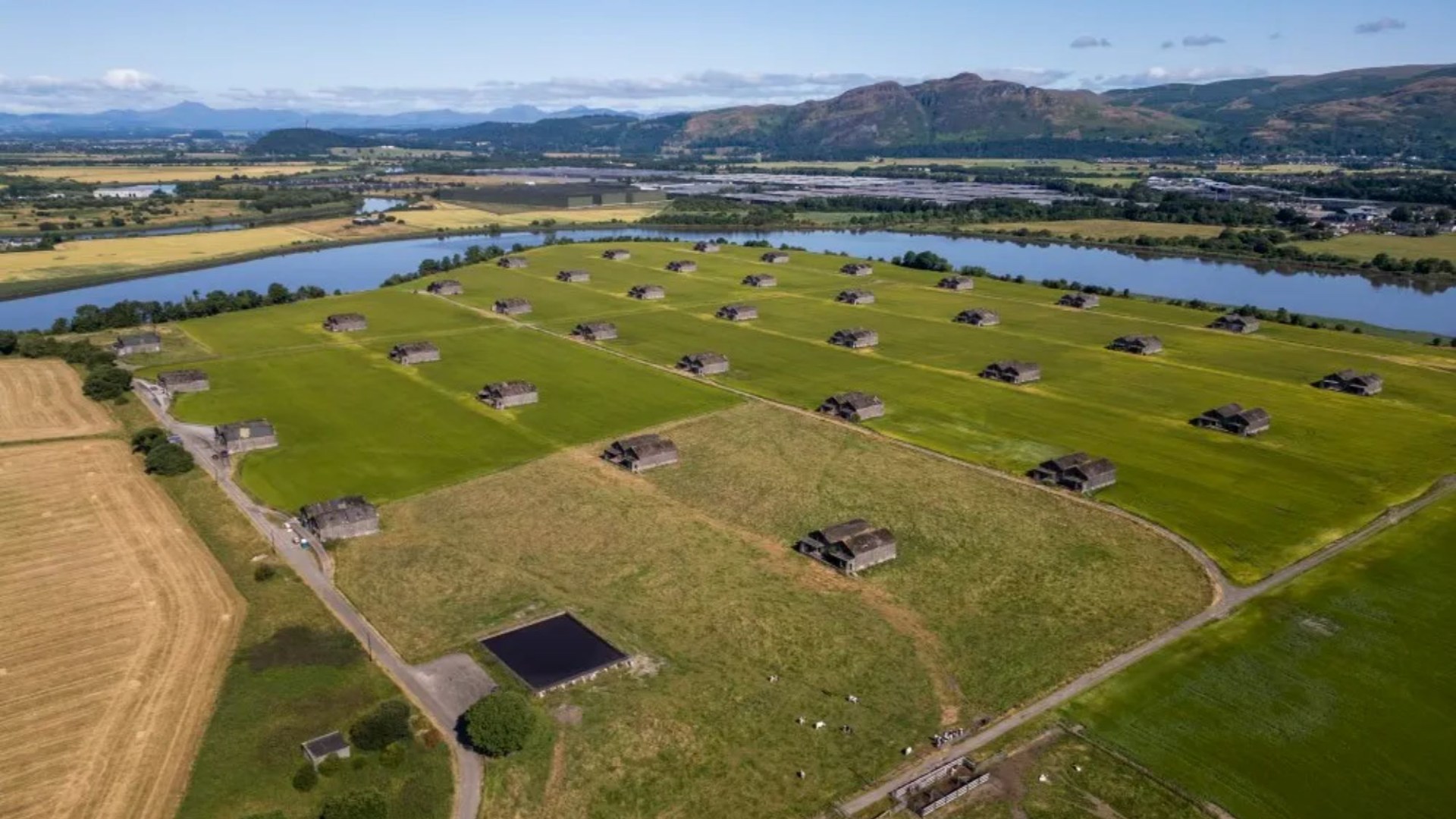
EERIE photos show the decaying ruins of a secret abandoned World War One bomb depot that has been left to decay. The site is part of the decrepit Bandeath Munitions Depo – a historical landmark in Scotland – where around 35 abandoned storage warehouses perch. The abandoned units are located near Stirling, Scotlan ad is part of the Bandeath Munitions Depot where around 35 abandoned storage warehouses perch Credit: Katielee Arrowsmith / SWNS The storage warehouses now lay empty after being first built in 1916 Credit: Katielee Arrowsmith / SWNS The facility was established in around 1916 as an admiralty depot during World War I, storing munitions and explosives to supply the British fleet. Credit: Katielee Arrowsmith / SWNS These abandoned units have been left to decay and tourists are not advised to visit. The facility was established in around 1916 as an admiralty depot during World War I. It was used to store munitions and explosives to supply the British fleet. Sign up for The Sun newsletter Thank you! They were also used to produce mines, shells, and bombs, some weighing up to 800kg for Britain’s illustrious naval fleet. Nearby was a prisoner-of-war camp called Polmaise whose labour was used to erect the stores, which are surrounded by rolling hills. They stand in six neat rows and were originally positioned in equal distances in order to prevent a blast from one triggering a blast in another. After the Great War, the depot grew in size with around seven further stores built to its south alongside laboratory buildings. But its use remained, becoming a Royal Naval Armament Depot (RNAD) during World War II. Historically, Bandeath was once an estate of the Abercromby family, an ancient clan who first attested in 1296. Most read in The Sun The depot was supplied via the main railway line, which connected to the site’s own internal railway. The stores were enclosed within protective earth blast walls, intended to direct the effects of an accidental explosion upwards and away, but they have disappeared over time. Other buildings such as a detonator store are nowhere to be seen. From the warehouses the railway was also connected to a rail mounted crane on a pier, where shells and mines would be loaded on to puffers or Victualling Inshore Craft (VIC), which would carry them out to sea, where they supplied the British navy. After the Second World War, many Polish servicemen stationed in Britain decided against returning to their home country as it had fallen into Soviet leadership. RNAD Bandeath functioned as a resettlement camp, housing these Polish soldiers and airmen and their families. In the 1950s and 1960s, the site remained under the ownership of the military until it was decommissioned in 1978 and sold to the then Central Regional Council, now Stirling Council. It was renamed Bandeath Industrial Estate, and some of the buildings on the site have been repurposed by local businesses.The crane still remains on the former pier, which is now privately owned. The location remains largely unknown in Scotland and is a reminder of the county’s war history. It is one of the last remaining of its kind in the UK. A number of pillboxes also remain. The units are nestled in the idyllic Scottish countryside Credit: Katielee Arrowsmith / SWNS Historically, Bandeath was once an estate of the Abercromby family an ancient clan who first attested in 1296 Credit: Katielee Arrowsmith / SWNS Comment now
Inside eerie abandoned World War One bomb depot left to decay and off-limits to visitors
Full Article
Original Source
Read the full article at Thesun →KhanList aggregates and links to publicly available news content. We do not host full articles from third-party sources. Always verify important information with original sources.