
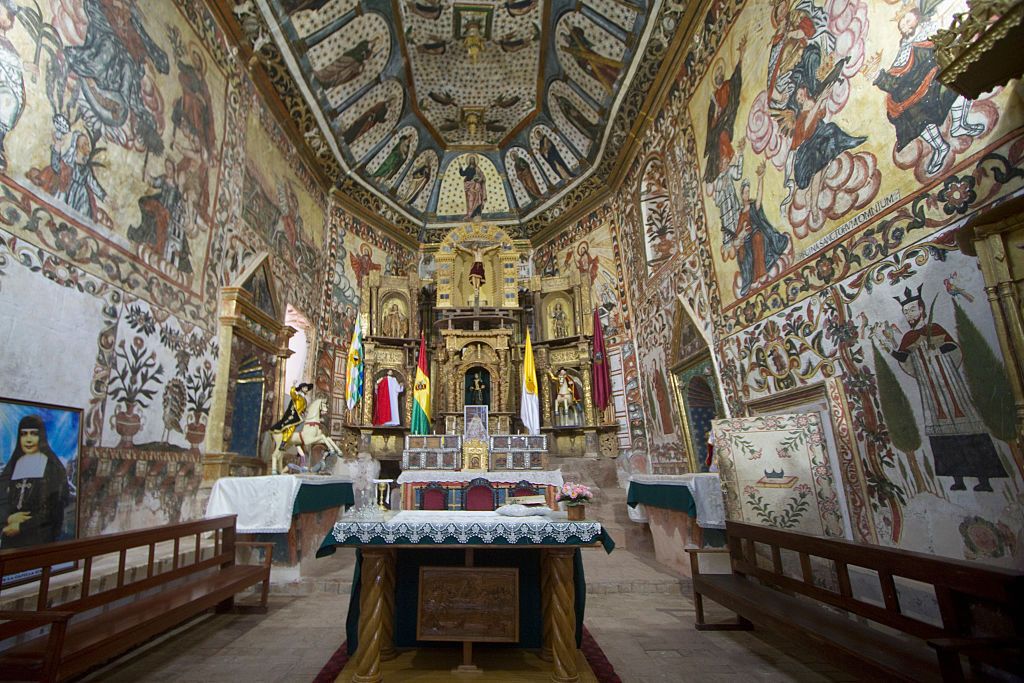
Located nearly 13,000 feet above sea level on Bolivia’s high plateau, the Santiago de Curahuara de Carangas church depicts guinea pigs at the Last Supper and magi riding llamas November 23, 2026 1:59 p.m. Restorers are finishing a six-month renovation at the Santiago de Curahuara de Carangas Church, which will reopen with a celebratory mass on December 15. Insights / Universal Images Group via Getty Images One of Bolivia’s oldest churches, built more than 400 years ago by indigenous craftspeople on the high-elevation Andean plateau, is celebrating the completion of a major, months-long renovation that will see it reopen in time for the Christmas season. The Santiago de Curahuara de Carangas church, which stands at nearly 13,000 feet above sea level on the Altiplano plateau, is better known by its nickname, the “Sistine Chapel of the Andes.” Elaborate murals span the walls and ceilings inside the stone and adobe building, evidence of artistic achievement and unique cross-cultural history. Scenes portraying both biblical stories and indigenous symbols are the outcome of rare collaborations between Spanish colonizers and native communities in the late 16th and early 17th centuries. Did you know? Restoring the Sistine Chapel This spring, the Vatican restored the Sistine Chapel for the first time in 30 years, including cleansing the sweat of tourists from Michelangelo’s murals and researching the multi-headed brushes that the painter used. “It is a jewel of mestizo Baroque art,” Reverend Jacek Dziadosz, a Polish priest known locally as Father Jacinto, tells Carlos Valdez of the Associated Press (AP). “I still use these paintings to teach catechism to children and young people from rural communities, even in the age of TikTok.” The church was constructed between 1587 and 1608, while the murals, painted with natural dyes and used for centuries by missionaries to convert locals to Christianity, weren’t finished until 1777, EWTN News’ Julieta Villar reported in April, when the restoration was announced. This decades-long creative process spanned many eras of painting, and the scenes inside reflect this range, exemplifying styles such as Mannerism and 18th-century Baroque. A fresco of Noah's Ark inside the Santiago de Curahuara de Carangas church, known as the "Sistine Chapel of the Andes" Insights / Universal Images Group via Getty Images Depictions of famed biblical scenes including the Great Flood, Nativity and Last Judgment are imbued with details that are significant to Andean culture and spirituality. A resurrected Christ is framed on either side by the moon, sun and a rainbow. Wrath, one of the seven deadly sins, is exemplified by a sword-wielding Spanish soldier. A guinea pig, not bread, is passed around during the Last Supper. The Three Wise Men ride on llamas instead of camels. And a black cat stands at the feet of Judas, while a white dog, representing good fortune, rests at Jesus’s side. “The murals were painted to warn people about sin and the importance of repentance,” Josefina Matas, an architect and conservator who is leading the renovation, tells the AP. “There is something from outside, but there is also something that is ours.” The church was built between 1587 and 1608, though its many murals weren't finished until 1777. Insights / Universal Images Group via Getty Images The church’s patron saint, the apostle James (known in Spanish as Santiago), is represented inside in similar stylizations as Illapa, the Incan god of thunder. “It’s very striking when you enter the church, because there isn’t any empty space,” Matas tells the Art Newspaper’s Graciela Ibáñez. “Everything is painted. Most of the churches in the region have murals. Here, they have been well preserved.” The $66,000 renovation project was funded by the U.S. Department of State’s Ambassadors Fund for Cultural Preservation, which has funded more than 30 projects in Bolivia since 2001. The most crucial part of the renovation is the repair and waterproofing of its aging thatched roof, which covers roughly 8,600 square feet and protects the murals inside from harsh highland weather. Roughly a dozen Indigenous Aymara workers are leading this effort, implementing a local technique that layers straw on top of hollow cane mats that will prevent leaks. The church’s buttress is also being restored, and its exterior walls, which have weakened over time, are being secured. Declared a national monument in 1960, the church will celebrate its reopening with a special mass on December 15. “We view culture as a catalyst for our national pride, of our essence, but also for the social cohesion and peace we so urgently need to truly understand where we come from and where we wish to go,” Andrés Aramayo, Bolivia’s deputy minister for sustainable tourism, said during an April press conference announcing the restoration, per EWTN News. You Might Also Like Get the latest stories in your inbox every weekday. More about: Art Art History Bolivia Colonialism Indigenous Peoples Religion Religious History Renovation and Restoration South America
Inside Bolivia's Newly Restored 'Sistine Chapel of the Andes,' Centuries-Old Murals Tell Biblical Stories With Andean Imagery
Full Article
Original Source
Read the full article at Smithsonianmag →KhanList aggregates and links to publicly available news content. We do not host full articles from third-party sources. Always verify important information with original sources.