
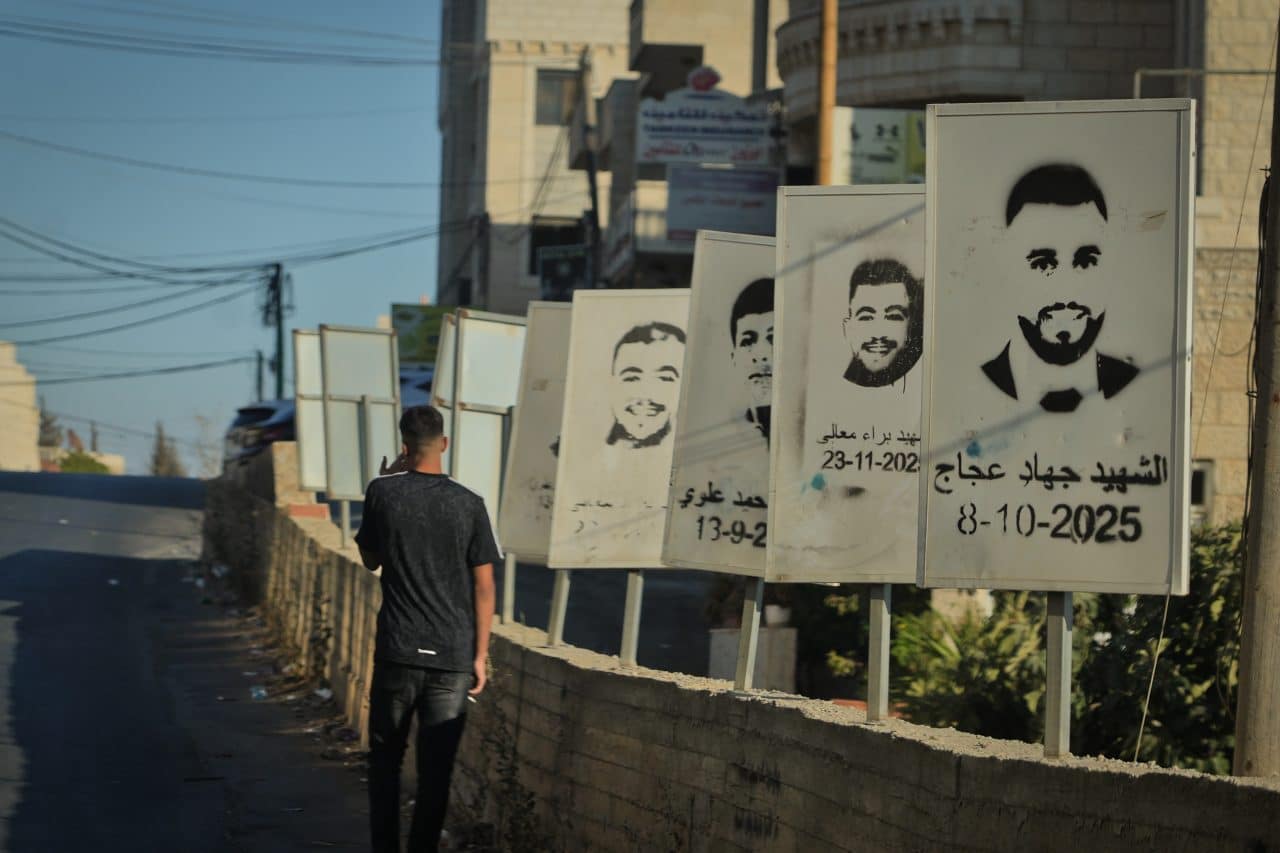
The road to Deir Jarir is a visual prologue to what its people have lived through for the past three years of facing Israel’s military and settler offensive. Arriving from Ramallah in the occupied West Bank, the 30-minute minibus journey stretches into a much longer one at the Israeli checkpoint in neighboring Silwad, marking the entrance to the chain of villages east of Ramallah. At the checkpoint, Israeli soldiers stop vehicles for search at varying hours and for changing periods every day, sometimes for half an hour, sometimes for three or four hours. A long queue of cars waits endlessly for the next chance to move a few feet forward. Once through the checkpoint’s distinctive yellow iron gate, the minibus I’m on passes by the foot of Mount al-Asour, one of the highest points in the West Bank that rises to 1,200 meters above sea level, and where an Israeli military base has sat since the occupation began in 1967. On the slope below the base, mounds of freshly-dug earth and two prefabricated houses mark a newly-installed Israeli settler outpost, positioned directly above Palestinian homes and gardens. I am heading to Deir Jarir to meet Ali Abu Khdeir, a Palestinian from the town who has experienced Israeli settler violence first-hand, and is still living through its consequences. In the last days of April, he had been forced to leave his family home, built long before he was born by his grandfather. The decision hadn’t come easily, but he felt that he and his family had been left with no choice, given the alternative. Along the main road into town, a stream of faces flies past the minibus window — portraits of Palestinians killed by the Israeli army or settlers in Deir Jarir since October 2023; there are nine of them, aged between 20 and 55, including one woman. The latest two, Odeh Abu Salha, 55, and Ahmad Abu Makhu, 26, were killed in a single shooting by an Israeli settler on the night of the FIFA World Cup final, last July. They had gone out to confront Israeli settlers stealing sheep from a barn. One settler opened fire at the crowd, and then at the ambulance trying to evacuate the wounded. Portraits of Palestinians killed by the Israeli army or settlers along the road to the entrance of Deir Jarir. (Photo: Qassam Muaddi/Mondoweiss) For Ali Abu Khdeir, those photographs mark a road he now travels only as a visitor, but it was once the road to the hometown where he had spent his entire life. He now lives in a rented apartment in the neighboring town of Silwad, along with his father, his wife, and four children. I meet Ali in the middle of Deir Jarir before we get into his car, and he drives off. We’re going to visit his now-abandoned home, but we won’t be able to go inside this time. As we begin to approach the now sealed-off road to the neighboring village of Kufr Malik, Ali points in the distance. The house is there, the one his grandfather had built, the one with the large veranda at the edge of town, standing empty. Ali gazes at his home from a distance for a few seconds. We don’t leave the car. He begins to recall his family’s story. “My grandfather built the house a few years before the Israeli occupation in 1967,” he said after taking a deep breath. What happened to Ali’s family in Deir Jarir is part of a documented and accelerating pattern across the eastern villages of the central West Bank. Since October 2023, Israeli settler groups have systematically targeted Palestinian communities along the axis connecting Deir Jarir, Taybeh, Mughayyir, Turmusayya, and Abu Falah, using violence, intimidation, and the seizure of homes to push Palestinians out of villages they have inhabited for centuries. According to the UN’s humanitarian arm, OCHA, settler attacks and access restrictions have displaced Palestinians across more than 130 communities since January 2023. B’Tselem has documented how the Israeli military routinely escorts settlers during attacks and fails to intervene when Palestinians are targeted. The goal, according to analysts who track the campaign, is territorial — not incidental. Ali Abu Khdeir’s house on the Kufr Malik street in Deir Jarir. (Photo: Qassam Muaddi/Mondoweiss) Gradual takeover “My father and his siblings grew up in it as children,” Abu Khdeir said. “Then they grew up and left, but one of my uncles lived in it with his own family when he got married. Years later, he built his own house and left.” Ali pauses and gazes down, then smiles as if coming back from his memories. “And for the past ten years I have lived in it with my family and my father, until we were forced to leave.” Deir Jarir is home to some 5,000 Palestinians belonging to nine extended families, with a centuries-old recorded presence on the land and oral traditions linking some of them to pre-Christian times. For most of its history, it was an agricultural village — olive groves and vines in the surrounding hills, wheat and barley in the lower plains. That economy has changed, but the people of Deir Jarir still work their lands, especially their olive groves east of the town. Since October 2023, those lands have become increasingly inaccessible. The settlers’ offensive moved in stages. First came attacks at the entrances and edges of the town, including the killing of 30-year-old mother Randa Ajaja on October 12, 2023, shot while driving back home with her family. Then came new outposts on Deir Jarir’s entrances, including the one on the slope of Mount al-Asour, with a road the Israeli army paved specifically to serve settlers. Most recently, settlers began to attack the heart of the town itself. Since Ali and I spoke at a distance from his house, I later came back on my own to see if I could photograph it up close. This time, I walked the Kufr Malik street alone. The house is the last one, isolated at the very tip of the street, just under the summit of al-Asour. The recently established settler outpost and Israeli army radars are close by. I’m unsure of how close I can get or how long I’ll be able to stay before I attract the settlers’ attention. I arrive at the last house before Abu Khdeir’s, some 150 meters away. It is a three-floor building with a porch shaded by a vine tree, and a man in his late fifties standing under it, looking down at the street. I ask him if it is safe to approach the house. He looks at my camera and asks if I’m a journalist. I confirm, but he takes a longer, more careful look at me, then smiles and declares, “You’re from Taybeh, aren’t you? Come in, let’s have a talk first. I’ll tell you everything you need to know.” He introduces himself as Muhammad Khamis, Ali Abu Khdeir’s next-door neighbor. He describes the recent series of attacks on Ali’s home in vivid detail. “This part of Deir Jarir, the Kufr Malik road, has become a battlefield with settler groups several times in the past months,” he recalled. “At one point, some 100 settlers attacked at the same time and began to throw rocks at the windows of the houses along the street as the Israeli army watched. The soldiers were stationed at the end of the street and blocked access to the center of the town.” Muhammad Khamis standing in his porch pointing to the Kufr Malik street. (Photo: Qassam Muaddi/Mondoweiss) “If it weren’t for the young men who took to the roofs to defend the houses, the settlers would have entered our bedrooms,” he added. Khamis takes us around his family’s building, located at the base of al-Asour, below the site where the settlers launched their attacks. “The settlers were here, and there, and they came up to here,” he said, pointing uphill as two little girls followed him shyly. He recalls further details of the attack from July. “The settlers came from up there in groups, while another group trapped us inside from the street,” he said. “This is why we installed this barbed wire, to prevent settlers in the future from getting close to the houses.” Khamis points to a shining new spiral line of barbed wire stretching some twenty meters from the house. “The pressure on the Abu Khdeirs was more intense because their house stands alone, and settlers could easily isolate it,” he explained, pointing toward the end of the road, where Ali Abu Khdeir’s house can be seen in the distance. The settlers’ offensive had begun much earlier than the July attack. Khamis says that when the settlers established the outpost on Mount Asour, “our sense of safety here was lost, especially when they began to bring their livestock to feed on the olive trees.” “When I confronted them,” he added, “and told them to stay away from our olive trees, one of them told me to leave for Syria, Jordan, or Egypt.” He lets out a sarcastic laugh. “I understood then that harder days were ahead.” Muhammad Khamis points to where Israeli settlers stood during a settler attack in July. (Photo: Qassam Muaddi/Mondoweiss) Jamal Jumaa, coordinator of the grassroots Stop The Wall campaign, says the pattern is deliberate. “The first part of this violent settler campaign after October 7 was expelling rural and Bedouin communities in Area C, but that is largely done,” Jumaa told Mondoweiss. “Now, the settler groups’ strategy is to increase pressure on the villages and towns, taking houses as outposts from which to harass the rest of the community.” Jumaa says that if the settlers’ strategy succeeds, the next phase will see the gradual takeover of houses at the edges of Palestinian villages, “like we have been seeing in Hebron and Jerusalem for years,” he explains. This strategy has been reinforced by Israeli government policy. In February, the Israeli government approved the draft bill that would allow Israel to enforce its own law, including on building policy, in areas under the Palestinian Authority’s jurisdiction. The government also revoked a Jordanian-era law that restricted Israeli individuals from purchasing land in the West Bank. Most recently, in July, a coalition of Israeli settler groups announced a plan to establish 100 settler outposts in Area A, in the heart of Palestinian cities. The plan was endorsed by Israel’s hardline Finance Minister, Bezalel Smotrich, shortly thereafter. Barbed wire around Mohammad Khamis’s home installoed by residents to protect from Israeli settler attacks. (Photo: Qassam Muaddi/Mondoweiss) Forced into leaving For Ali, the takeover of his house followed the same incremental logic. “First, around December 2025, settlers began to roam close to the house, among the fig and almond trees,” Ali recalled during my first trip to Deir Jarir. In late February, the Israeli army demolished the barn Ali had built adjacent to the house, claiming it was located in Area C, the over 60% of the West Bank under full Israeli civil and military control in accordance with the 1993 Oslo Accords. “From that moment on, settlers began to harass us daily.” “In March and April, settlers attacked the house directly with stones and threatened us,” Ali said. One morning, Ali’s elderly father woke to find a settler sitting on the porch. “That day, I realized that the house wasn’t safe anymore.” What followed was not a decision so much as a trap: leaving meant risking permanent loss of the house, and staying meant risking the family’s safety. “What I really feared was a fire attack, like the many ones that have happened when settlers set fire to the house in the middle of the night, which I didn’t want to risk,” he recalled. Finding a solution for his father — for whom the house was not mere property, but the embodiment of his entire family’s legacy — proved to be the hardest part. “The house to him represents his entire life memories,” Ali said. “But he wanted me to leave with my family for the safety of my children.” Young men from the village offered to take shifts guarding the house while the family was away. But Ali’s father refused to let others be endangered in his place. The family was trapped between several painful choices. Israeli settler outpost on the slope of Mount al-Asour overlooking Palestinian homes. (Photo: Qassam Muaddi/Mondoweiss) Nakba day Muhammad Khamis says he was there the night a group of young men came to the Abu Khdeirs’ house to make their offer. “Ali’s father refused emphatically,” Khamis said. “He said he didn’t want anybody to get hurt on account of protecting his own house, but he was clearly disturbed.” “Ali had begun to look for an apartment to rent, and he had identified one in Taybeh and one in Silwad,” Khamis went on. “It was clear that deep down, he wished that, by some miracle, his family wouldn’t have to leave.” Khamis sighs before adding in a hushed tone: “We all wished that. Who wouldn’t?” Khamis describes the days before the Abu Khdeir family’s departure as “tense and sad,” because all the neighbors understood what it meant. “This was only the first part of Deir Jarir that was being expelled, and it made us all even more anxious, forcing us to think through what we would do if faced with the same choice.” Khamis believes this is why Ali decided to leave so swiftly, with as little drama as possible.” “Finally, my father gave in, because he understood that if he stayed, I would stay,” Ali says. “Up until then, I had only thought of my family’s safety. But when the moment came, the most painful part came with it, all at once: my childhood, my memories, my family’s life here, but I had to keep it all inside, and I pushed on.” The day they left, Ali and his wife didn’t send the children to school. They loaded their belongings onto a truck, and his father stayed silent throughout. Ali’s wife focused on the children. That night, in their rented house in Silwad, Ali’s young daughter began to cry when she realized that they weren’t going back home. Her siblings soon followed suit. In the other room, her grandfather dried his tears in silence. A few days later, Israeli settlers raised an Israeli flag on the rooftop of Abu Khdeir’s house. Residents of Deir Jarir took it down, but the message had already been delivered. “After the Abu Khdeirs left, settlers came back twice, this time more emboldened, and they’ve gotten closer than they ever have been to the other nearby houses, possibly hoping that others will end up leaving, too,” Khamis recalled. “After the latest settler attack, I spoke to my neighbor and relative, a school teacher whose house had just been attacked, and he said that he decided to stay, no matter what happens,” Khamis said solemnly. “He was even more determined to stay.” When I asked what he would do if that came to it, Khamis immediately replied, “The same, of course! I saw what Ali’s family went through, and I’m not leaving. None of us is!” He turns back to me, raising his finger as if remembering an important detail. “And just because Ali left for now, it doesn’t mean that he gave up on his house!” I finally decide to approach Ali’s house after Khamis tells me that the settlers are absent. Just a few meters above the street, dry branches scattered along the path towards the house give away that the place is abandoned. The windows are shuttered, but the inside is visible through the glass veranda. Grass has grown, and it’s already dried around the entrance. Just beside the house, a pile of torn-apart corrugated aluminum sheets, bricks, and rebar indicates the location where the sheep barn had stood before the Israeli army demolished it in February. Ali Abu Khdeir’s house on the Kufr Malik street in Deir Jarir. (Photo: Qassam Muaddi/Mondoweiss) But the most noticeable thing was the silence, which gave way to a terrifying realization: it gradually dawned on me that I was staring into the face of the same scene that Palestinians have carried with them since the Nakba — the same scene they’ve been struggling to keep from repeating itself. Chills go down my spine, and I remember that I shouldn’t stay much longer. I snap a few photos before hurrying back to the center of Deir Jarir. That was my only encounter with the Abu Khdeir family’s displacement. But Ali still returns to check on his house and the trees whenever settlers are not around, taking his oldest son with him. He refuses to describe what happened as a permanent loss. “It is not only about me going back to my house,” he told me during my first visit to Deir Jarir as he drove me back to Silwad. “It’s about why I was forced to leave in the first place. Why did my father have to be expelled from his childhood home at the end of his years? ” Ali turns the car toward the road leading away from Deir Jarir, away from the familiar. “Why do my children have to remember their expulsion from now on? Why are these violent settlers supported by their government?” Portraits of Palestinians killed by the Israeli army or settlers along the road to the entrance of Deir Jarir. (Photo: Qassam Muaddi/Mondoweiss) As we leave Deir Jarir, the posters of slain Palestinians are there to see us off, their smiling faces flying past the car window. “Isn’t there anyone who will support and protect us?” The sun sets to Ali’s left. To his right, the reflected twilight shines off the windows of Israeli settlers’ prefabricated houses, crouched on the slope of Mount al-Asour as they overlook the houses and gardens of Deir Jarir. Qassam MuaddiQassam Muaddi is the Palestine Staff Writer for Mondoweiss. He covers social, political, and cultural developments in Palestine, and has written for several outlets in English and French, including the Catholic Terre Sainte Magazine and other outlets. Follow him on Twitter/X at @QassaMMuaddi.
Inside a Palestinian family’s agonizing decision to abandon their home under threat of Israeli settler violence
Full Article
Original Source
Read the full article at Mondoweiss →KhanList aggregates and links to publicly available news content. We do not host full articles from third-party sources. Always verify important information with original sources.