
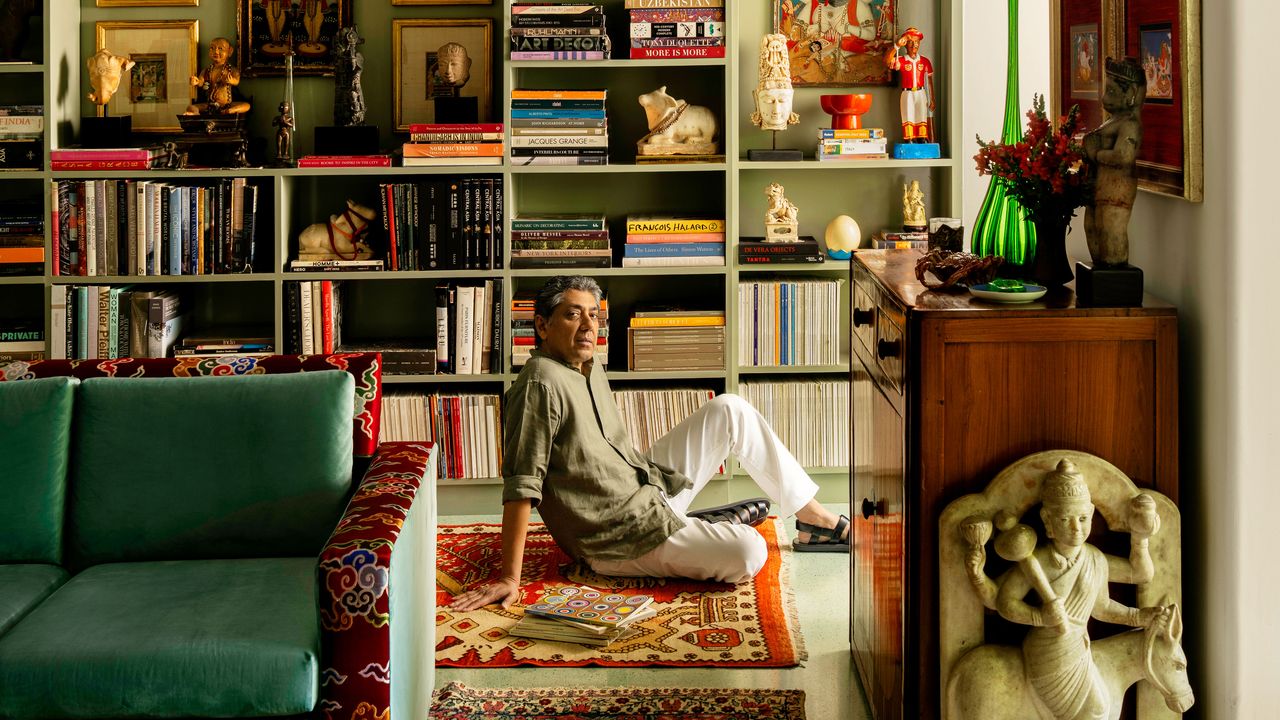
With a gift for making objects speak, designer Vikram Goyal layers heirlooms, art, and exuberant craftsmanship into a home that tells his storyDesigner Vikram Goyal in the first-floor study surrounded by family heirlooms and objects he’s collected. At left, Vikram Goyal Studio’s Kurma the Tortoise coffee table can be glimpsed.When you’re a man of the world, as Vikram Goyal surely is, making a new home for yourself must be laced with temptation. You’ve seen too much, read too much, and very probably dreamed too much to shrink your requirements down into anything as rational as a design brief.Raised and now based in New Delhi, Goyal has been building his personal image bank for a lifetime. A successful furniture designer and self-described “craft revivalist,” as creative director of Vikram Goyal Studio and Viya, he has clients across the globe. He came to his profession circuitously. At Princeton, where he studied economics, Goyal marveled at the Venetian-Gothic student center and blanketed his dorm room with block-printed textiles and silk lampshades (“Probably the only decorated room on the entire quad,” he jokes). As a young economist in Manhattan, he haunted the galleries of the Frick Collection; on a two-year stint in Hong Kong, he made the China Club, the late David Tang’s glamorous evocation of a 1930s Shanghai nightspot, his second living room.In the first-floor study, a Forged floor lamp and Red Earth side table by Viya stand next to an Indian tufted armchair in the corner. Botanical paintings are from Rome; 20th-century Anglo-Indian teakwood desk; Tabriz rug. In the ground-floor living room, a 20th-Century Shatrunjaya Pata textile is flanked by Vikram Goyal Studio’s Serpent’s Gaze (left) and Crocodile’s Vigil mirrors, and a Mohenjo Daro side table by Viya stands in the foreground. When Goyal came across this villa in the heart of New Delhi a few years ago, he’d long since returned to his home city. The house lured him back to his childhood neighborhood, an enclave sandwiched between Delhi’s Old Fort and Humayun’s Tomb, two monuments he considers to be among the most beautiful in India. Amid fort and tomb, now part of the axial grid laid out by architect Sir Edwin Lutyens, a small green quarter established in the early 1950s is where he now makes his home. “It’s central, but it’s not part of the hullabaloo,” Goyal says. “I value serenity and quiet.”The house’s original Art Deco banister winds its way up the staircase. A bedroom features an Art Deco bed from South India. Artworks include paintings by Thukral and Tagra (above bed) and Riyas Komu, as well as a Yali wood sculpture lamp. Vyaghra the Tiger, a console by Vikram Goyal Studio, stands in the ground floor living room. ART: Thukral and Tagra. Riyas Komu / Kalakriti Art Gallery.His guests are often surprised to discover that the three-story stucco house was conceived in the Art Deco style. India took up Deco in the late 1920s, and confections like Jodhpur’s Umaid Bhawan Palace and the New Palace in Morbi were crafted to please maharajahs. But it was the more plebeian movie palaces and restaurants that popularized the fizzy style. When India gained independence in 1947, Deco was a convenient signifier of modernity writ large, and its influence continued.As he began work on the house, Goyal realized it had a tale of its own to tell. The entry staircase, with clef-shaped railings and steps paved in matcha-colored terrazzo, started the conversation. “When I walked up the stairs the first time, I was like, “My gosh! I try to be bold with my interiors, but I couldn’t have imagined this,” he says. To up the glamour, Goyal outlined the walls and windows in jet-black molding, lending the rooms a tuxedo-piping effect.The ground-floor main entry features a wooden chair Goyal inherited from his grandfather, a marble bust of Vikram’s maternal ancestor, the Late Rai Pannalal Mehta, and an Aravali bronze door handle by Viya. A view into the ground-floor living room A Bagh Chandelier by Vikram Goyal Studio hangs in the ground-floor dining room. Viya’s Under the Banyan candleholders stand on the brand’s Red Earth dining table. Other than enlarging the kitchen and one of two dining rooms, he limited his interventions to essential repairs. When it came to the furnishings, though, Goyal cut loose. He decided to put a new narrative spin on his trove of art and objects, a harmonious approach that would stand up to the space’s bold framing and exaggerated proportions. (The 12-foot ceilings are almost unheard of in Delhi, where height restrictions are taken seriously.) Over a thali dinner in the red-lacquered dining room, his guests may lose sight of the meal in a sea of light from Goyal’s candlesticks, reflected in walls paved with Gujarati mirrors. The effect, he admits, may be more Venetian than Indian—“but that’s not such a bad thing.”In a second dining room, Goyal’s Garden of Life wall panels—a collaboration with de Gournay—capture animals along the Silk Road in billows of gold and bronze, echoed in the cast-bronze base of Goyal’s table and also in ornaments and repoussé accessories from Viya, his lifestyle brand. Holding their own are a curious set of chairs from the designer’s grandfather. A riff on English Arts and Crafts, Viennese Secession, and chinoiserie, they have a shadowy provenance. “Various people who came to the family house in Jaipur would look at them and say, ‘Wow, they look like Charles Rennie Mackintosh,’ ” he remembers. “And we, of course, had no idea who Mackintosh was.”A Pichwai textile painting, a family heirloom, commands a wall of the first-floor study. A portrait of Goyal’s ancestor, the Late Fateh Lal Mehta, is visible in the reflection of Vikram Goyal Studio’s Crocodile’s Vigil mirror. A glimpse of the exterior By the time Goyal was old enough to inherit them, he did. But 10 chairs didn’t divide evenly between all the relatives who wanted them, so copies were made. He decided his set needed zhuzhing up, and he had seats of yellow silk brocade loomed in Benares by weavers to the Bhutanese royal family. The same artisans made the deliriously patterned emerald brocades in the living room—a telescoping run of spaces that encourages parties to spill over into increasingly intimate quarters, and where vintage carpets and works by Jamini Roy, Dayanita Singh, and M.F. Husain, among others, brighten the scene.An Eye Plate by John Derian sits on a 20th-century Anglo-Indian Teakwood Foyer table in the first-floor library. On floor, a Samarkand carpet. Goyal in the ground-floor living room. Vikram Goyal Studio’s Marine Drive console stands in the back right corner. A view of the first-floor study with Vikram Goyal Studio’s Kurma the Tortoise coffee table at center Goyal in the first-floor library in front of a collection of 20th-century Indian miniature paintings handed down from his family Objects on a shelf in the library include a 20th-century wood sculpture of Shiva, at right. Of all the belongings Goyal has collected, Indian and otherwise, a suite of textile paintings from his grandfather offer the most poignant narrative. Devotional works known as Pichwai, they mirror his lifelong affection for the animal kingdom. Last month in London, Goyal debuted a new collection of furniture, wall panels, and objects, including monkey-themed brocades and turtle-patterned carpets, alongside jasmine-adorned vessels—inspired by the Ramayana, an Odyssey-like saga of loyalty, friendship, and sacrifice.“I’m doing a lot of Indian storytelling these days,” Goyal muses. There’s an argument to be made that he always has.This story appears in the November issue. Never miss a story when you subscribe to AD.Not a subscriber? Join AD for print and digital access now.Sign up for our daily newsletter to get the best of design in your inbox.Read MoreThe Best Hotels in London Offer Plenty of English RefinementWhether you’re dropping in for high tea or booking a grand guest room upstairsLucy Hale Embraced Her Good Witchy Style—and Found Herself—in Her Los Angeles SanctuaryThe Pretty Little Liars actor brought rich colors and bold personality to her home—it’s “witchy, but not bad witchy,” says designer Marie TrohmanThe Best Airbnbs in Paris, Where Romance Meets High-End DesignFrom hidden architectural gems to stays with dazzling Eiffel Tower viewsAxel Vervoordt Transforms a 1980s Chalet Into a Serene Mountain Retreat That Feels as Though It Has Always ExistedUsing centuries-old woodwork and ancient stone, the AD100 designer balances art and architecture to achieve peak zen in the Swiss AlpsIn This Midcentury Home the Terrazzo Floor Creates a Color Palette That Explores Femininity, Nature, and SoftnessAD100 firms Geremia Design and Terremotto worked with Marsden Architecture to restore the glass-walled, postwar Joseph Eichler house for recent empty nestersLucy Hale Loves a Good Throw PillowThe Pretty Little Liars actor embraces bold patterns and offbeat pairings in her LA homeArtist Sunshine Thacker Built Her Upstate New York Dream House Brimming With Color, Memory, and EmotionIn a shaded clearing in the Hudson Valley, the ceramist realized her lifelong vision of homeBy Amir Capogrossi BadreddineIn This Elegant Paris Pied-à-Terre the Interiors Are Inspired by a 1960s Novel and Model Betty Catroux“There’s a passage where the protagonist says how much she loves the silence, the warmth, and the freedom of the night," designer Giampiero Tagliaferri saysWhere to Stay in Tokyo: 16 Design-Driven Hotels and Airbnbs in Japan’s CapitalFrom cool boutique accommodations to authentic rentals in the heart of the cityThis Cozy New York Cabin Is Full of “Moments of Delight” and One Very Important Detail: Reading NooksJesse Parris-Lamb filled an upstate home with cozy crannies around one very large fireplace for a family of voracious readersThis Artistic Northern California Home Celebrates the UnexpectedAnalog devices, one-of-a-kind furniture, and Robert Rauschenberg artworks populate rooms with views of the San Francisco Bay
Inside a Bold Art Deco Villa in New Delhi Filled with a Lifetime's Worth of Globe-Spanning Finds
Full Article
Original Source
Read the full article at Architecturaldigest →KhanList aggregates and links to publicly available news content. We do not host full articles from third-party sources. Always verify important information with original sources.