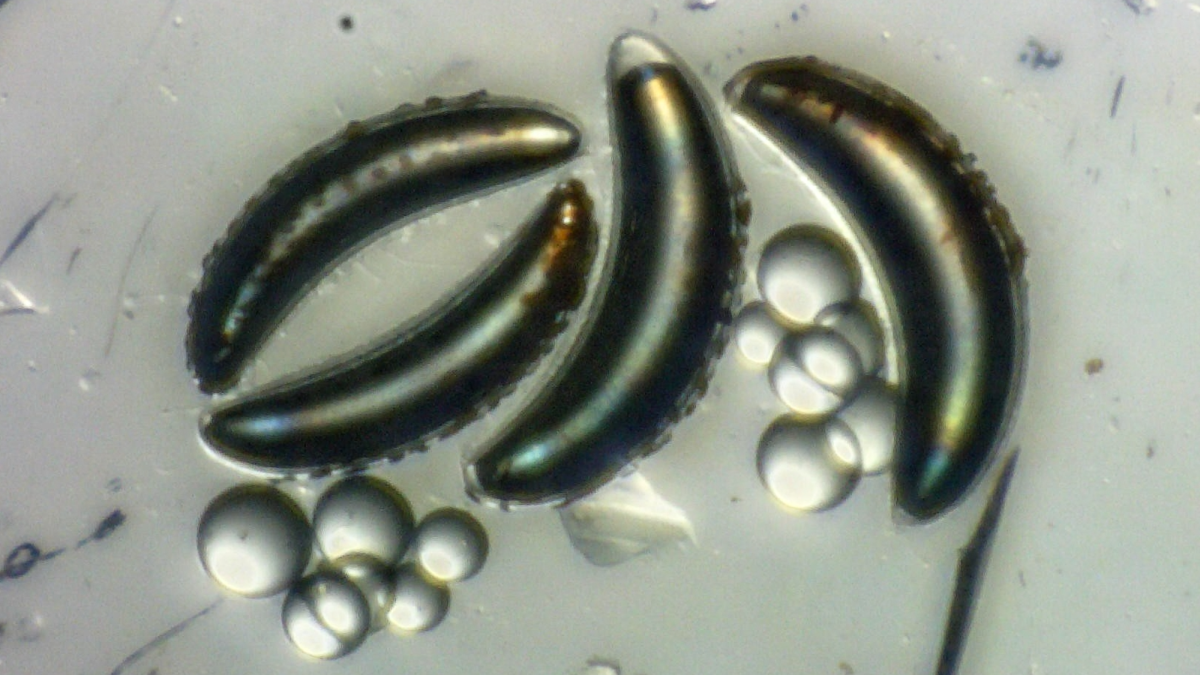
Removed ‘Chaoborus edulis’ airsacs. Image: Philip Matthews Get the Popular Science daily newsletter💡 Breakthroughs, discoveries, and DIY tips sent six days a week. By signing up, you confirm you are 16+, will receive newsletters and promotional content and agree to our Terms of Use and acknowledge the data practices in our Privacy Policy. You may unsubscribe at any time. Like it or not, insects are everywhere, including places where you may not want them to be. Yet there is one environment that they don’t call home—the open ocean. An enduring explanation for this absence is that deep water pressure would fill their tiny respiratory systems with air and they would then cave in. But one particular insect larva is challenging this idea. Meet lake flies (Chaoborus edulis). In East Africa’s Lake Malawi, billions of their larvae spend their days over 656 feet (200 meters) below the surface of the water before coming back up to feed at night. “Uniquely, Chaoborus midge larvae have modified their respiratory system into two pairs of air-filled sacs which they use to control their buoyancy,” Philip Matthews, a co-author of the study and a researcher who studies insects’ respiratory adaptations at the University of British Columbia tells Popular Science. “By regulating the pH of the air sacs’ walls, they cause them to expand or contract via a distinct ‘chemo-mechanical’ system.” ‘Chaoborus edulis’ larvae close up Matthews and his team were intrigued by how this mechanism works, but realized that using air sacs to regulate buoyancy while diving presents a problem. “The gas inside an air sac is not pressurized (it is roughly the same as the atmospheric pressure at the water’s surface),” he explains. “This begged the question: how deep can these insects dive before their air sacs cannot expand against the pressure? And at what depth do they fail completely and implode?” The team decided to investigate this in Lake Malawi’s Chaoborus edulis larva, to solve this puzzle. The findings, detailed in a study published today in the journal Science, trace the larva’s daily diving routine with a sonar system, and look at what is going on at the biological level. The walls of C. edulis’ air sacs have resilin, a substance that grows or shrinks in volume according to the wall’s pH. This dynamic gives the larvae the ability to change their buoyancy. A swarm of the lake fly larvae over Lake Malawi. Image: Philip Matthews. But how long can their air sacs hold out? Pressure chambers provide the answer. The researchers put larvae in these small chambers to see how much pressure they could withstand before their air-sacs imploded. The larvae’s air sacs could endure pressure equivalent to over 1,213 feet (400 meters) below the surface of the water, which is way deeper than they routinely descend. The study ultimately suggests that pressure isn’t what’s keeping insects out of open oceans, and their findings regarding resilin could hold relevance for material science. “Resilin was previously known as a passive and flexible part of insect exoskeleton, but through its ability to swell and shrink in response to changes in pH, it generates force of its own in Chaoborus, changing the shape and volume of the air sac,” says Evan McKenzie, a co-author of the study and a PhD student at The University of British Columbia’s Department of Zoology. “We think this could make Chaoborus resilin of great interest to material science where it could be developed as a dynamic material that morphs its shape in response to changes in its chemical environment.” 2025 PopSci Best of What’s New The 50 most important innovations of the year
Insects survive 1,213 feet of pressure under water, defying physics
Full Article
Original Source
Read the full article at Popsci →KhanList aggregates and links to publicly available news content. We do not host full articles from third-party sources. Always verify important information with original sources.