
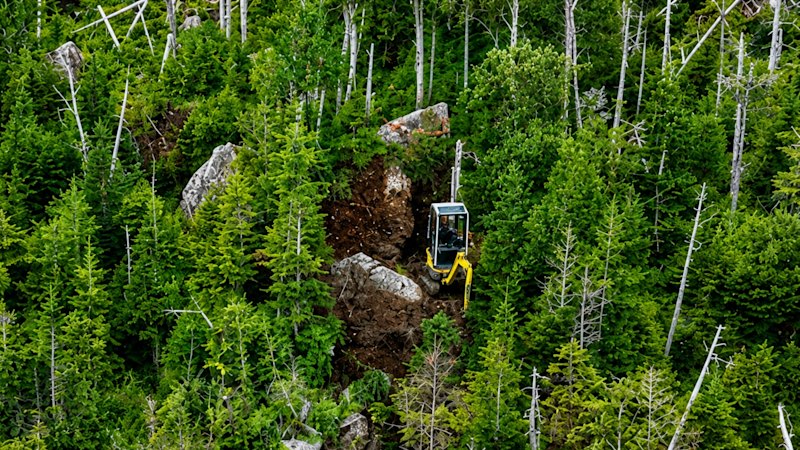
Brought to you by BULLS N’ BEARSPenny TaylorAugust 31, 2026 — 12:56pmInfini Resources has materially expanded exploration at its Portland Creek uranium project in western Newfoundland, Canada, committing to 5000 metres of diamond drilling backed by 1000m of trenching.The bigger tilt follows completion of the company’s 2026 airborne magnetic, electromagnetic and radiometric surveys and field program, plus a detailed reinterpretation incorporating two previous phases of drilling. Infini says the combined work has transformed a series of surface uranium occurrences into a coherent district-scale exploration picture.Trenching underway at Infini Resources’ Portland Creek uranium targets in Newfoundland, Canada, where structural complexity, magnetic destruction and uranium anomalism converge.The earlier drilling gave the model some geological teeth. Phase two alone ran for 5310m and confirmed fracture-controlled uranium mineralisation, including uraninite associated with chlorite-hematite alteration. Meanwhile, petrographic analysis independently verified the fracture-controlled alteration assemblage. Previous exploration has also delineated more than 6km of anomalous uranium and radon responses.The subsequent surface field program added 283km of traverses and more than 51,000 radiometric measurements, with the strongest responses repeatedly associated with fractured and altered granite. Structural interpretation identified two principal fault families – one east-west and another running north-northwest through north to north-northeast – with their intersections considered particularly prospective, as increased fracturing often provides pathways and space for uranium-bearing fluids.‘We are well positioned to take this program into its most substantial phase of drilling to date.’Infini Resources chief executive officer Rohan BoneFresh three-dimensional magnetic inversion has now added another dimension, resolving for the first time the boundary between preserved highs and low-intensity zones associated with extensive magnetic destruction, which closely tracks the interpreted structural network.Infini sees that destruction as the footprint of hydrothermal fluids altering the host rock, potentially changing magnetite to hematite, with its scale and continuity at depth considered a positive pointer to the mineralising system’s size potential. Bringing the datasets together has now defined specific three-dimensional targets where structural intersections, magnetic-destruction boundaries and uranium anomalism coincide.Infini Resources chief executive officer Rohan Bone said: “We have expanded the program to a substantially larger commitment than we previously contemplated, one that reflects both the quality of the target set and the scale of the system we are now dealing with.”With that geological picture dialled in, Infini has moved quickly from interpretation to execution. The diamond drilling program has been expanded fivefold, from approximately 1000m to approximately 5000m, with 1000m of trenching already underway across the ranked targets.The trenching marks the first systematic excavation undertaken at Portland Creek and is designed to expose bedrock for channel sampling and collect structural measurements to further refine drill designs. Geological services contractor CMG and Rodren Drilling have mobilised ahead of drilling, which is scheduled to kick off in the third quarter.Drilling will zero in on the strongest convergence of structural intersections, magnetic-destruction boundaries, uranium anomalism and complex fault corridors. Hole positions and orientations can be refined using trenching, oriented structural logging and downhole radiometrics, with laboratory assays from 2026 rock and trench-channel sampling providing another stream of results in the next few weeks.Rock samples analysed to date also contain low copper and arsenic and elevated lead, which Infini interprets as radiogenic lead derived from uranium decay rather than a base-metal association. The company says alternative mineralisation styles remain under assessment as new results emerge.The project has come a long way from its surface-discovery beginnings, when soil sampling at Falls Lake defined an800m by 100m high-grade uranium-in-soil anomaly peaking at a whopping 7.5 per cent uranium oxide. Infini is now armed with a structurally controlled exploration model pointing to defined drill targets across what it interprets as a potential district-scale uranium system.The Canadian push sits against a robust uranium backdrop supported by reactor life extensions, new nuclear builds and rising interest in reliable power as electricity demand grows. Western energy-security concerns are also focusing attention on politically aligned nuclear-fuel supply, adding strategic weight to successful Canadian exploration.Portland Creek has moved from eye-catching uranium numbers at surface to a three-dimensional hunt for the sweet spots within what Infini interprets as a much bigger system. The expanded drill campaign now has the job of showing whether that increasingly detailed geological picture can translate into the grade, width and continuity needed to give the uranium story real scale.Is your ASX-listed company doing something interesting? Contact: mattbirney@bullsnbears.com.auFrom our partners
Infini steps up Canadian uranium hunt with 5000m drill push
Full Article
Original Source
Read the full article at Smh →KhanList aggregates and links to publicly available news content. We do not host full articles from third-party sources. Always verify important information with original sources.