
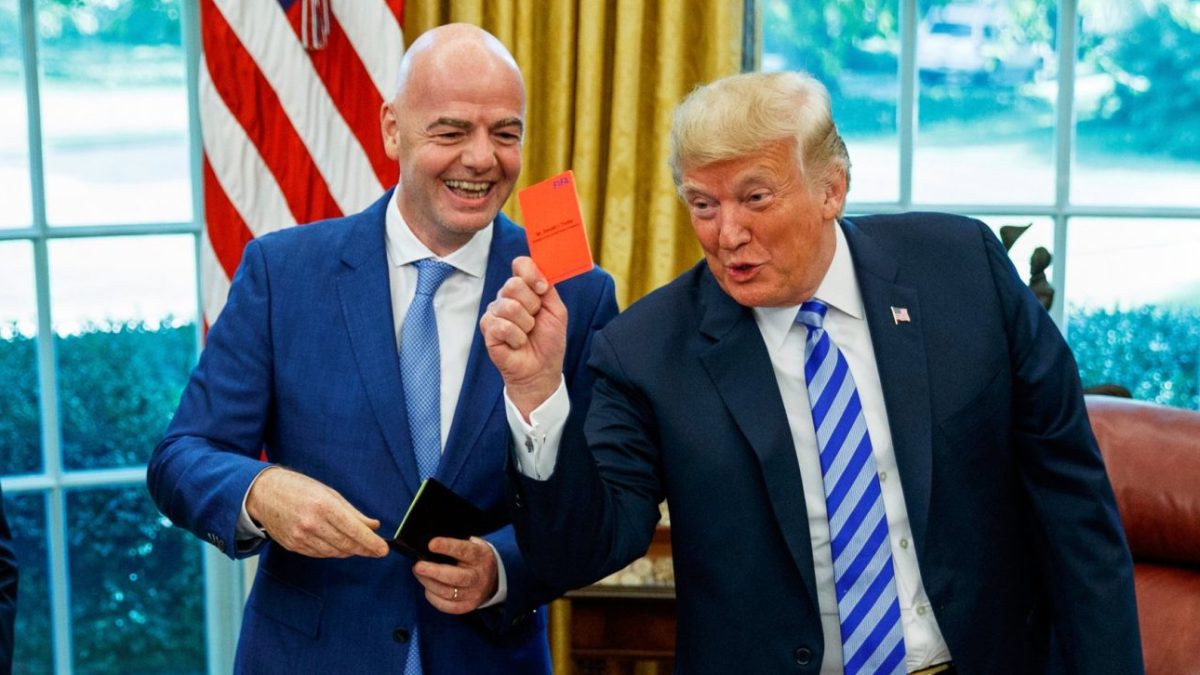
It is not surprising that whoever is in charge of world football’s governing body should have to dine with the devil on occasion. Gianni Infantino, Fifa’s beleaguered president, is following the example set by his predecessor Sepp Blatter; but if Blatter enjoyed the pomp and circumstance attached to his role, he did not actively seek out the company of many of the world’s most unsavoury autocrats. Infantino, who was elected to the job in February 2016, hasn’t sent back the “Order of Friendship” medal Vladimir Putin pinned on his jacket at the Kremlin three years later. He counts Rwandan de facto dictator Paul Kagame as one of his closest allies in Africa. He has presented personalised Fifa football jerseys and mementos to an impressive gallery of “strongmen”, from Uganda’s Yoweri Museveni to Azerbaijan’s Ilham Aliyev. He appears to have a penchant for populist leaders such as Narendra Modi and Javier Milei. Then there is Donald Trump. Since Joe Biden lost the 2024 US presidential election, Infantino has nailed his colours to the Maga mast and his behaviour has become noticeably more erratic and reckless – culminating in this summer’s World Cup and his disastrous efforts to sell off the tournament, linked to a member of the extended Trump family. Trump made himself scarce during most of the tournament played on US soil, making his sole public appearance at the final, when Infantino tried (unsuccessfully) to steer him away from the presentation of the trophy to the victorious Spanish team. But the pair had been in touch, as was demonstrated when Trump was unable to accept the red card handed to US striker Folarin Balogun during the round of 32 match against Bosnia and Herzegovina. Trump said he had called his friend to put a stop to that nonsense; “Johnny” complied. Balogun escaped his automatic one-game suspension, triggering a furious reaction across the globe, and creating a deep crack in the unity of the “football family”. But Infantino appeared impervious to the reaction – or was no longer able to understand when he had gone too far. Perhaps he believed that he could get away with everything, as the US President has mostly done, provided he followed the Trump handbook. As a former high-ranking Fifa executive who left the organisation recently told The i Paper, “Gianni lost all sense of reality and is paying the price for it”. Trump and Infantino hand the World Cup trophy to Spain captain Rodri ahead of the trophy lift (Photo: Reuters/Hannah Mckay) The first known meeting between the two men took place in the Oval Office in August 2018, shortly after it had been announced that the US-Canada-Mexico bid had won the right to host the 2026 men’s Fifa World Cup. Infantino stuck to the usual routine of handing the US President a “Trump”-stamped shirt and delivered an excruciating joke about yellow and red cards, setting the tone for the bizarre relationship, one made in unequal measure of shared interests, expediency and subservience on Infantino’s part. It has been said that the progress of Fifa to full-blown autocracy was inspired by the example of Trump’s use and abuse of the powers he believes are invested in the presidential function. This elides the fact that the organisation’s transformation under Infantino started well before Trump was elected for a second term. What is undeniable, however, is that by July last year, Infantino was insisting Fifa needed to base its New York World Cup office in the Trump Tower, and 2025 ended with him presenting Trump his grotesque inaugural “Fifa Peace Prize” (without consulting anyone other than his coterie of private advisers). In February, Infantino wore a red “USA” cap bearing the numbers “45-47” (referencing Trump’s presidencies) at the first meeting of the US President’s Board of Peace. Now, his attempt to put up the World Cup for sale – to none other than Josh Kushner, younger brother of Trump’s son-in-law Jared – has finally led to a rebellion from most of the football world. Infantino had lost all sense of danger, having secured enough endorsements at the Fifa Congress just before the World Cup to reassure himself that he’d be re-elected for a third and last four-year term in March of next year. After that, he hoped to carry on as master of international football in his new £30m-a-year role as “commissioner” of Fifa Forward Enterprise (FFE), his proposed subsidiary to manage the commercial rights of major tournaments. Russian President Vladimir Putin and Infantino attend the Russia 2018 World Cup final between France and Croatia at the Luzhniki Stadium in Moscow (Photo: Alexey Nikolsky) Goodbye to all that. The now-abandoned initiative recalled another incident of Infantino’s interests intersecting with those of the Trump family that emerged last April, when a company called ADI Predictstreet was announced by Fifa as its first official “prediction market” partner. All transactions on the platform were to be conducted using a cryptocurrency issued by World Liberty Financial, reported Norwegian investigative website Josimar. World Liberty Financial was originally majority-owned by Trump’s family, and a large stake was sold to the Abu Dhabi royal family, the primary backer of ADI Predictstreet. “The Trumps [received] 75% of net proceeds when World Liberty sells tokens,” the Wall Street Journal reported. It is tempting to see Infantino as a textbook example of the vassal who mistakes the acceptance of his fealty by his lord and master for a token of friendship. Cravenness masquerades as loyalty. This much is true. Infantino placed too much stock in Trump’s public effusions towards him, and contorted himself into ever stranger shapes to court the US President. Democratic Congressman Jamie Raskin, ranking member of the House of Representatives’ Judiciary Committee, has described this as “Fifa’s brazen campaign to curry favor with Donald Trump since his re-election” in a scathing letter sent to Fifa’s Trump Tower address, in which Raskin summoned Infantino to an in-person grilling in Washington. But this Infantino was always there. Trump may have triggered the metamorphosis, but did not engineer the DNA. When the “Fifagate” corruption cases emerged in 2015, Infantino was Uefa’s general secretary, the closest aide of confederation president Michel Platini, who everyone expected to succeed Blatter as head of Fifa. Infantino was linked to two individuals who were indicted and later convicted for wire fraud and racketeering by the Americans, the Argentinian father and son marketing agents Hugo and Mariano Jinkis. Infantino, who has strenuously denied all wrongdoing, signed the contract under which Uefa was selling the TV rights to its competitions at a price that the Jinkises were able to multiply by three when they sold them on to a Brazilian company three months later. On 6 October, 2015, an investigation by Sueddeutsche Zeitung revealed, Infantino flew from Geneva to New York, returning on the 8th. The reason for Infantino’s trip, according to internal Uefa documents, was a board meeting of Uefa partner CAA. But that meeting took place on 5 October, and Infantino attended via video conference from Nyon, Switzerland, where Uefa is headquartered. What Infantino did in New York, only he and the people he met there know for sure. No explanation was ever given, despite repeated requests from Sueddeutsche Zeitung. What is known is that Infantino, the Uefa-backed candidate for the Fifa presidential election which was convened after Blatter’s resignation, visited the US on two more occasions before the vote took place, and that he owes at least part of his success to the active support of the Americans and the then-president of the United States Soccer Federation Sunil Gulati, who, at the 11th hour, worked to “flip” votes destined to go to the favourite, Asian Confederation boss Sheikh Salman bin Ibrahim al-Khalifa. Trump was still campaigning for the Republican nomination at the time. When approached by journalists in March 2016, a month after Infantino’s election to the presidency, Fifa stated that its new president had never had any dealings with anyone involved in the “Fifagate” scandal. Infantino’s true debt may not be to a single man, but Trump has a habit of burning those who fly too close to his unpredictable flame. Infantino was not the first and will not be the last to discover it to his cost. Is it game over for Infantino? While it is possible that Gianni Infantino could resign to avoid the humiliation of a public defeat in the face of overwhelming opposition, we are still a long way away from this option. It would be more in line with the Fifa President’s character to try to fight his way out of this crisis, compromised as he appears. The leaders of the rebellion against Infantino, following the announcement of his plan to sell stakes in the World Cup, could force Fifa to convene an extraordinary congress and use it to stage a vote of no-confidence. Should Infantino lose, he would be replaced on an interim basis by the longest-serving member of the Fifa Council, Asian Football Confederation President Sheikh Salman. But the wheels would have to be set in motion quickly for this to take place before the Fifa presidential election set for 18 March 2027, since Fifa has up to three months to hold such a congress from the time it is demanded and the date and venue must be announced to member associations at least two months in advance. Infantino remains the only declared candidate for the election. Three Confederations (Asia, Africa and South America) endorsed him before the start of the World Cup, and several Member Associations (MAs) signed sponsorship forms saying they will not endorse any other candidate. Asia (AFC), Africa (CAF) and South America (Conmebol) represent a bloc of 110 votes which would be large enough to ensure Infantino gets more than the majority of the 211-strong electoral college and is elected for a third consecutive full term. However, what was true in June no longer is in August. The Asian Confederation has flipped and aligned itself with the position of Uefa and Concacaf (Confederation of North, Central America and Caribbean Association Football), who have led the rebellion against the Infantino regime. A few Asian MAs (Lebanon and Qatar, for example) have indicated they still support Infantino, while the Mexicans have adopted a more conciliatory tone towards him than their confederation, Concacaf. Opponents retain the upper hand in terms of numbers, however, and it is believed that the 11 countries which make up the Oceanian Confederation (OCF) are minded to join the Uefa-Concacaf-AFC camp. Infantino’s remaining strongholds are Africa and South America, not enough to secure victory on their own, should Uefa, Concacaf and AFC back another candidate, who it is understood would not be European. Nasser al-Khelaifi, the Qatari president of PSG and chairman of European Football Clubs, which he represents at the Uefa Executive Council, has been mentioned, but a potential candidacy would be impaired by several active criminal investigations in France in which he (who denies any wrongdoing) is a person of interest. A likelier candidate is Canadian sports administrator Victor Montagliani, president of Concacaf, who is said to consider running for the position.
Infantino mistook Trump for an ally. Now he’ll pay the price
Full Article
Original Source
Read the full article at Inews →KhanList aggregates and links to publicly available news content. We do not host full articles from third-party sources. Always verify important information with original sources.