
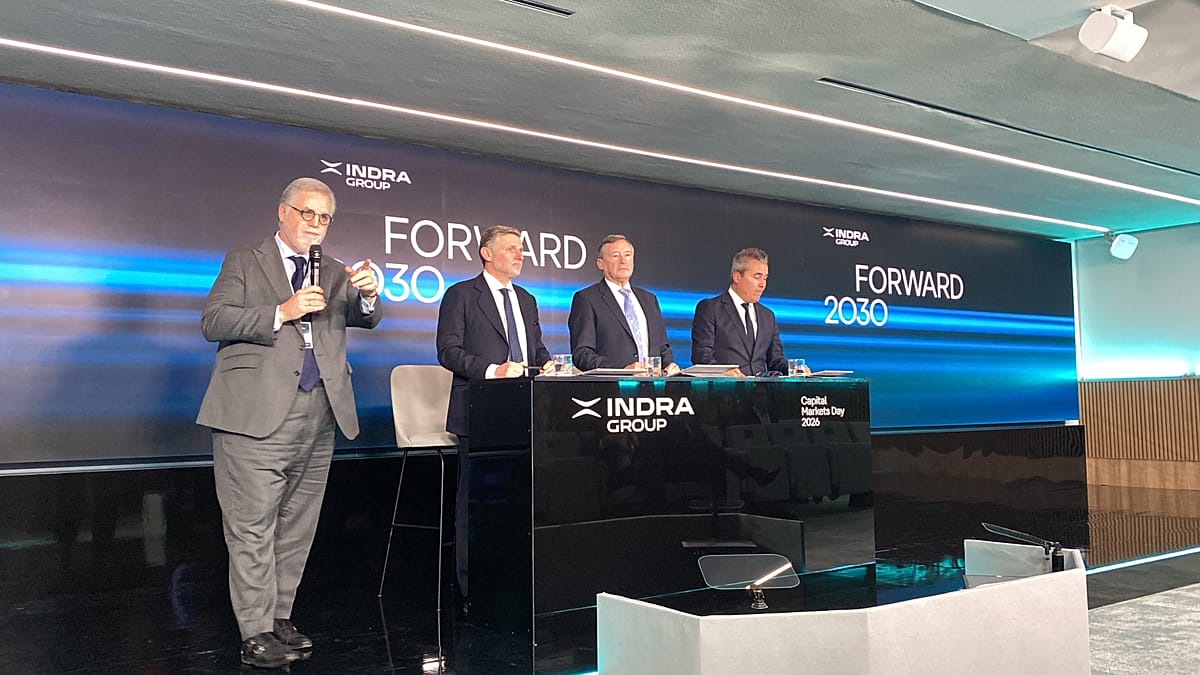
Indra wants to more than double its size in five years. The company on Wednesday presented its strategic plan Forward2030 at its Investor Day, with which it aims to exceed 12,000 million euros in revenue in 2030, compared with 5,457 million in 2025, and to achieve EBIT of more than 1,500 million. The stock market received the plan positively, and the share price rose as much as 7% in the first minutes of trading. ADVERTISEMENT ADVERTISEMENT The new strategic plan replaces Leading the Future, presented in 2024, which had set a target of 10,000 million euros in revenue for 2030 and an EBIT margin of 12%. The company is now looking ahead to 2035, when it expects to generate 20,000 million euros in revenue, half of it outside Spain. Before turning to the figures, Indra chairman Ángel Simón devoted much of his speech to the wider context. He recalled that there are currently 60 armed conflicts of medium and high intensity around the world and that in Spain a cyber incident is handled every four minutes. He referred to security alerts that have disrupted commercial flights in Europe and to cyberattacks that have hit supermarkets and schools. "Our everyday life depends on secure and reliable systems," he said. Simón argued that Defence "is a public good that benefits all citizens" and called for the Armed Forces and state security forces to have the best technological capabilities. He also warned that the boundary between civil and military technology is disappearing, and that artificial intelligence has opened up the market to companies that are born with it already embedded. According to the chairman, Forward2030 should help Indra stop being "a mere aggregator of businesses" and become "an integrated, synergistic company". He wants the firm to pull along the rest of Spain's defence industry, from SMEs to start-ups and universities, and to spread its production centres across different parts of the country. Europe, he added, has to overcome the fragmentation of its defence markets, and Indra aspires to be Spain's main representative there. Chief executive Josep Maria Recasens explained why a new strategic plan was needed. He gave two reasons. The boundaries between the civil and military sectors are blurring, and tech giants and newcomers that compete in different ways have entered the playing field. "It is a totally different sport, in which the recipe of the past no longer works," he summed up. The company has structured the strategic plan around what it calls the three Es: execute, evolve and expand. Recasens stressed that they do not follow one after the other, because a company like the one he wants to build has to manage "two clocks" at the same time, delivering today while preparing for the future. The most immediate lever is the order book, worth more than 22,000 million euros, of which around 70% should turn into revenue before 2030. Some 12,000 million relates to physical deliveries, mainly from Defence Special Modernisation Programmes (PEM), air-traffic control radars for the United States, equipment for London and the European IRIS² satellite programme. To achieve this, execution will depend on a single team under a new chief operating officer, while the business units retain the client relationship and their profit and loss accounts. Indra will keep control of system architecture, integration and delivery, and will rely on partners and around 2,500 suppliers for the rest. It will go from six plants in 2025 to 14 in 2027, will add 2,000 engineers to the industrial side and will quadruple its manufacturing footprint, with an investment of 400 million euros. The factories will be grouped into three corridors in Spain. The northern corridor will focus on land vehicles, the central one on drones, electronic warfare and simulators, and the southern one on radars and anti-drone systems. The model Recasens wants to replicate is Córdoba, where the company has multiplied its radar production capacity by seven in less than six months and cut costs by 30%. This year Indra will deliver 70 air-traffic control radars, the highest number in its history. IndraMind, the piece that holds the strategic plan together The second E, evolve, translates into money for products. Indra will invest 1,000 million euros of its own resources between 2026 and 2030, four times more than in the last five years, to launch more than 200 products. Seventy percent will have dual use, civil and military, and 90% will have artificial intelligence built in. Recasens pledged to cut to a third the time it takes its products to reach the market. At the centre is IndraMind, the artificial intelligence unit the company launched in October 2025. It has an order book of 400 million euros, 15 solutions developed, contracts signed for eight of them and more than 3,000 experts. Recasens described it as an open operating system, "more Android than iOS", to which solutions from the group and from third parties can connect. He gave an example. Today, coordinating the response to a threat across several systems in different domains takes about 45 minutes. With IndraMind, according to the chief executive, 23 seconds are enough. In Defence, Indra wants to consolidate its position as one of Europe's main prime contractors, with an order book of around 11,400 million euros. One of its bets is Land Next Gen, a modular, hybrid and electric land platform, crewed or uncrewed, in which it will invest nearly 20 million euros. It wants to have it ready in 2028 or 2029 for under 1 million euros per unit and to cut to three years a development cycle that in the sector usually runs to around ten. The space business has changed scale after the purchase of Hispasat and Hisdesat. With IRIS² and the SpainSat NG and PAZ II satellites, the company wants to become a European integrator of complete missions and to move from being a niche player to generating revenue of 1,000 million euros in 2030. Minsait, "the elephant in the room" Recasens devoted a separate section to Minsait, the information technologies subsidiary. "Let us be honest, it is a bit the elephant in the room," he admitted, referring to those who believe that artificial intelligence is going to sweep away technology services. "We believe in Minsait," he replied. The change, he explained, consists in betting "on value and not on volume". Minsait will also serve as a talent pool for the rest of the group. According to Recasens, Indra does not need to go out to the market to look for profiles for Defence, space or IndraMind, because it can train the people it already has. The plan keeps a stable workforce of around 56,000 employees and sets aside 240 million euros for retraining programmes. "This company is not going to destroy jobs," he said. To grow abroad, the group wants to copy the air-traffic business model, which already earns 88% of its revenue overseas, has delivered more than 450 radars and has another 185 under contract in the United States. Without counting on higher Defence spending Chief financial officer Miguel Forteza argued that the figures are prudent. Revenue will grow at an average annual rate of 17% and EBIT by around 24%. The forecasts also do not assume that Spain will raise its Defence spending above 2.1% of GDP, nor that new large European programmes will be launched. Forteza presented them as additional potential, outside the targets. The company expects to generate more than 3,100 million euros of free cash flow between 2026 and 2030, excluding advances from the PEM programmes, and it could take on debt of up to around 1.5 times if an acquisition appears that justifies it. Acquisitions will be selective and will focus on aerospace, Defence and IndraMind. "We are not going to make acquisitions simply to gain size," the chief financial officer concluded.
Indra presents Forward2030 plan to exceed €12bn in revenue and more than double size by 2030
Full Article
Original Source
Read the full article at Euronews →KhanList aggregates and links to publicly available news content. We do not host full articles from third-party sources. Always verify important information with original sources.