
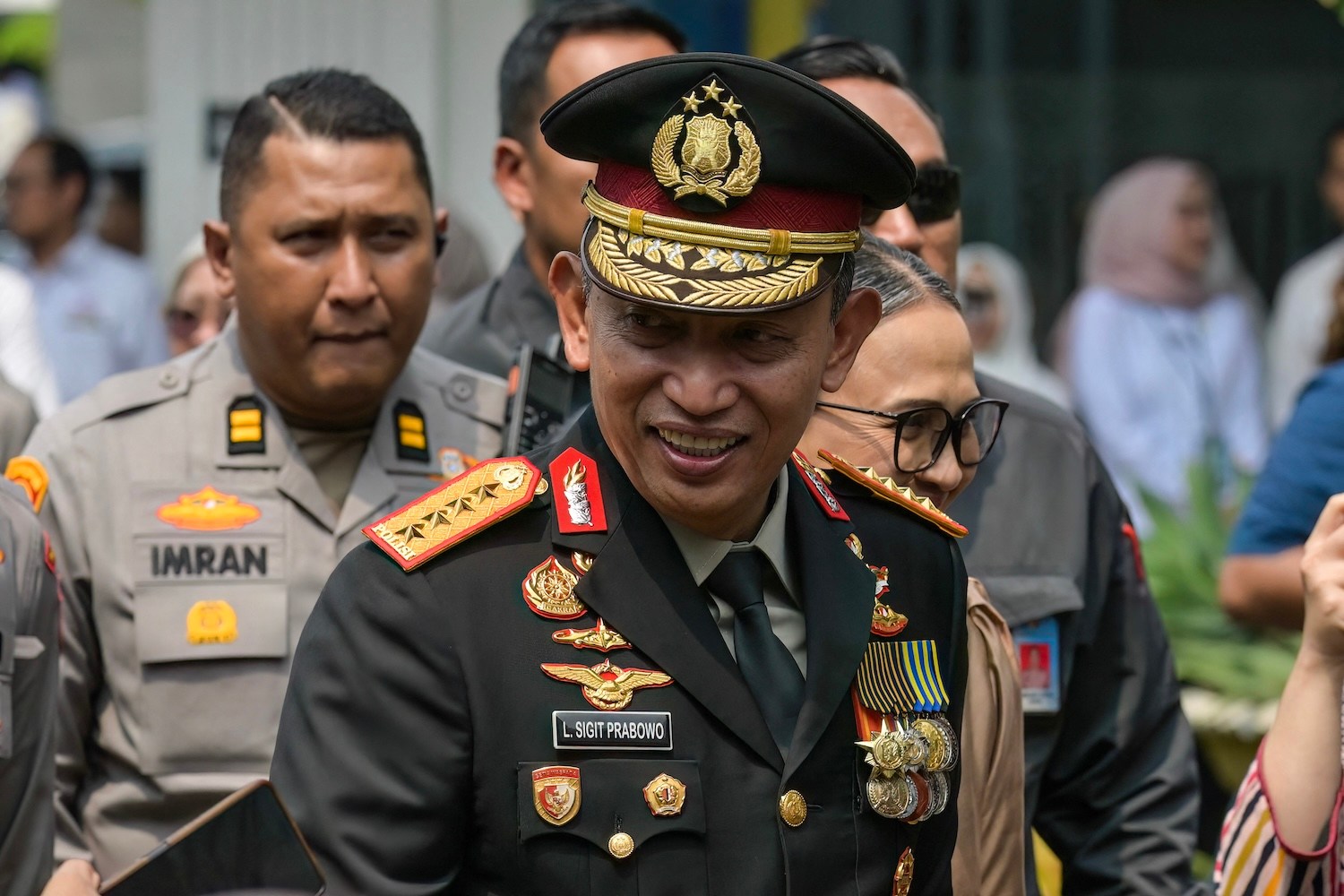
Welcome to Foreign Policy’s Southeast Asia Brief. The highlights this week: Indonesia’s former chief of police is arrested on suspicion of wiretapping the president, a Florida cruise ship abandons passengers in Cambodia, and we explore the Southeast Asian dimension of Jensen Huang’s affair with Alice Huang. Former police chief charged with spying on president Shortly after this newsletter was finalized, it was announced vice-president Gibran Rakabuming Raka had tendered his resignation. The dramatic development comes amidst a growing swell to impeach him, and a dramatic wiretap scandal covered below. Last Tuesday, Indonesia’s former chief of police and Presidential Chief of Staff Gen. Listyo Sigit Prabowo and two other police generals were arrested on suspicion of wiretapping President Prabowo Subianto. That same day, the government flooded Jakarta with more than 20,000 troops. The development is widely seen as heralding a showdown between the president and his rival-turned-ally, former President Joko Widodo, whose son Gibran Rakabuming Raka serves as vice president. Since the initial revelations, the story has grown more extraordinary. The presidential palace has accused the men, as well as a fourth police general, of treason, which can carry the death penalty. The government reportedly suspects them of helping foster protests, which have rocked the government over the past two years. Police alleged the president was one of some 6,000 people—including top politicians, businesspeople, journalists, and activists—illegally surveilled from 2025 until last month. Prabowo himself apparently suspected that he was being tapped for more than a year. The political implications are explosive. Listyo is widely seen as Widodo’s man and is part of the “Solo Gang,” a group of officials from Widodo’s hometown of Surakarta, where the former president began his political career as mayor. Listyo is alleged to have operated as something of a Mr. Fix-It for Widodo in delicate political situations, from intraparty disputes to the 2024 election. Police investigators have rather pointedly announced that neither Widodo nor his son were on the list of those wiretapped. The move against Listyo seems to herald a wider move against Widodo, whose political relationship with Prabowo has deteriorated steadily since the 2024 election. In parliament, there is now a growing push to impeach Gibran. The Supreme Court ruled in October that he had failed to properly prove he had graduated high school, which is a requirement to run for the vice presidency, opening the door for parliament to take action. Widodo himself is keeping schtum. When asked about the arrest of Listyo and the Supreme Court ruling against Gibran, he has limited his responses to platitudes about respecting the legal process. Gibran has also confined himself to broad statements about respecting legal processes and focusing on his job. Still, Widodo has also been maneuvering to shore up his position. He has effectively taken over the Indonesian Solidarity Party of which his other son, Kaesang Pangarep, is the general chair. Widodo’s enormous personal popularity gives him some potentially powerful cards to play. Another impact is that Indonesia is looking at tightening legal controls on wiretapping. This is not the country’s first wiretapping scandal. In 2022, Reuters revealed that Pegasus spyware, created by Israeli cyber-intelligence firm NSO Group, had been used in Indonesia since 2018 to target politicians and other prominent figures. Evidence later suggested the software was being used by Indonesia’s security services. Despite the scandal, little action was taken and regulations governing the use of wiretaps remain a mess. More generally this will only contribute to the sense that the wheels are coming off for Indonesia. The political elite are gearing up for a round of brutal infighting while Indonesia is facing its worst forest fires in a decade, there is growing pressure on government bonds as the energy shock rockets up the price of fuel subsidies, and the third finance minister in two years takes the helm amid protests from a fed up populace. What We’re Watching Abandon ship. More than 200 passengers were abandoned in Cambodia by a Florida cruise-liner company, Villa Vie Residences, last Wednesday. The ship then steamed toward Singapore with 50 crew aboard and it was later impounded. The ship, Villa Vie Odyssey, is one of a handful of ships worldwide that offers people the opportunity to reside on it long term. The price of permanent residence ranged from $120,000 to $440,000. Rentals started at $3,500 a month. However, in late October, the company abruptly suspended operations, saying increased fuel costs due to the Iran war had made operations unsustainable. Residents were reportedly given seven hours’ notice. Problems seem to have been long-running. Passengers recounted two occasions in recent months where the company asked them to pool money to buy fuel for the ship. And last year—even before the Iran war— Villa Vie Residences was sued for fraud by a plaintiff who had bought a cabin and alleged the company had misrepresented its financial stability. According to Cambodia’s Ministry of Tourism, there are now 98 passengers left in Cambodia. Others have already left the country. Growth falters further. Indonesia isn’t the only country where the political elites are playing games while the country struggles. On Tuesday, the Philippines reported a dismal GDP growth of 2.1 percent. This was below the predicted 3 percent as growth slowed for the fifth consecutive quarter. Inflation also surged to a three-year high of 7.8 percent due to increased fuel prices linked to the Iran war. Still, the Senate remains absorbed in the impeachment of vice president Sara Duterte. And politicians are pursuing their usual budget shenanigans, unabashed by the enormous scandal that such antics sparked last year. But why is growth so weak? The Philippines is extremely dependent on fuel imports, and 90 percent of those imports passed through the Strait of Hormuz prior to the Iran war. This means the war has hit hard, with food and fuel inflation eroding consumption. It has had a major impact on the country’s economy as private consumption accounts for roughly three-quarters of the Philippines’ economy. The other key factors are a 4.8 percent contraction of the agricultural sector and 4 percent contraction in construction. Bad weather hit the former hard, with nearly all senators urging El Niño to be declared a calamity. Meanwhile, the latter has struggled after a massive scandal last year involving the embezzlement of state funds slowed public investment. Fatal shooting stirs war memories. One civilian was killed and 23 were injured in an Indonesian Army operation in Aceh last Wednesday. Six army personnel were also injured in the incident. The spark was the raising of a crescent and star flag during a celebration of the prophet Muhammad’s birthday at Pulo Keunari village in the province of Aceh. The flag is associated with Aceh’s former separatist movement. Despite a 2005 peace agreement, the flag has remained a symbol of ongoing tensions between the province and the central government. In 2013, the provincial government tried to adopt it as Aceh’s official flag but the central government objected. Accounts of the sequence of events last Wednesday differ. An aide to Aceh’s governor told The Jakarta Post that soldiers had used a loudspeaker to demand the flag be taken down. A soldier then took down the flag, angering the crowd and sparking the clash. The aide added that the resident who died was killed via a gunshot wound to the chest. Representatives of the military claimed that their attempts to remove the flag were met with stone throwing. The soldiers and accompanying police responded with riot control equipment, including the firing of blank shots and rubber bullets. FP’s Most Read This Week The Experts Are Taking Their Revenge Again by David Milne Hegseth’s Leadership Has Damaged the Pentagon by Kori Schake Who Will Succeed Xi Jinping? by Deng Yuwen Regional round-up In Cambodia, nearly 24,000 foreigners have been deported after scam center raids over the past year; and 15,000 volunteer for military service this year, which is 5,000 more than needed. Politicians and royals in Malaysia row over a former prime minister’s house arrest. Rebels cautiously welcome U.S. peace plans for Myanmar; The Economist reported how rebels’ Starlink terminals are being unpredictably turned off; and Myanmar migrants reject the government’s new IDs. Philippines police find child abuse material on devices owned by Meghan Markle’s dad. China buys influence in Thailand media; opposition leaders allege they had their phones hacked ahead of a no confidence vote; a former Miss Thailand is accused of stealing millions from a charity; two Uyghurs face deportation to China; and a book about Thailand’s king is banned on national security grounds. Vietnam security services may have abducted an Australian and a Norwegian activist in Cambodia; and To Lam visits Japan. In Focus: Nvidia Scandal’s Southeast Asian Background The affair between Jensen Huang and an alleged Chinese spy, Alice Huang, is making headlines worldwide, with the scandal containing an almost filmic mix of geopolitical implications and salacity. One aspect that bears further scrutiny is the Southeast Asian aspect. Alice Huang was a senior executive, and self-described CEO, of Megaspeed, a company based in Singapore with offices in Malaysia and Indonesia. The company has been under scrutiny by the U.S. government since 2024 over its alleged sanctions-busting activity smuggling top-end Nvidia chips into China. Singapore also conducted its own investigation and detained Alice Huang in 2025. The scandal reflects that Singapore, and Southeast Asia more generally, has become a hub for China’s chip sanction-busting efforts on a massive scale. Some smuggle them into China. Other companies operate in a gray zone, building data centers with top-end Nvidia chips in Southeast Asia and then leasing their processing power to China. Culper Research, a short seller that flagged Jensen Huang’s relationship with Megaspeed and Alice Huang back in May, estimated that 20 percent of Nvidia’s compute revenues were driven by China “via illegal GPU diversion and Southeast Asian intermediaries.” (You can read more on this topic in FP’s China Brief.) The latest scandal comes against the background of numerous others. In 2025, the United States launched another investigation into whether DeepSeek had used Nvidia chips smuggled via Singapore. In May, Taiwan arrested three people suspected of planning to smuggle Nvidia chips into China via an unnamed Southeast Asian country. In late October, Malaysia estimated that a single syndicate was behind at least five cases where Malaysia authorities had seized smuggled chips that were cumulatively worth more than 100 million ringgit ($24.6 million). These murky happenings reflect that the region is deeply enmeshed with both China and the United States’ economies and has its own thriving tech ecosystem. Malaysia has become a thriving data center hub, welcoming investment from both superpowers. The country of 34.4 million people now has half as much artificial intelligence compute power as the entire European Union. But, for those in the region who have tried to not let geopolitics affect business, or at least turn tensions to their advantage, the walls may be closing in. Busts in Malaysia reflect ongoing U.S. pressure to crack down. And, on Friday, Bloomberg reported Nvidia was stepping up its tracking of chips in Southeast Asia to crack down on smuggling. Pressure is also coming from Taiwan. It recently canceled trade talks with Malaysia, which could threaten future investment in the latter’s thriving semiconductor space, due to anger over comments in which Malaysian Prime Minister Anwar Ibrahim appeared to accept China’s right to use force to assimilate Taiwan.
Indonesia’s Wiretap Scandal Heralds a Political Showdown
Full Article
Original Source
Read the full article at Foreignpolicy →KhanList aggregates and links to publicly available news content. We do not host full articles from third-party sources. Always verify important information with original sources.