
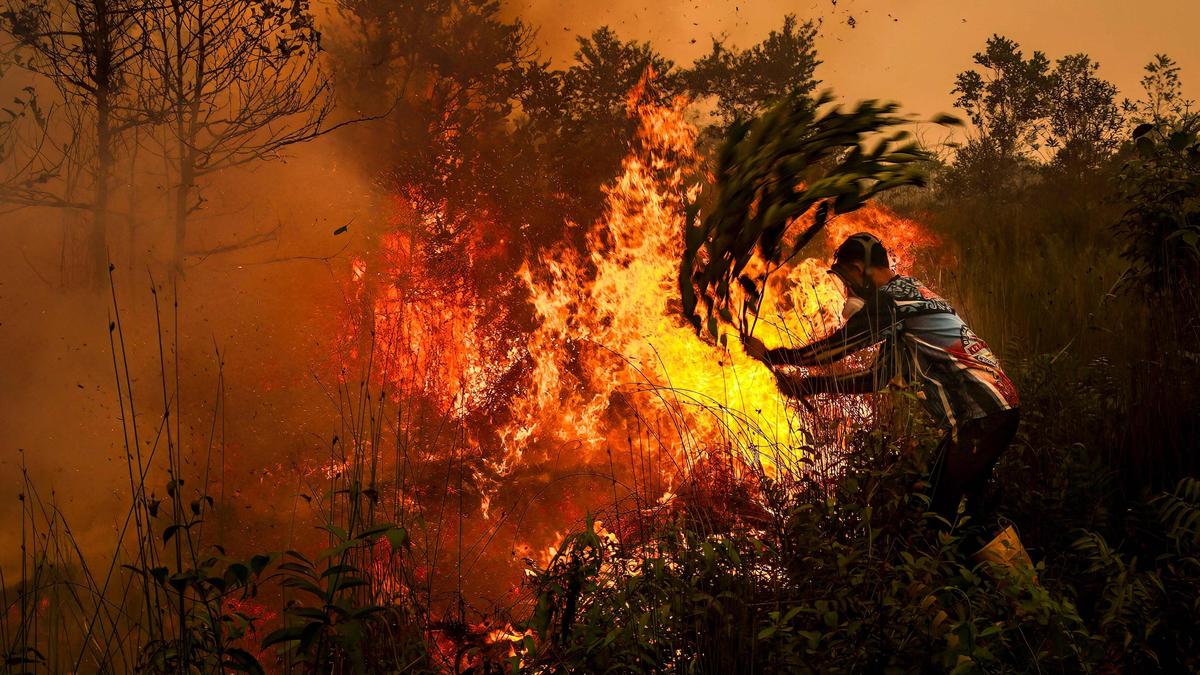
Fighting flames: A man uses a tree branch to fight a peatland fire in Central Kalimantan, Indonesia, on October 22, 2026. | Photo Credit: REINA Wildfires scorching Indonesia’s forests and peatlands have sent thick, toxic haze across parts of Southeast Asia, fuelling public anger over the government’s response. On October 28, thousands of Indonesians took to the streets, with protesters linking the worsening fire crisis to broader grievances over President Prabowo Subianto’s policies and handling of the country’s problems. “No Clean Air Under Dirty Government,” read one placard, while another warned: “If we burn, you burn with us.”More than 1.9 million hectares burned across Indonesia between January and September 2026, according to Nusantara Atlas FireWatch data. The annual hotspot count in 2026 has already surpassed the yearly totals recorded every year from 2019 to 2025, with two months of the year still remaining.The fires reflect a combination of land-clearing practices and unusually dry weather. Land is often deliberately burned to clear space for agriculture and plantations. The risks are particularly acute in peatlands, wetlands rich in partially decomposed organic matter that store large amounts of carbon. When peatlands are drained for plantations or other development, the peat dries out and becomes highly flammable. Once ignited, peat fires can smoulder underground for weeks, making them difficult to detect and extinguish while releasing large amounts of smoke.El Niño has compounded these risks this year. Meteorology, Climatology, and Geophysical Agency (BMKG) of Indonesia, in a release in September, said “the phenomenon of El Niño with very strong intensity and Indian Ocean Dipole (IOD) in the ocean around Indonesia has an impact on reducing rainfall.” It said that 61.91% of the area of the Indonesian mainland is currently experiencing a dry season.The scale of the fires is also striking when compared with previous El Niño years. By September 2026, the cumulative burned area had reached 38% higher than the 1.39 million hectares recorded by the same point in 2019 and more than double the 886,172 hectares recorded in 2023.The fires are spread across Indonesia’s vast archipelago, extending beyond traditional hotspots in Sumatra and Kalimantan. Papua Selatan recorded the highest number of hotspots in the October 28-29 period, which coincided with nationwide protests.Burned-area figures also show a sharp escalation between July and September in several provinces, with Papua Selatan, Kalimantan Barat and Nusa Tenggara Timur among the worst affected by September.The Centre for Research on Energy and Clean Air (CREA), an independent research organisation that studies air pollution and its health impacts, estimated that air pollution-related deaths rose 42%, from 3,740 in August to 5,310 in September in Indonesia. Of the September deaths, an estimated 3,560 were linked to smoke from forest and land fires, while 1,750 were attributed to non-fire sources, including urban and industrial pollution.The number of people exposed to unhealthy or hazardous air reached a monthly record of 58 million, up 40% from August. CREA also estimated that high PM2.5 exposure triggered 333,470 acute respiratory infection cases across seven fire-affected provinces, with children under five accounting for nearly a quarter.The effects of the fires extend beyond areas directly affected by the flames, worsening respiratory illnesses and air pollution in neighbouring Malaysia and Singapore. With private firms in Indonesia coming under heavy criticism for contributing to the fires with their ‘slash and burn’ activities to clear vast tracts of life, Singapore has initiated action under its Transboundary Haze Pollution Act. The foreign ministers of Indonesia and Singapore, after their meeting on October 27, said that the two countries will explore setting up a joint task force to deal with haze from Indonesia’s forest fires.Source: Nusantara Atlas FireWatch data and Centre for Research on Energy and Clean Air (CREA), an independent research organisation that produces data and analysis on air pollution and its health impacts Published - November 03, 2026 10:15 am IST
Indonesia’s wildfires scorch 1.9 million hectares
Full Article
Original Source
Read the full article at Thehindu →KhanList aggregates and links to publicly available news content. We do not host full articles from third-party sources. Always verify important information with original sources.