
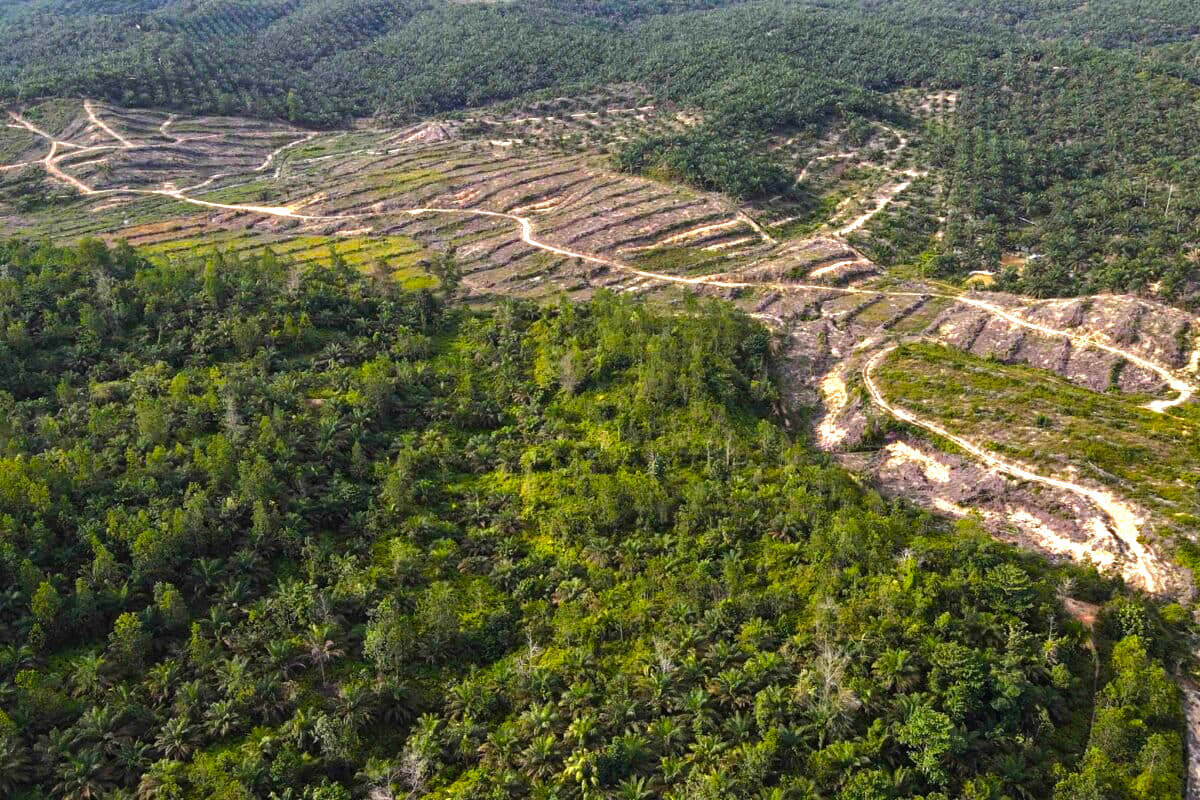
Indonesia’s domestic market consumed more than half of the country’s palm oil production in 2024, with a new analysis attributing two-thirds of Indonesia’s palm oil-related deforestation exposure to domestic consumption.While deforestation linked to palm oil has declined sharply, domestic supply chains face a transparency gap, with far less coverage by corporate no-deforestation commitments than export markets.The effectiveness of those corporate pledges remains contested, while rising palm oil prices and expanding biofuel mandates risk driving renewed pressure for plantation expansion.Environmental groups warn that plans for more palm oil and sugarcane production for biofuels could threaten forests, particularly in Papua, and say meeting future demand without further expansion will require better use of existing plantations and stronger support for smallholders. JAKARTA — Indonesia is the world’s biggest producer of palm oil, and the commodity is the most widely used vegetable oil across the globe. That makes all the issues associated with palm oil — from sustainability claims, to allegations of deforestation and labor abuses — the subject of close scrutiny for buyers worldwide, especially in markets with increasingly stringent environmental requirements. Yet this focus on global supply chains overlooks a major source of demand: Indonesia is the biggest consumer of its own palm oil, with more than half of total production going into the domestic market in 2024 — an all-time high driven partly by demand for biodiesel. And because the domestic market doesn’t impose strict sustainability requirements, much of the palm oil produced on deforested land is consumed within the country: For every 1,000 metric tons of crude palm oil consumed locally, 25 hectares (62 acres) of land was deforested, according to a new analysis calculating this “deforestation exposure.” It estimates that domestic consumption in 2024 was associated with 629,000 hectares (1.55 million acres) of deforested land, or two-thirds of all palm oil-related deforestation exposure; that’s nine times greater than the 71,400 hectares (176,400 acres) associated with exports to India, the largest foreign buyer of Indonesian palm oil. These figures from the analysis by Trase, a research initiative that maps commodity supply chains, reflect a 10-year historical attribution period; they don’t represent the area deforested in 2024 alone. “One of the most important issues is the sharp increase in domestic demand, while the domestic market remains highly exposed to deforestation,” Adelina Chandra, a data scientist at Trase, said during a discussion about the findings in Jakarta. “This high deforestation exposure is a major outstanding challenge.” Among Indonesia’s export markets, China had the highest deforestation exposure, at 20.3 hectares (50.2 acres) per 1,000 metric tons of CPO. Trase defines deforestation exposure as the extent to which supply chain actors, such as trading companies or importing countries, are connected to deforestation through the commodities they source. To calculate it, Trase overlays satellite-based deforestation data with commodity production maps to identify forest cleared for a particular crop or product. It then allocates that area among buyers according to the volume of commodities they source from the area. For example, if 50 hectares of forest are cleared for oil palm in a municipality and an exporter sources 80% of the municipality’s oil palm, the exporter is assigned 40 hectares of deforestation exposure. Because the data trace commodities to broader production regions rather than individual farms, exposure reflects environmental impacts associated with a buyer’s sourcing region. It does not, by itself, establish that the buyer directly caused the clearing. Deforestation for an oil palm plantation in Sumatra. Image by Rhett A. Butler/Mongabay. Domestic market faces transparency gap Adelina said the findings were concerning because Indonesia’s domestic market isn’t covered by “no deforestation, no peat, and no exploitation” policies, or NDPE, as extensively as some foreign markets, including the European Union. In the EU market, 88% of palm oil was covered by NDPE commitments, while 1% was covered by zero-deforestation commitments alone, according to Trase’s analysis. Corporate zero-deforestation commitments (ZDCs) covered almost 93% of observed Indonesian palm oil exports in 2024. Palm oil entering domestic supply chains, however, may not receive equivalent scrutiny, Adelina said. As Indonesia becomes its own largest consumer of palm oil, strengthening governance of the domestic market is crucial, she added. This would require better reporting by domestic buyers and publicly accessible information about their sourcing locations. “As domestic demand grows, our governance must also improve,” Adelina said. “For example, reporting mechanisms need to be improved, and data must be made accessible so that the implementation of NDPE commitments can be scrutinized.” Dedi, an official with the Ministry of Agriculture’s directorate responsible for oil palm plantations, agreed that better plantation governance was important to reducing deforestation risks and strengthening the acceptance of Indonesian palm oil in global markets. “Because palm oil is a national asset, we cannot talk only about production volumes, even though demand is enormous and palm oil can be used to make a wide range of products,” he said during the discussion in Jakarta. “We must also discuss land legality, sustainability, and the acceptance of Indonesian palm oil in global markets.” Data are critical to improving governance, Dedi said. The government already collects plantation information through platforms such as the plantation licensing information system, known by its Indonesian acronym, SIPERIBUN. Dedi said the government is also promoting more accurate mapping data, rather than relying solely on tabular records, to improve plantation monitoring and supply chain traceability. “We hope that our plantations can be properly recorded so that policies can be more accurate and supply chains can be traced more effectively,” he said. But whether existing systems can trace palm oil from individual plantations through mills, refineries, and domestic buyers remains an important question, particularly given the difficulties of tracking smallholder production. Cleared land at an industrial oil palm plantation at Tripa peat swamp in Aceh province. Image by Dita Alangkara/CIFOR via Flickr (CC BY-NC-ND 2.0). Are corporate pledges helping bring deforestation rates down? Despite the high deforestation exposure associated with domestic consumption, Trase said overall deforestation for palm oil remained at a historic low of 32,000 hectares (79,000 acres) in 2024. A global study, not yet peer-reviewed, also found a substantial decline in the conversion of old-growth rainforest to oil palm after 2015. The study, which examined oil palm expansion across 47 tropical countries, estimated that an average of 343,000 hectares (847,600 acres) of old-growth rainforest was converted to oil palm annually between 2001 and 2015. That fell to 80,000 hectares (197,700 acres) annually between 2016 and 2024. Oil palm conversion also accounted for a smaller share of tropical rainforest loss after 2015, falling from 12.2% before 2015 to 2.2% afterward. Remote-sensing scientist David Gaveau, founder of technology consultancy TheTreeMap and a co-author of the study, attributed the decline to several factors. One is the adoption of zero-deforestation commitments and NDPE policies by some of the world’s largest palm oil producers, traders, and buyers, often following pressure from consumers and environmental organizations. Under these voluntary commitments, companies set cutoff dates after which they will no longer accept into their supply chains any palm oil grown on newly deforested land. More recently, the EU Deforestation Regulation (EUDR) has required companies bringing palm oil into the EU market to demonstrate that their products aren’t linked to deforestation occurring after Dec. 31, 2020. However, the effectiveness of corporate commitments in reducing deforestation remains contested. A study published earlier this year examined zero-deforestation commitments in Indonesian oil palm concessions between 2018 and 2020. It found that concessions covered by corporate commitments experienced no additional reduction in deforestation compared to those without such commitments; both groups recorded very low levels of forest loss. But this doesn’t necessarily mean the commitments have had no broader impact, according to Robert Heilmayr, an associate professor of environmental and ecological economics at the University of California and a co-author of the study. During the discussion in Jakarta, Heilmayr said the commitments might have had a much greater effect than the study’s concession-level comparison captured. “Perhaps NDPE commitments are transforming the palm oil sector as a whole, rather than just the companies that have made their own ZDCs,” he said. Gaveau also pointed to the possibility of wider industry changes, noting that forest conversion continued to decline even as palm oil prices recovered sharply. Prices rose from approximately $600 per metric ton in 2015 to nearly $1,500 in recent years, he said. Earlier research by Gaveau and colleagues found an association between palm oil prices and plantation expansion and forest loss in Indonesia. A 1% annual increase in CPO prices was associated with a 1.08% increase in new industrial plantation expansion and a 0.68% increase in forest loss between 2001 and 2019. Gaveau said the continued decline in forest conversion despite rising prices suggests the relationship between commodity prices and deforestation may have changed. This could indicate that corporate commitments have helped alter industry practices, although other factors may also have contributed, he said. These include the declining availability of suitable land for new plantations, domestic forest-protection policies, and the growing need to replant ageing plantations rather than expand into new areas. “What is clear is that the palm oil sector today looks different from that of the 2000s,” Gaveau wrote in an article. “We know from the field that new plantations are now less likely to directly replace forest because major traders and buyers increasingly scrutinise deforestation in their supply chains and face strong reputational and commercial risks when sourcing from recently deforested land.” Tropical peatland clearance in Riau, Indonesia. Image by Rhett A. Butler/Mongabay. Biofuel boost feeds ongoing concerns Despite the overall decline in forest conversion, deforestation continues in parts of Indonesia that have traditionally been less prominent centers of agricultural expansion. Trase’s data show that deforestation for oil palm in the Papua region, in Indonesia’s far east, more than doubled in 2025 from the previous year, rising from 3,600 hectares to 7,300 hectares (8,900 to 18,000 acres). Indonesian Borneo, known as Kalimantan, accounted for 56% of Indonesia’s total palm oil-driven deforestation. The industry also continues to contribute to climate change through emissions from drained peatlands. Trase estimated that peat subsidence caused by oil palm plantations released 148 million metric tons of carbon dioxide equivalent in 2024. Together with peat fires, peat subsidence accounted for almost 85% of the greenhouse gas emissions assessed for the sector. “As shown by MapBiomas Indonesia’s mapping of burned areas, among all extractive concessions, oil palm concessions continue to record the highest number of fires,” Timer Manurung, executive director of Indonesian environmental NGO Auriga Nusantara, said in a press release. “The palm oil industry still needs to improve.” Demand for palm oil is also expected to grow, Trase’s Adelina said, pointing to the Indonesian government’s push to increase the mandatory palm-based biodiesel blend. In July 2026, the government began implementing a requirement for diesel fuel to contain 50% biodiesel, a blend known as B50. The policy is intended to strengthen energy security and could further increase domestic demand for palm oil. That demand is growing as Indonesia’s existing oil palm plantations approach what environmental NGO Madani Berkelanjutan and three partner organizations describe as the country’s environmentally supportable limit for the commodity. According to their assessment, Indonesia can support up to 18.15 million hectares (44.85 million acres) of oil palm plantations, an area the size of the U.S. state of Oklahoma. As of 2024, there were already 17.8 million hectares (44 million acres) already planted. (The upper limit is an assessment by the NGOs, not a binding government limit.) Madani warned that expanding biofuel production without addressing the industry’s land-use impacts could increase pressure on forests, peatlands, and biodiversity-rich ecosystems. “Bioenergy must not be allowed to expand without limits,” Riza Egi Arizona, community-based energy transition program lead at Madani, said in a press release. “There must be clear boundaries: no natural forests, peatlands, savannas or customary territories should be sacrificed to meet fuel-blending targets.” The government has also pledged to direct future food and biofuel production toward degraded land. At a recent international sustainability forum in Jakarta, presidential special envoy Mari Pangestu said degraded land in Indonesia covered more than 12 million hectares (30 million acres). But it remains unclear how the government intends to define degraded land or translate the commitment into binding rules. Madani welcomed the pledge, but said it would have little meaning unless incorporated into binding regulations and applied to the energy sector as well as food production. The organization has also raised concerns about government plans to establish approximately 2 million hectares (5 million acres) of new sugarcane plantations to support a separate target of blending 20% ethanol into gasoline, known as E20. It warned that the proposed expansion could threaten forests and customary territories, particularly in Papua. Madani executive director Nadia Hadad said in the press release that the plan “poses a direct threat to forests and customary territories,” and called on the government to “immediately clarify Indonesia’s biofuel policy direction. The ambition to develop biofuels must not come at the expense of ecosystems.” B50 and E20 use different feedstocks: palm oil for biodiesel and sugarcane for ethanol. The land-use implications of the two fuel targets therefore need to be considered separately, observers say. Rather than clearing new land, Madani said, producers could increase yields by optimizing existing plantations. According to the NGO, there are approximately 7 million hectares (17 million acres) of ageing oil palm plantations that could benefit from replanting. But replanting isn’t straightforward, particularly for smallholders, who produce 35% of Indonesia’s palm oil, according to Trase. They face barriers including insecure land tenure, difficulties accessing replanting support, and the loss of income while replacement trees mature. Whether Indonesia can meet growing domestic demand without further expanding plantations will depend in part on addressing those barriers, observers say — and ensuring domestic supply chains receive the same scrutiny increasingly demanded of its exports. Citations: Descals, A., Salim, M. A., Yaen, H., Gunawan, R., Salsabila, F., Sheil, D., … Gaveau, D. (2026). Global oil palm deforestation declines after zero-deforestation commitments [Preprint]. Research Square. doi:10.21203/rs.3.rs-10762359/v1 Stigler, M., Grabs, J., Heilmayr, R., Carlson, K. M., Chandra, A., Benedict, J. J., & Garrett, R. D. (2026). Zero-deforestation commitments in Indonesia’s palm oil sector achieve high compliance but no additionality. Proceedings of the National Academy of Sciences, 123(29). doi:10.1073/pnas.2511503123 Gaveau, D. L., Locatelli, B., Salim, M. A., Husnayaen, Manurung, T., Descals, A., … Sheil, D. (2022). Slowing deforestation in Indonesia follows declining oil palm expansion and lower oil prices. PLOS ONE, 17(3), e0266178. doi:10.1371/journal.pone.0266178 Banner image: Oil palm plantations in Tesso Nilo National Park, Riau province, Indonesia. Image by Suryadi/Mongabay Indonesia. FEEDBACK: Use this form to send a message to the author of this post. If you want to post a public comment, you can do that at the bottom of the page. Cite this articleHans Nicholas Jong (2026). Indonesia’s domestic palm oil market carries the biggest deforestation footprint. Mongabay Conservation news. DOI: https://doi.org/10.66709/news-335934 Credits Topics
Indonesia’s domestic palm oil market carries the biggest deforestation footprint
Full Article
Original Source
Read the full article at News →KhanList aggregates and links to publicly available news content. We do not host full articles from third-party sources. Always verify important information with original sources.