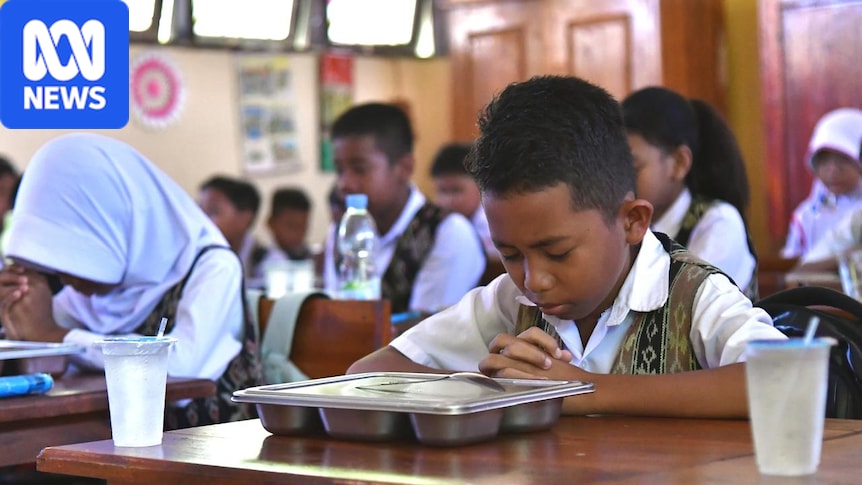
Read the story in Bahasa IndonesiaIndonesia's Constitutional Court has ruled the country's flagship Free Nutritious Meals program, designed to combat under-nutrition, cannot be funded through the national education budget.The free meals program, or MBG, was launched in 2025 with the aim of feeding 83 million school children and expectant mothers that year.On Thursday, Indonesia's chief judge Suhartoyo ruled that the budget for educational needs and the free meals program must be separated within two years. "Funding for the Free Nutritious Meals program, which is currently classified as a component of education spending, must be separated from operational education funding," the court said.The ruling came after students and educators filed petitions against this year's state budget law, arguing that counting the free meals program as an educational provision violated Indonesia's constitution.The court found while the provision did not breach the constitution this year, it must separate the funding allocations by no later than the 2028 state budget, but ideally earlier.Teachers worry ruling will not be implementedUnder the constitution at least 20 per cent of Indonesia's state budget must be allocated to education.In the 2026 budget, education spending accounted for 20.1 per cent of total expenditure.At the centre of the case was the government's decision to allocate almost one-third of Indonesia's Rp769.1 trillion ($61.5 billion) education budget to the free meals program.Sources of funding for the Free Nutritious Meals program. (ABC News: Jarrod Fankhauser; Indonesian Ministry of Finance)The petitioners argued that if MBG spending were excluded, education spending would fall to about 14 per cent — well below the legal requirement.They asked the court to ensure all of the education budget was directed to core learning functions like school facilities, teachers' salaries, classroom learning and scholarships.The Education and Teachers' Association was one of the groups behind the challenge.Iman Zanatul Haeri at the Constitutional Court. (ABC News: Ari Wu)Iman Zanatul Haeri, head of teacher advocacy at the association, welcomed the court's decision but described it as "a grey area ruling"."This kind of ruling is usually used by the government to keep a program going while making a few adjustments so it can continue operating while still complying with the constitution," Mr Haeri told ABC Indonesia."With this decision, the constitutional court must ensure that education funding is used for the welfare of educators, including university lecturers."But we also know that even in the best-case scenario there is no guarantee that the government will implement the ruling."Mr Haeri said it was possible the government already had a plan to preserve the MBG, which it considered a priority initiative."We will continue to speak out until the government realises that using education funding for MBG is a fundamental constitutional mistake," he said.Riga Felix was one of the petitioners for education funds to the Constitutional Court. (ABC News: Ari Wu)Rega Felix, another petitioner who attended the Constitutional Court hearing, described the ruling as a "victory" for educators because it means "the education budget can no longer be interfered with by the MBG program". He said some concerns remained."There are two key phrases in the ruling. Funding for MBG from the education budget is considered constitutional for 2026, but not for subsequent years," Mr Felix said."So I feel the Constitutional Court has still taken a middle path that remains somewhat grey. But in principle, our petition has been granted."Mr Felix also said the court's decision to allow up to two years for the ruling to be implemented could be open to differing interpretations."We would prefer to see the political will start now because, in principle, this is not education spending," he said.Some teachers paid less than $43 a month, association says The Indonesian government plans to appoint tens of thousands of MBG's core kitchen workers as government employees. (Supplied: Nur Zaid, Kompas.com)The test now will be whether the government fully implements the decision and redirects education funding towards schools, teachers and students.The Institute for Demographic and Affluence (IDEAS) has previously said that the amount of money currently allocated to MBG was enough to provide free basic education for all Indonesian children, scholarships for nearly 3 million low-income university students and salary increases for more than 2 million contract teachers.The Indonesian Teachers Association (PGRI), citing data from IDEAS, told parliament earlier this year that Indonesia still had at least 700,000 contract teachers.According to the organisation, 74 per cent of those contract teachers earned less than Rp2 million ($170) a month, while some received less than Rp500,000 ($43)."For example, in Dompu, West Nusa Tenggara, salaries are far below a decent standard, at just Rp139,000 ($11)," a PGRI representative told parliament.Petitioners vow to see change enforcedPresident Prabowo Subianto inspecting the distribution of free meals in Bogor, West Java, last year. (Supplied: Presidential Secretariat Press Bureau, Cahyo)Although the Constitutional Court has partially granted the challenge, Mr Haeri of the Education and Teachers' Association said he did not believe it would guarantee change and there was work to do."We will formally hand over the Constitutional Court's ruling to the state secretariat, the National Nutrition Agency, and the ministries and institutions involved in administering MBG," he told the ABC."We want to ensure that the executive branch truly implements the constitutional mandate, and hopefully that will lead to changes in the 2027 State Budget Law."Petitioners celebrated the Constitutional Court's ruling prohibiting the use of education funds for MBG. (ABC News: Ari Wu)Mr Haeri said the ruling represented an important test of the Constitutional Court's willingness to defend constitutional principles."We can see now whether these judges are truly guardians of the constitution or not, because a constitutional mandate is not a matter of whether it can or cannot be carried out, but a matter of obligation," he said."A constitutional mandate must be implemented, full stop."Prasetyo Hadi, Indonesia's minister of the state secretariat, said the government had received the court's ruling and would respect the decision."We will need to review it because budget matters are not decided by the government alone," he told reporters."The budget is drafted together with parliament, so please give us some time."A group of people demonstrated in front of the Constitutional Court demanding that the government comply with the decision. (ABC News: Ari Wu)MP Yahya Zaini, part of the ruling coalition, said the ruling should be acted on quickly, with policymakers finding a way for the MBG program to continue."The National Nutrition Agency must undertake major efficiency measures," Mr Zaini said."That includes refocusing spending, limiting the construction of new kitchens and improving the governance of the MBG program."Meals program faces ongoing scrutinyThe National Nutrition Agency (BGN), which oversees the MBG program, has been under the spotlight in recent months.In the lead up to the ruling there was a string of controversies involving the agency including allegations of corruption involving former BGN head Dadan Hindayana, the resignation of his successor Nanik S Deyang, and the closure of hundreds of MBG kitchens.The government also reduced the program's budget on two occasions and said more cuts were possible.Mr Haeri said those developments appeared less like a genuine internal review and more like an effort to adapt to the legal challenge."Whether this is predictive or something else, throughout the hearings we saw BGN continually trying to improve itself in line with the direction of the proceedings," he said."That is actually not good news, because they should have been conducting evaluations without needing to be challenged first, without us having to go to the Constitutional Court."The government is … revising things here and there, even though the root of the problem is that the design of BGN was flawed from the very beginning."
Indonesian court bans use of education funding for free school meals
Full Article
Original Source
Read the full article at Abc →KhanList aggregates and links to publicly available news content. We do not host full articles from third-party sources. Always verify important information with original sources.