
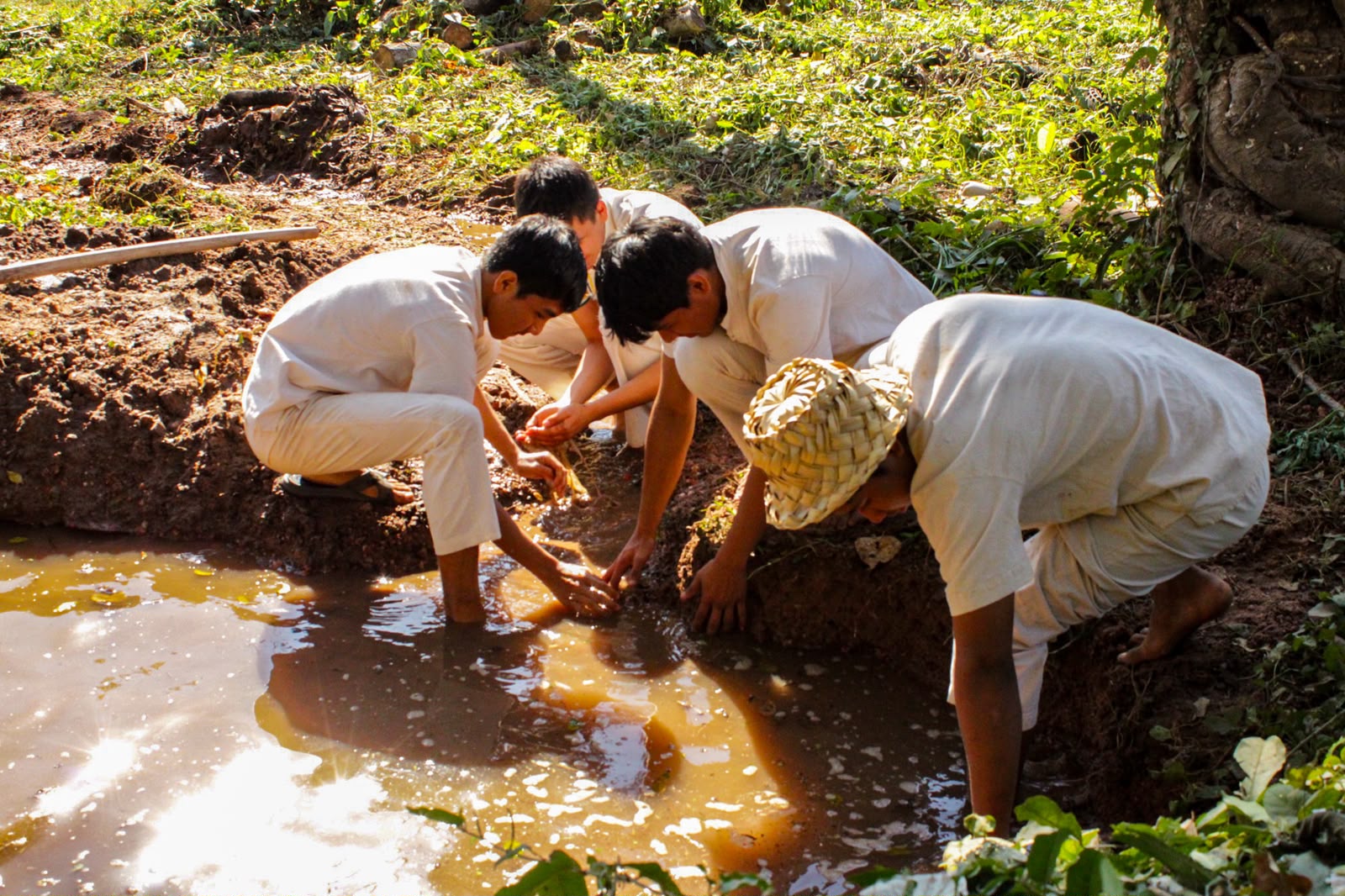
When a 2022 drought hit Bolivia’s Ascensión de Guarayos, restoring traditional paúros helped the community survive after the municipal reservoir ran dry.The youth-led effort to revive paúros has grown into a broader conservation project, including a legally protected urban ecological corridor.The initiative is part of a global trend to restore Indigenous water systems as low-cost, climate-resilient solutions to growing water scarcity.Experts say blending traditional and modern approaches can strengthen water security — but only if local communities lead and retain control. SANTA CRUZ DE LA SIERRA, Bolivia — When Rolando Ágreda was 16, a severe drought hit his community of Ascensión de Guarayos in the Bolivian Amazon in 2022. Rumors spread that the municipality’s only water reservoir was dwindling. But it was the communal spring-fed pool, or paúro, that Ágreda had been visiting since childhood that evaporated first. “Confusion was the strongest feeling,” Ágreda says in a video call. “But also sadness, because for everyone I know that place represents joy.” According to the Guarayú Indigenous People, who settled the area around Ágreda’s village of Ascensión de Guarayos in the 18th and 19th centuries, woodland spirits guard the paúros, and the community is responsible for maintaining them. But with urbanization, the arrival of non-indigenous Bolivians, and modern water infrastructure, this Indigenous knowledge had nearly disappeared. Ágreda says only three of his 28 classmates knew about paúros. “The others didn’t. It was easy not to know because [the paúros] had been neglected: The grass was so overgrown that they looked like abandoned lots. You would never imagine that there was a pool of water in the middle,” he says. A mural in Ascensión de Guarayos, where ranching is putting pressure on nature. Image by Douwe den Held. With help from his teachers, Ágreda launched a districtwide competition during the spring semester of 2022 to restore paúros across the municipality, which involved locating them, removing trash and clearing vegetation from the walls so water could filter through. By June 2022, they had restored eight. And in September, when rumor turned to reality and the municipal reservoir ran dry, it became clear that paúro restoration was more than a beautification project: It was a lifeline. “That first day without potable water in our homes was alarming. But instead of waiting for the municipality to solve it, people went to the paúros,” Ágreda remembers. “Something we did with that first project was clearly working, it was responding to a real need in the community.” Today, Ágreda runs MAPEKO, a collective dedicated to helping Ascensión de Guarayo adapt to climate change, in part by conserving the paúros. His initiative is part of a growing global trend to revive Indigenous water systems as a low-cost, sustainable way to address and mitigate the water crisis. The anomalies shown above indicate by how much the month was warmer or colder than the 30-year climate average from 1980 to 2010 in Ascensión de Guarayo. Red indicates months warmer than normal, and blue, colder ones. Source: Meteoblue.com In 2026, the world entered an era of “global water bankruptcy,” according to the United Nations. In Bolivia, that global crisis is felt through recurring droughts and floods, shrinking water sources, and unequal access to safe drinking water, especially in rural and Indigenous communities. The result is not just water stress but also damage to agriculture, public health and local economies. “[Water] is linked to all sectors: Agriculture, energy, industry, health,” explains Musaed Aklan, a senior researcher focused on water, the environment and climate change at the Sana’a Center for Strategic Studies. “It’s the blood of life. ” Ancestral systems, local design Indigenous water management draws on local knowledge, law and values. “It comes from the accumulated knowledge of generation after generation,” says Aklan, adding that, compared with modern infrastructure, Indigenous systems are typically smaller, more decentralized and rely on local materials. Though they are hyperlocalized, most systems fall into one of three categories: Rooftop rainwater harvesting, flood and overland flow harvesting and groundwater harvesting. Often, they store water when it’s scarce, but also divert it when there is too much. This makes them well suited to the climate crisis, which exacerbates extreme weather events. “Sometimes it is flash floods, other times drought, and sometimes [both] in the same area,” Aklan says. Rolando Ágreda photographs a pauro in Ascensión de Guarayo. Image courtesy of MAPEKO. The Guarayú paúros are a form of groundwater harvesting, but Indigenous nations across the Andes developed different systems, including raised fields (camellones), communal rainwater reservoirs (q’otañas), infiltration canals (amunas), and managed wetland systems (bofedales). “Everyone has their own system. But even if the ideas are different, the fundamentals are almost the same. They are global,” Aklan explains. They are also declining. Over decades, many Indigenous water systems have been abandoned or fallen into ruin. Climate change has drained some, while others have been lost to rural abandonment or deteriorated because of large modern infrastructure that depletes groundwater, disrupts local ecologies and disincentivizes caring for traditional systems. Often, a combination of these factors erodes Indigenous water knowledge. In Ascensión de Guarayos, the drought exposed the paúros’ neglect, but they had fallen into disrepair long before. “Little by little, people forgot how important it was to maintain them, to ask permission in those places and to take only what they needed,” Ágreda says. But that may be changing, and not only in Ascensión de Guarayos. “There was a long period of decline, and now we’re starting to revitalize,” Aklan says of Indigenous water management systems worldwide, adding that funding for their restoration is coming not only from communities but also from the World Bank, the UNDP and other international development programs. Beyond infrastructure: Stewardship rooted in community Indigenous water stewardship goes beyond technical management, centering a deep connection with nature and a set of cultural beliefs, rituals, and processes involving whole communities. “No two paúros are cleaned the same way and that’s because each has its own spirit,” Ágreda explains. “The community living near the paúro is the one that perceives and determines [who the spirit is].” Paúros provide a critical source of freshwater to communities increasingly facing drought. Image courtesy of MAPEKO. To restore and maintain the paúros, Ágreda says that he and his classmates first had to understand the spirit and ask it permission to proceed. They also had to learn about the nature surrounding the paúros, distinguishing, for instance, between plants that could be eliminated and those that were useful or even vital. This knowledge comes from community elders, who played a key role. “There is an intergenerational exchange. A son might know less than his father, but the father would guide his son, and the father in turn would be guided by the grandmother,” Ágreda says. According to Ágreda, projects revitalizing Indigenous water systems help sustain Indigenous knowledge, community, and engagement with nature. “These are community-based systems, community-based management, community-based solutions,” Aklan explains, adding that this local ownership often makes such systems more self-sufficient, durable, sustainable, and adaptable than high-tech centralized ones that depend entirely on outside expertise and can falter when that support disappears. “Even if there is a catastrophic flash flood or even if [the Indigenous systems] are destroyed, there is a way for locals themselves to construct them back.” A hybrid model for water management Yet, when strategically combined, Indigenous and modern models can maintain resilience, while also bringing benefits beyond water management. In Ascensión de Guarayos, paúro restoration has set a broader conservation project into motion, with support from outside partners. After successfully launching the paúro project while still in school, Ágreda started university in the regional capital of Santa Cruz de la Sierra in 2023. There, he met young professionals passionate about conservation and began recruiting them to help with the project back home. He secured international funding and brought on lawyers, environmental engineers, biologists and other specialists, who formed the MAPEKO collective. All under 30, they work with Indigenous elders to restore paúros, incorporating modern construction techniques to make them more durable. Together they also blend Indigenous and scientific knowledge to support conservation education, and collaborate on biodiversity and ecological studies. A child’s drawing of how pauros get abandoned, produced during a MAPEKO outreach with the community. Image courtesy of MAPEKO. These studies showed that a channel extending over two city blocks connects the paúros and is critical not only for water security, but also for local microclimate regulation in a region facing land degradation and record-breaking temperatures of up to 40° Celsius (104° Fahrenheit). These findings served as the foundation for an ecological corridor and new conservation laws. In 2024 and 2025, MAPEKO successfully campaigned for the passage of two municipal conservation laws, including the Yande I Yar Ecological Corridor Law, which establishes and legally protects an ecological corridor inside the Ascensión de Guarayos city limits, restricting land use and development. “This is certainly a very important legislative precedent,” says Rodrigo E. Herrera Sánchez, a lawyer and representative of the civil legal organization Justicia Ambiental. He says that while there are other laws generally restricting mining activity in some municipalities, “in this case we have a much more precise rule that defines a corridor, a specific area, and [a broader range of] restricted activities.” He also says that the law shows how municipalities can create meaningful environmental protections without waiting for the national government. Ágreda says protecting the paúros now requires combining ancestral knowledge with modern governance, science and technical tools. Policy and academic experts agree, with many suggesting that a blend of Indigenous and modern systems offers the best chance to address the water crisis, but only if local communities are treated as equal partners with control over water management. “New systems are good, and they are very advanced. But if they are not linked to the locals’ habits, if they are not linked to sustainability, they are problematic,” he says. Banner image: The community of Ascensión de Guarayos helps to restore paúros via ancestral knowledge. Image courtesy of Rolando Ágreda, MAPEKO. Citations: Aklan, M., de Fraiture, C., … Hayde, L. G. (2025). Why we should revitalize indigenous water harvesting systems: Lessons learned. International Soil and Water Conservation Research, 13(1), 152-163. doi:10.1016/j.iswcr.2024.05.004 Kasuri, L., Watkins, S., … M. Collins, A. (2026). A systematic review of Indigenous peoples’ participation in dominant systems of water governance. Nature Water, 4(2), 241-255. doi:10.1038/s44221-025-00580-y Kehinde, M. O., Bharadwaj, L. A., Bataebo, S., … Schuster-Wallace, C. J. (2025). Principles, barriers, and challenges of Indigenous water governance around the world. Environmental Science & Policy, 164, 103987. doi:10.1016/j.envsci.2025.103987 FEEDBACK: Use this form to send a message to the author of this post. If you want to post a public comment, you can do that at the bottom of the page. Cite this articleAnastasia Austin (2026). Indigenous water systems gain ground as climate pressures intensify in Bolivia. Mongabay Conservation news. DOI: https://doi.org/10.66709/news-327250 Credits Topics
Indigenous water systems gain ground as climate pressures intensify in Bolivia
Full Article
Original Source
Read the full article at News →KhanList aggregates and links to publicly available news content. We do not host full articles from third-party sources. Always verify important information with original sources.