
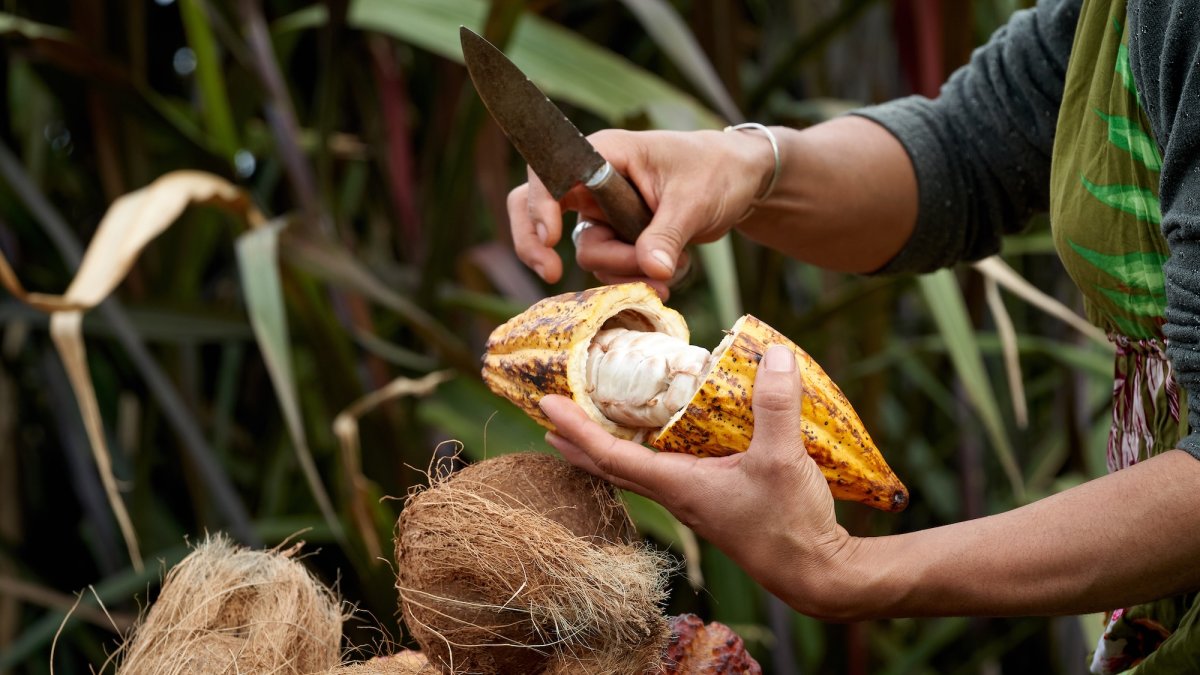
Cacao residue on pottery shards in Georgia date back to around 1000 CE. Credit: Raota Jose Luis via Getty Images Get the Popular Science daily newsletter💡 Breakthroughs, discoveries, and DIY tips sent six days a week. By signing up, you confirm you are 16+, will receive newsletters and promotional content and agree to our Terms of Use and acknowledge the data practices in our Privacy Policy. You may unsubscribe at any time. Various Indigenous peoples across the southwestern United States as well as Central and South America have harvested cacao plants for millennia. The same can’t be said for communities living on the other side of the continent, however. The absence of chocolate’s main ingredient on their menus isn’t due to culinary preferences, but a completely different climate in the southeast that remains largely inhospitable to the tropical plant. That said, new evidence indicates eastern Indigenous nations like the Muscogee and Cherokee were still familiar with cacao’s deliciousness. According to a study published today in the journal PLOS One, pottery shards excavated from the famous Etowah mounds in present-day Georgia contain trace residues of the plant. The discovery comes over a decade after researchers first examined the artifacts. Initial investigations began in 2014, when archaeologists at the University of South Carolina (USC) collaborated with the Muscogee Nation to collect 31 pottery shards from the Etowah mounds. Located near the city of Marietta, the 54-acre site contains remarkable remnants of the vibrant Indigenous communities that once flourished in the region over 1,000 years ago. Constructed in stages between roughly 1,000 and 1,550 CE amid the Mississippian cultural era, the Etowah mounds featured vast structures and houses built atop and around multiple raised earthen tiers. The Etowah mounds encompass 54-acres in Georgia. Credit: Archaeo-Geophysical Associates Researchers already knew Indigenous peoples living in the southwest U.S. were consuming cacao at roughly the same time, and wondered if ancient trade routes potentially brought the plant further east. “Our interest was in using the chemical composition of residues, determined through mass spectrometry, absorbed into the pottery to find evidence for the consumption of cacao at Etowah,” USC archaeologist and study co-author Adam King tells Popular Science. King’s team identified staple cacao alkaloids (naturally occurring organic compounds with at least one nitrogen atom) including theobromine, theophylline, and caffeine on the shards. However, their presence didn’t necessarily prove anything right away. Indigenous peoples in the southeast have long utilized a plant called yaupon holly (Ilex vomitoria) for a culturally important drink, which also contains the same alkaloids. “Since we could not distinguish between the two plants, we chose the conservative interpretation—that our results indicated that people at Etowah consumed yaupon holly drinks,” said King. Ten years passed before King could reexamine the evidence. In 2024, he got the chance to submit three of the shards for a separate study on ancient cacao DNA overseen by the French National Research Agency. The results revealed two of those samples unequivocally contained cacao residues. The latest findings better contextualize a pivotal moment in local Indigenous history. The earliest community members built Etowah mounds by first digging soil for the earthen platforms, then filling them with the remains of ritual feasts. King explains that both the construction project and its celebrations were intended to “bind members together as they remade the world” as symbolized by the mound itself. “This suggests that the cacao was somehow part of placing Etowah in the cosmos and tying its community members to it,” he says. But although King and his colleagues can now pinpoint cacao at Etowah, it’s still unclear how the plant arrived so far from its native climate. It’s possible that travelers may have intentionally brought the beans north from hundreds of miles away, or they arrived at Etowah via the era’s extensive continental trade routes. This doesn’t mean that cultures like the Muskogee or Cherokee were directly influenced or inspired by cacao-prominent civilizations like the Maya or Aztecs. Instead, it suggests a deep awareness of the much larger world. “What the presence of cacao tells us is that the Indigenous world of the Americas and Caribbean was a connected, international world where people from different regions shared ideas, things, and practices,” says King. “People were connected across wide areas, and knew what their neighbors and distant people were doing.” 2026 Popular Science Home of the Future Awards 39 products that will improve your everyday life.
Indigenous nations in present-day Georgia may have enjoyed cacao
Full Article
Original Source
Read the full article at Popsci →KhanList aggregates and links to publicly available news content. We do not host full articles from third-party sources. Always verify important information with original sources.