
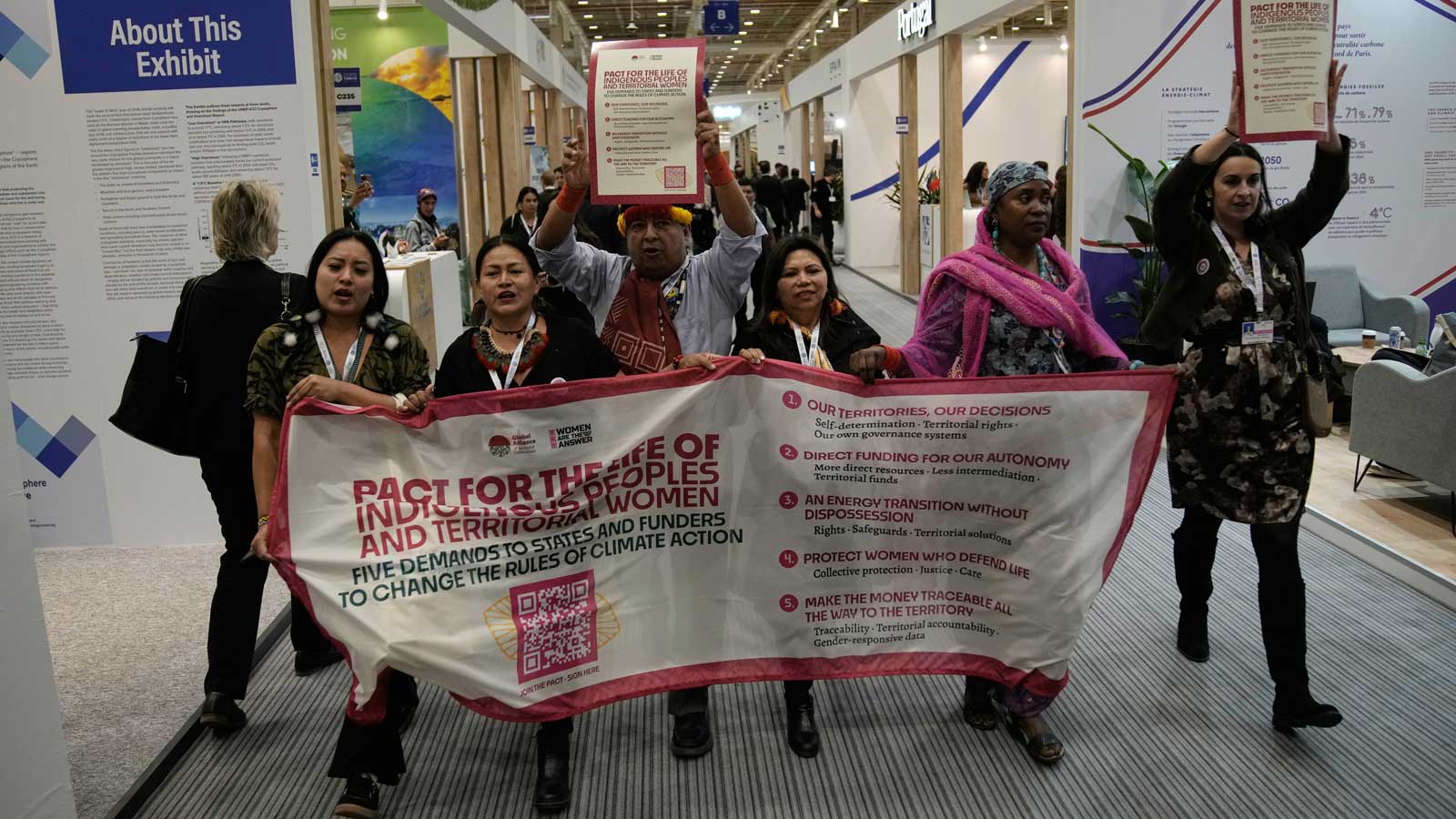
ANTALYA, TURKEY – As representatives of the world’s countries gathered in Antalya, Turkey, to discuss how to accelerate the transition to climate-friendly electric technologies, Indigenous people spoke out against mining on their territories for the raw materials that the tech requires. “Why can protecting our territories wait, but exploitation cannot? What is really urgent? What is really critical?” asked Djalma Ramalho, a member of the Aranã Caboclo community, a territory in the Jequitinhonha Valley of Brazil. Ramalho raised this question to the audience gathered at the Indigenous peoples’ pavilion for a panel on mineral extraction. The panel set the tone for Indigenous people’s demands during negotiations at the United Nations Framework Convention on Climate Change Conference of the Parties, also known as COP31. Nearly 200 countries attended the recent two-week annual conference to debate an international agreement to limit climate change. Negotiations focused on the goal of rapidly increasing the share of the world’s energy needs that are met with electricity, which can be produced with climate-friendly solar, wind, and nuclear power. The talks broke down over the weekend when major oil-producing nations blocked language about phasing out fossil fuels, which cause climate change. Growing demand for minerals The push for electrification is accelerating demand for raw materials like lithium, which is used in the batteries that power electric vehicles and provide back-up power for solar panels. Production of uranium, which fuels nuclear power plants, is also rising. That has big implications for Indigenous people: Fifty-four percent of mining projects for the minerals critical to an energy transition are located on or near Indigenous peoples’ land, according to a 2022 study. According to the World Nuclear Association, the largest-producing uranium mines are in Canada, Namibia, Kazakhstan, and Australia. Over a quarter (29%) of the uranium stemming from these mines is on recognized Indigenous land. As demand for these materials grows, Indigenous representatives are pushing countries to write their rights into the Just Transition Mechanism, a framework agreed upon in 2025 to coordinate international cooperation, technical assistance, capacity-building, and knowledge-sharing. Left out of the decision-making process Ramalho’s community in the Jequitinhonha Valley has seen firsthand the impacts of lithium extraction. Mines have contaminated waterways and exacerbated water scarcity in an already arid region. “Our relationship with the water needs to be respected,” Ramalho said in a video produced for COP31. “This is a relationship that goes far beyond the physical. We believe the Jequitinhonha River is a reclining ancestor. Where does my ancestor go when you pollute my river? Where does my ancestor go when you kill my river? When the river has rights, life has a future.” “They are literally destroying our territory,” Ramalho added. “Whatever the promises of clean energy development, my territory cannot be treated as a sacrifice zone for the world.” Sigma Lithium, which operates mines in the area, did not respond to a request for comment. Indigenous people don’t have a formal voice in COP31 negotiations – only countries do. Indigenous people’s input is dependent on sympathetic countries willing to use their speaking time and power to champion their demands. Ramalho was at COP31 as non-government personnel invited by Brazil. During the conference, he and other Indigenous people challenged negotiators to uphold their rights as they set mining targets. Djalma Ramalho (far right), a member of the Aranã Caboclo community, poses with COP31 attendees on November 13, 2026. (Image credit: Courtesy of Cultural Survival) “Climate change action cannot happen without respecting human rights,” said Alicia Moncada of the Wayuu people and director of advocacy and communications at Cultural Survival. “Calling a project green does not change the legal test. Indigenous rights are rights and deserve to be respected.” Bryan Bixcul, director of advocacy and partnerships for the SIRGE Coalition and member of Maya-Tz’utujil in Guatemala, called for a negotiated text acknowledging that mining carries risks for ecosystems and Indigenous peoples. “Self-determination,” Bixcul said, is a “right that gives Indigenous peoples a right to say ‘yes’ to development, to say ‘no’ to development, or to say ‘yes’ with conditions to development.” Bryan Bixcul (far right), director of advocacy and partnerships for the SIRGE Coalition and member of Maya-Tz’utujil in Guatemala, at a panel at COP31 on November 9, 2026. (Image credit: Lizeth Ortega Luna) Moncada does not dispute that the world needs to move away from fossil fuels. “The energy transition is necessary,” she said. “But at the same time, what we don’t want is to be the sacrificed lambs and the sacrificed sons for the transition. We don’t want to be the expendable beings in order [for] the Global North to have their amazing electric cars.” Republish our articles for free, online or in print, under a Creative Commons license.
Indigenous communities push back against mining for clean energy
Full Article
Original Source
Read the full article at Yaleclimateconnections →KhanList aggregates and links to publicly available news content. We do not host full articles from third-party sources. Always verify important information with original sources.