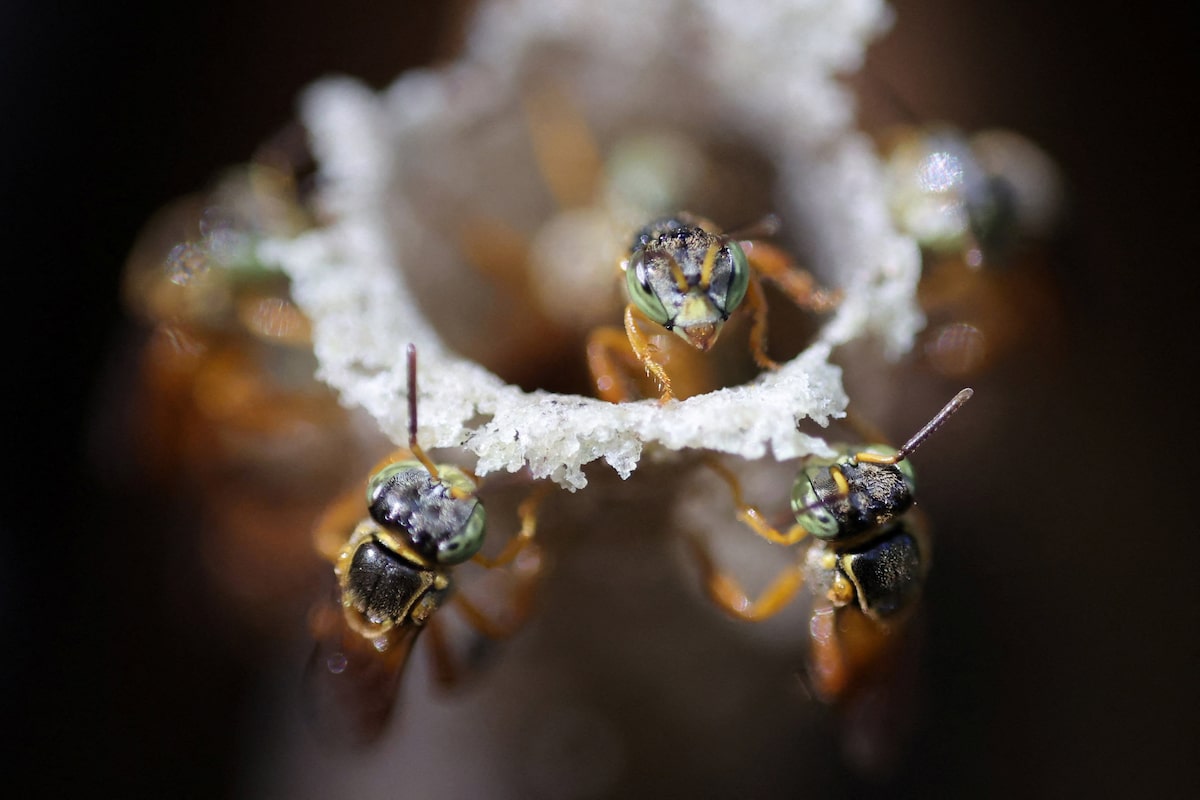
Marcio Karai straddles a tree trunk near his home on the outskirts of São Paulo, setting a small cube before him. The wooden box will serve as a new hive for a colony of native Mirim stingless bees, a species that he and his Indigenous Guarani community have long looked after.“Our elders are very concerned about the disappearance of these native species that they have always worked with, always had close at hand, and that are becoming increasingly scarce today,” Mr. Karai said.Open this photo in gallery:Marcio Karai raises bees in Ytu village, drawing on the knowledge of Guarani who have lived in this part of Brazil for generations.While the Mirim bees and other species Mr. Karai nurtures are not classed as endangered, he worries about how changing ecosystems might affect them and other native species in the future. In many places wild pollinators like bees are threatened with extinction, according to a major intergovernmental biodiversity assessment in 2016. Climate change, deforestation, and pesticides are the leading culprits.Animal pollinators are essential for the reproduction of 90 per cent of wild flowering plants around the world, while 75 per cent of human food crops depend at least in part on pollination. Mr. Karai grasps a tree trunk where bees once nested in a hollow, until they died. Mr. Karai has the remains of a dead bee nest in the meliponary near his house. The care of stingless bees, known as meliponiculture, differs from beekeeping in places like Europe and North America.Meliponiculture produces smaller quantities of often more highly prized honey. The bees are also much smaller than species like the Western honeybee, which use their stings to aggressively protect their hives.Scientists have identified some 300 species of stingless bees in Brazil, but it is possible others have died out due to the ecological damage caused by agricultural expansion, said Osmar Malaspina, the coordinator of a research group on ecotoxicology and bee conservation at the Universidade Estadual Paulista.In the Jaragua Indigenous Territory – in the Atlantic Forest, though increasingly being swallowed up by the São Paulo suburbs – Mr. Karai, 42, is transferring members of an existing bee colony to a new hive. The manoeuvre forms part of his daily tasks of looking after 13 different varieties of native bees, including species like Mirim bees and Jatai bees.His community, Mr. Karai said, sees itself as “the guardians of these species that are so important to our ecosystem, to our lives, and to future generations.”Open this photo in gallery:Mr. Karai smokes a sacred petyngua pipe after transferring a nest.The honey and wax produced by stingless bees play important roles in the community’s religious ceremonies. In the solemn dark of a Guarani ritual, a ring of beeswax candles – each representing a person – flicker together and blaze as one on the community’s ceremonial altar. The candles are made by Guarani women, Mr. Karai says, explaining that the spiritual world is strengthened through feminine spirituality.“It’s through song that the voice of the Guarani people reaches [our god] Nhanderu. Candles and the smoke from the burning wax carry that song up to Nhanderu’s heaven,” Mr. Karai said. It’s why Mr. Karai learned the art of caring for stingless bees from his father and grandfather, he said. For the Nhemongarai, a baptism ritual, each Guarani must offer a candle to the altar. They believe that each flame will reveal a person’s spiritual strength, or an illness to be treated by a shaman. The day before the ceremony, Mr. Karai and his mother, Irene Mendonca, had to melt the beeswax onto strips of fabric, to be cut into candles. Though he hopes his oldest son will follow in his footsteps, Mr. Karai is afraid future generations will lose interest in taking care of the stingless bees and choose higher-paying jobs instead.Of all the native bees he protects, Mr. Karai relates to the Jatai species the most. The species continues to thrive despite the many threats it faces because of a strong spiritual protection that goes hand-in-hand with the conservation work of the Guarani, Mr. Karai said.“Even though non-Indigenous peoples tried to eliminate us, we resisted,” he said. “We understand that the Jatai bees are also experiencing this same process of resistance.”Open this photo in gallery:The wild life: More from The Globe and MailThe Decibel podcastCanada is a major hub in the illegal wildlife trade, and law enforcement is ill-equipped to stop it. Jenn Thornhill Verma spoke with The Decibel about criminal groups that traffic polar bear pelts, narwhal horns and other contraband, and what they’re doing in this country and beyond. Subscribe for more episodes.Insect insightsHow to de-bug your outdoors this summer without harming yourself, your pets, or wildlifeStudy finds number of insect species on Earth is more than double previous estimatesSeirian Sumner: How I learned to stop worrying and love the wasp – and why you should, too
Indigenous beekeepers make it a mission to keep Brazil buzzing
Full Article
Original Source
Read the full article at Theglobeandmail →KhanList aggregates and links to publicly available news content. We do not host full articles from third-party sources. Always verify important information with original sources.