
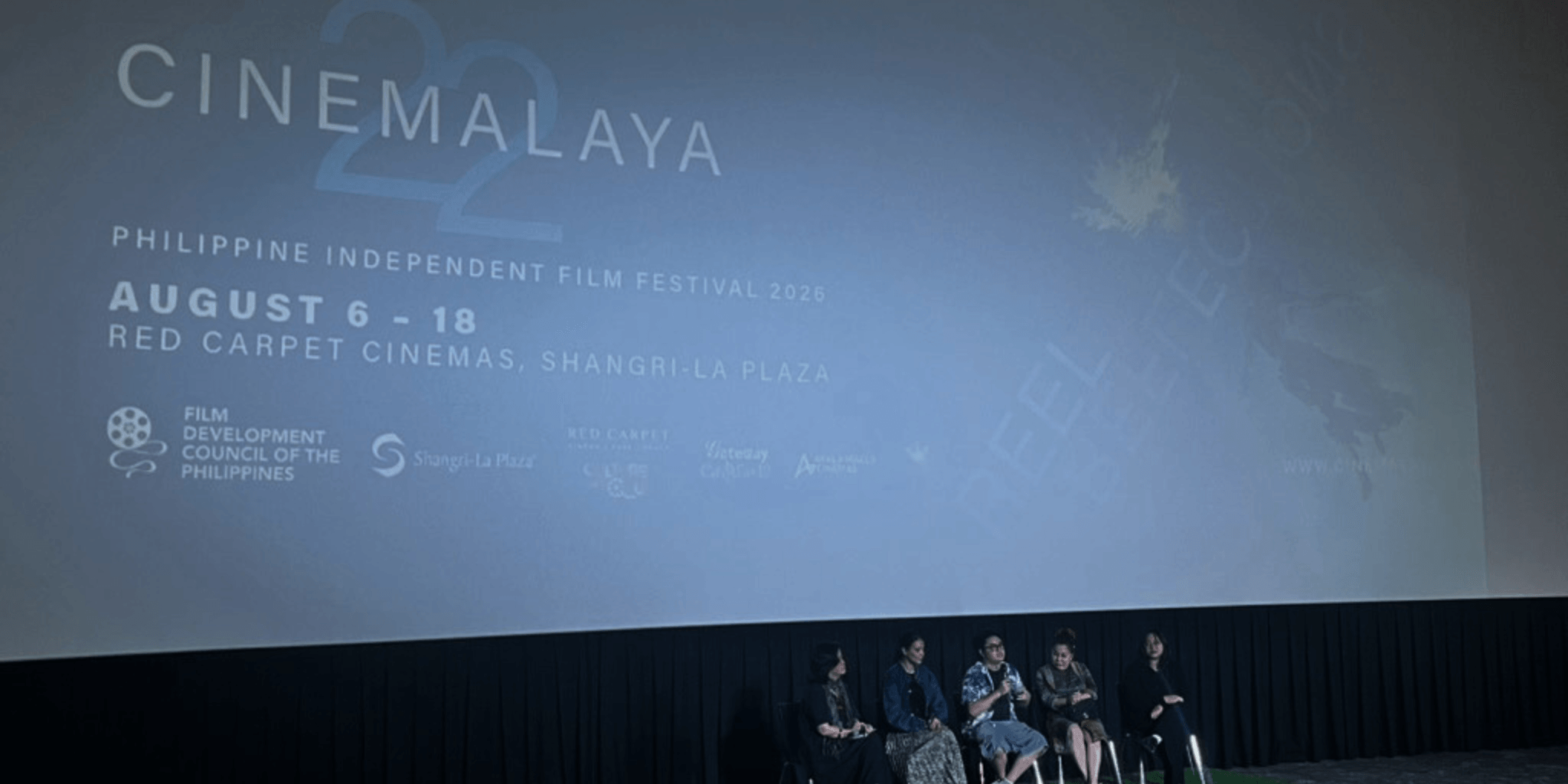
There has been a recent discussion about Cinemalaya being inaccessible. And honestly, I understand the criticism. For 22 years, Cinemalaya has largely been a Manila experience. And because the Cultural Center of the Philippines has been under construction, the festival has had to move around. There was the PICC—which, let’s be honest, was not exactly built with cinema screening in mind. We were literally sitting on regular chairs, trying to settle into a film while our bodies were already negotiating with the venue. Then there was Ayala Malls Manila Bay, which was actually decent. And now, for two consecutive years, Cinemalaya has found itself in Shangri-La. Which, of course, has prompted the inevitable: never beating the burgis allegations. And I get it. But I also think we need to have a bigger conversation about what we are asking from Cinemalaya, and what we are willing to give back. I have been trying to expose myself to local independent cinema for a very long time, actually maybe too long. My undergraduate thesis was already an attempt to understand the relationship between independent cinema and social issues. Since then, I have spent what feels like half my life trying to convince people that films are not merely films. Cinema can be a mirror, a document, an archive, a conversation starter. Sometimes a film can articulate something about our society that we haven’t quite found the words for ourselves. And Cinemalaya has always been one of the clearest manifestations of that belief for me. Since 2018, I have been going to Cinemalaya religiously. Every year, I return with the same excitement, not necessarily because I expect every film to be good (but mostly they are), but because I know I am entering a space where filmmakers are trying to say something. Sometimes the films are angry, quiet, messy, uncomfortable, funny, heartbreaking, frustrating, beautiful. Sometimes I leave the theater thinking, What the hell did I just watch? And sometimes I leave thinking about the film for days, even years. But what I love most about Cinemalaya has never really been the films alone. It is the community around the films. There is something profoundly moving about watching a film with a room full of strangers and realizing that, for the next two hours, you are all participating in the same emotional experience. The automatic applause when a film ends. The silence before the lights come back on. The people immediately turning to their friends to dissect what they just watched. The questions during talkbacks—sometimes thoughtful, sometimes rambling, sometimes bordering on a mini thesis defense because apparently someone has been waiting their entire life to ask that one question. The filmmakers listen. The audience responds. The conversations continue outside the theater. That, to me, is also cinema. Maybe even the most important part of it. But yes, Cinemalaya is inaccessible. We should say that plainly. For someone like me who now lives outside Metro Manila, going to Cinemalaya is not simply a matter of buying a ticket. There is transportation, food, time, sometimes even taking a day off work. And sometimes you have to convince yourself that a festival is worth the expense when that money could be spent on something much more practical (especially in this economy). And even within Metro Manila, accessibility is not equally distributed. The CCP has a particular cultural and historical significance, and there is something poetic about watching Filipino independent films in a space so closely associated with Philippine arts and culture. But the CCP is under construction. Cinemalaya has to exist somewhere. So now, Shangri-La. Yes, there is something ironic about an independent film festival being held in one of the more upscale shopping centers in Metro Manila. The jokes practically write themselves. But I think we need to pause before turning “Cinemalaya is in Shangri-La” into a straightforward indictment of Cinemalaya. Because we have to remember what Cinemalaya actually is. It is a platform for independent filmmakers, and platforms like this are not swimming in money. Cinemalaya itself is trying to survive. It has to make partnerships, find venues, negotiate costs, work within logistical limitations, and somehow continue providing a platform for filmmakers whose films are already struggling to find space in the commercial ecosystem. So if a partnership with Shangri-La gives Cinemalaya a viable venue, favorable terms, logistical support, or simply allows the festival to continue functioning, why shouldn’t they take it? We need to be careful about criticizing a cultural institution for making the kinds of compromises that allow it to remain alive. Because there is a strange contradiction in how we talk about independent cinema. We want independent filmmakers to survive. We want better venues, cheaper tickets, wider distribution, regional screenings, more equitable access, and more films to be made. But somewhere along the way, we forget that all of these things cost money. Cinemalaya does not exist outside the economic realities that independent cinema is already fighting against. The question of expansion is even more complicated. One of the most common responses to the accessibility problem is: “Why don’t they bring Cinemalaya to other parts of the country?” And again, I understand. I would love that. I would love to see Cinemalaya films screened in more cities, especially with cinematheques and cultural spaces already existing around the country. I would love for someone outside Metro Manila to experience the same communal viewing experience that I have grown to love. But there is another question we have to ask: If Cinemalaya expands, will we actually show up? Not theoretically. Not rhetorically. Not on Twitter. Actually. Because expansion is a risk. A festival cannot simply decide to screen in ten more cities and magically find an audience waiting for it. Regional expansion only works if there is an audience large enough and consistent enough to justify doing it again. And this is where I think we, as audiences, have to examine ourselves too. We cannot demand that Cinemalaya expand across the Philippines while simultaneously ignoring Filipino films when they are already shown near us. We cannot say “Bring independent cinema to the provinces!” while local screenings remain half-empty. We cannot ask festivals to take financial risks on regional audiences that we ourselves have not demonstrated are there. We need to support Philippine cinema before we ask Philippine cinema to become more accessible to us. And perhaps this is the uncomfortable part. Maybe accessibility is not simply a question of where Cinemalaya chooses to screen. Maybe accessibility is also a question of whether we have built an ecosystem capable of sustaining independent cinema outside Manila. Because the problem is bigger than Cinemalaya. Cinemalaya did not invent the centralization of Philippine culture. For decades, so much of our cultural infrastructure has been concentrated in Metro Manila that it is almost inevitable that festivals like Cinemalaya follow where the infrastructure already exists. There is a reason independent films struggle to reach audiences outside the capital. And there is a reason commercial cinemas are often reluctant to take chances on them. A cinema is a business. If a Filipino independent film gets one screen and an internationall blockbuster gets ten, it is not necessarily because the cinema hates Filipino filmmakers. It is because the blockbuster has already demonstrated its capacity to sell tickets. And that is precisely why independent cinema needs audiences who are willing to take the risk. The irony is that we often talk about independent films as if they are supposed to become accessible before we participate in making them sustainable. Maybe we have to build the audience before we can demand the infrastructure. Maybe we have to prove that people will come before we can ask exhibitors to take the risk. And that doesn’t mean accepting the status quo. It means understanding what it takes to change it. I don’t think Cinemalaya should be above criticism. In fact, quite the opposite. Cinemalaya is important enough that we should be able to have difficult conversations about it. We should ask how festivals like Cinemalaya can become more accessible without putting the entire burden on an organization that is already trying to keep independent filmmaking alive. We should push for regional partnerships, community screenings, university collaborations, local cultural organizations, alternative venues—whatever can help bring these films closer to more people. But I don’t think the answer is simply: “Cinemalaya should expand.” The more important question is: “What would it take for Cinemalaya to expand sustainably, and what are we willing to do to make that possible?” Those are two very different questions. I’ve spent years advocating for the idea that cinema can be an extension of social reality. But perhaps I have been thinking about that too narrowly. Because the politics of cinema do not only exist inside the film. They exist outside it, too. Who gets to make films, who gets funding and distribution, who gets a theater, who gets an audience, and perhaps most importantly, who is expected to carry the burden of making cinema accessible. We cannot put all of that on Cinemalaya. A festival is not an entire industry. Cinemalaya cannot single-handedly decentralize Philippine cinema, fix the country’s cultural infrastructure, or create audiences where there are none. And it certainly cannot be expected to sacrifice its own survival just to satisfy an ideal of accessibility that the rest of the ecosystem has not yet learned how to sustain. This doesn’t mean we stop demanding better. It means we demand better with an understanding of the system we’re demanding it from. I’ve always loved Cinemalaya because it makes watching films feel like a communal act. And perhaps that is why this conversation matters so much to me.Because I don’t want independent cinema to remain a Manila privilege. I want more people to experience it. I want to not travel 6 hours just to watch a quality local film. I want regional filmmakers to have the same opportunities to find audiences. I want our independent cinema ecosystem to grow beyond the capital. But wanting something and building the conditions for it are two different things. So perhaps before we ask Cinemalaya to go everywhere, we should ask ourselves: Are we supporting Filipino cinema where it already exists? Are we buying the ticket when a Filipino film comes to the cinema closest to us? Are we watching the local film that isn’t playing in the biggest theater? Are we telling our friends to watch it? Are we willing to take a chance on a film whose trailer doesn’t have millions of pesos behind it? Because accessibility is not just about bringing cinema closer to the audience. It is also about creating an audience that will meet cinema halfway. And maybe that’s where the real work begins. Every year I go to Cinemalaya, I am reminded that the most beautiful thing about independent cinema is not necessarily that every film is perfect. It is that somebody made the damn thing anyway. Somebody wrote a story they thought needed to be told, pointed a camera at a reality that might otherwise remain unseen, and risked money, time, exhaustion, rejection, and uncertainty because they believed that this particular story deserved to exist. And then, for a couple of hours, a room full of strangers watches it together. That is why I will continue to go. Not because Cinemalaya is perfect. Not because its venues are always perfect. Not because its accessibility problem isn’t real. But because I still believe in what it makes possible. And I think the challenge before us is not to tear down the platforms that are barely surviving. It is to build more. More platforms. More audiences. More venues. More regional partnerships. More Filipino films. Because if we want Philippine cinema to become more accessible, perhaps the most radical thing we can do is not simply ask: “Why isn’t Cinemalaya coming to us?” Maybe we should also ask: “What are we doing to make sure that when it does, we are there?” I want a future where we no longer have to choose between Manila and the rest of the country. Where Cinemalaya isn’t something you have to travel to, and independent cinema isn’t a special event that happens once a year in a particular part of the country. I want that future, too. But I think we have to build it together.
Indie ko na rin alam: Who’s gonna save independent cinema?
Full Article
Original Source
Read the full article at Youthforceph →KhanList aggregates and links to publicly available news content. We do not host full articles from third-party sources. Always verify important information with original sources.