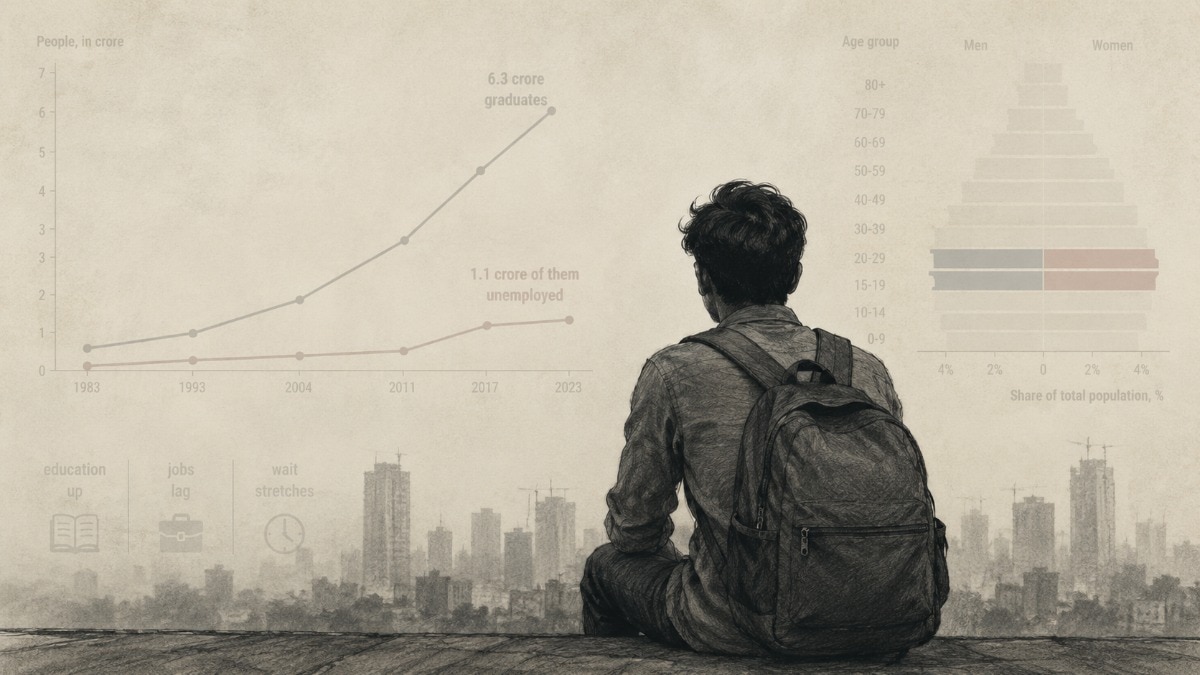
India has 13 times as many young graduates as it did in 1983. The share of them who cannot find work has barely moved in all that time.Two out of every three unemployed young Indians now hold a degree. In 1983, it was only one in eight.That inversion is the clearest measure of what four decades of expanding higher education have and have not done. India today has 6.3 crore graduates aged 20–29 years, up from 50 lakh in 1983, according to the 2026 State of Working India report from Azim Premji University. Over the same period, the number of them who are unemployed rose from seven lakh to 1.1 crore. Graduates multiplied 13 times. Graduates without work multiplied 16 times.Among the youngest graduates, the failure rate itself has hardly shifted.Unemployment among graduates under 25 was 35 per cent in 1983 and 39.3 per cent in 2023, according to the report. That is four decades in which the figure moved barely four percentage points. What multiplied was the number of people standing inside it. India did not get worse at employing its youngest graduates. It got much better at producing them, and never solved the second half of the problem. For slightly older graduates, the picture did deteriorate. Among those aged 25–29, unemployment nearly doubled from 12.2 per cent in 1983 to 20 per cent in 2023. The years a graduate spends waiting now stretch further into their late twenties than they once did. The scale of the supply side is not in dispute, and it is a genuine achievement. Graduates were four per cent of Indians aged 20–29 in 1983. They are 28 per cent now. Tertiary enrolment, the report notes, is about where you would expect for a country at India's income level, and the gains among women have been sharper than among men.What has not kept pace is the kind of work available at the end of it. Between 2004 and 2023, India added about 50 lakh graduates a year. About 28 lakh of them found work of any kind. Only about 17 lakh found salaried jobs.Tracked over a year from the point they report themselves unemployed, half of young graduate men find work of some sort, according to the report's panel data. Only about seven per cent find permanent salaried employment, and 3.7 per cent find white-collar work.Where a graduate lives changes the odds sharply.Among graduate men under 30, unemployment runs from 8.8 per cent in Delhi to 40.3 per cent in Odisha. Among graduate women, it reaches 73.5 per cent in Jammu and Kashmir, 52.3 per cent in Telangana, and 51.6 per cent in Andhra Pradesh. The national figures are 25.1 per cent for men and 36.6 per cent for women. Women fare worse in most states, but not all. In Maharashtra, Karnataka, and West Bengal, the graduate unemployment rate is lower for women than for men.The freshest official numbers are more recent than the report, and they point the same way. Our own extraction from the government's Periodic Labour Force Survey annual series, which now runs to calendar 2025, puts graduate unemployment across all ages at 11.2 per cent (nine per cent for men and 17.4 per cent for women). That is a much wider population than the youth figures, since it includes graduates in their forties and fifties who are mostly settled in work. Even on that generous basis, the rate for graduate women is close to double the rate for graduate men.A degree is still worth having, and the report is unambiguous about it. Graduate salaried earnings exceed those of non-graduates both on entry into the labour market and across the working life, and graduate salaries start at roughly twice those of non-graduates. The premium is narrowing, and graduate earnings have stagnated since about 2017, but it has not disappeared. The degree still pays. What has grown is the wait before it starts paying, and the first job at the end of that wait is worse than it used to be.The wait is expensive for the families funding it. Some 37.8 per cent of secondary-school students were enrolled in private coaching in 2025, according to the National Sample Survey's education module. Among higher-secondary students, the figure is 37 per cent, against 22.9 per cent at the primary level.The money follows the same curve. Families with a child in higher secondary spent about Rs 6,380 per student on coaching in 2025, on top of Rs 20,130 on schooling itself, which puts coaching at close to a quarter of what they spend on educating that child. At the primary level, it is about a tenth.The arithmetic from here is unforgiving. Every year for two decades, India has produced roughly 33 lakh graduates for whom it had no salaried work. The demographic dividend the government wants converted into a development dividend is, on these numbers, also a delivery deadline.Prime Minister Narendra Modi told the 11th Governing Council meeting of NITI Aayog on June 11 that India's young people are the country's "greatest asset" and must be "transformed from a demographic dividend into a development dividend". He urged states to focus on "education, skilling and capacity-building initiatives to prepare young people for future opportunities and challenges".The education half of that has largely been delivered. India has the graduates. What it has not built is the thing on the other side of the classroom door, and for four decades running, close to two in five graduates under 25 have been waiting on the wrong side of it.Data Note: "Graduate" means graduate and above. Unemployment is measured in usual status, principal plus subsidiary, and is a share of the labour force, not of all graduates. A graduate still studying is not counted as unemployed. The coaching share of education spending is coaching expenditure divided by coaching plus school expenditure; the survey reports the two separately.- EndsPublished By: Pathikrit SanyalPublished On: Jul 27, 2026 17:55 IST
India's youth unemployment paradox: Two in three jobless young people are graduates
Full Article
Original Source
Read the full article at Indiatoday →KhanList aggregates and links to publicly available news content. We do not host full articles from third-party sources. Always verify important information with original sources.