
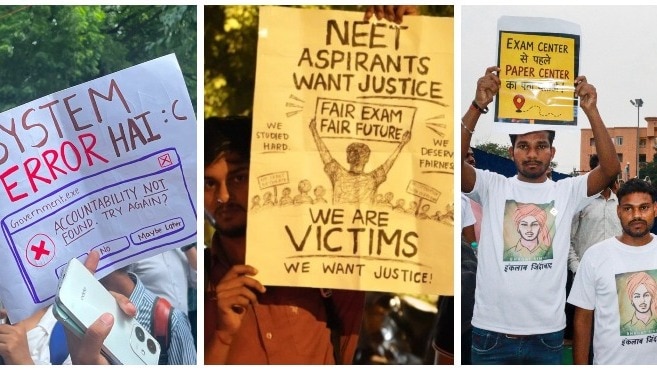
A Mood of the Nation survey found 67 percent of respondents had little or no confidence in exam fairness after a year of cancellations, re-tests and evaluation disputes. The finding highlights a wider credibility crisis across entrance, recruitment and board examination systems.67% have little or no confidence in exam fairness: MOTNFor millions of Indians, examinations are supposed to offer something very basic. A level playing field. Study hard, sit the test, get your marks and move on. But the latest Mood of the Nation (MOTN) survey suggests that this basic promise is losing credibility.As many as 67% of respondents said they have little or no confidence in the fairness of India’s entrance and government recruitment examinations. While 27% said they had “not much” confidence, another 40% said they had “no” confidence. Only 23% expressed confidence — 14% said they had “a great deal” and 9% a “fair amount”. Another 10% said they did not know or could not say.The Mood of the Nation is a bi-annual survey that's been commissioned by the India Today Group for around two decades now. The August 2026 edition was conducted by CVoter with a sample of 25,184 people directly surveyed between July 1 and August 25. Another set of 91,795 interviews conducted over the last six months as part of CVoter's regular tracking were also used to formulate the findings of the August 2026 MOTN.Check the numbers here: The numbers are significant because they come after a year in which some of India’s biggest examinations have been hit by cancellations, re-tests, technical glitches, alleged paper leaks and questions over evaluation. The result is a trust deficit that goes beyond one examination or one examination agency.A YEAR OF CANCELLED PAPERS, RE-TESTS AND TECHNICAL FAILURESAt least one major national entrance examination, NEET-UG 2026, was cancelled and re-conducted this year, while individual papers and centres in UGC-NET, AIAPGET and other examinations have faced cancellations or re-tests. On the recruitment side, major examinations and recruitment processes, including JSSC CGL, JPSC Civil Services, Civil Judge, Forest and Assistant Professor recruitments in Jharkhand were cancelled amid allegations of irregularities. Maharashtra’s Drug Inspector examination was also scrapped following a paper-leak controversy.Jharkhand alone listed 44 cancelled recruitment examinations, although some of the cancellations have subsequently been challenged in court.The sheer number of examinations, however, tells only part of the story. The bigger question is how many people are caught up when an examination goes wrong.NEET, CUET AND CBSE: WHEN EXAMS AFFECT LAKHS OF STUDENTSNEET-UG alone affected 22.05 lakh candidates who had appeared for the cancelled examination. CUET-UG had around 15.69 lakh registered candidates, with technical problems forcing affected candidates to be rescheduled.And then there is the CBSE Class 12 examination. More than 17 lakh students appeared for the CBSE Class 12 board examinations this year. The introduction of On-Screen Marking was followed by complaints over evaluation and marks, with more than 1.6 lakh candidates seeking verification or re-evaluation covering over 3.8 lakh answer books.Taken together, the major cancellations, re-tests, technical disruptions and evaluation controversies of 2026 have potentially affected tens of lakhs of candidate-examination attempts. The figure cannot be treated as a count of unique individuals because the same student may appear for several examinations, but the scale is unmistakable.CBSE CONTROVERSY ADDS ANOTHER LAYER TO TRUST DEFICITThe CBSE episode is particularly relevant because it shows that public confidence in examinations can be damaged even when there is no paper leak and no cancellation of the entire examination.The concern here was whether the new digital evaluation process could reliably assess the work of more than 17 lakh students. Students raised questions about their marks and sought verification and re-evaluation. CBSE subsequently examined complaints and provided mechanisms for verification, re-evaluation and access to answer scripts.The controversy also reached the Supreme Court, which sought safeguards for students who may have been affected by problems with the On-Screen Marking system. That distinction matters. An examination system does not necessarily lose credibility only when a question paper leaks. A technical failure, an unexpected score, an error in evaluation or a delayed correction can have a similar impact on a student who has spent years preparing for a decisive examination.The controversy therefore adds another dimension to the MOTN finding. The question is no longer simply whether an exam was conducted. It is whether students believe that the entire process, from question paper to evaluation and redressal, is fair.PROBES, COMMITTEES AND RE-TESTS: THE GOVERNMENT'S RESPONSEThe government has responded to the examination crisis with probes, committees, tighter security and re-tests. After the NEET-UG controversy, the Centre handed the matter to the CBI on May 12. By July, the agency had charge sheeted 13 people in connection with the alleged paper leak.Ahead of the NEET re-examination, authorities also stepped up security and monitoring, including biometric authentication, surveillance and tighter scrutiny at examination centres.For UGC-NET, a committee examining three disputed papers — English, Commerce and Sociology — found factual, typographical and translation errors and recommended fresh examinations. The papers were subsequently scheduled for re-test.At the national level, however, this is not India’s first attempt at examination reform. The K Radhakrishnan committee, constituted in 2024 following the examination controversies of that year, made 101 recommendations covering examination security, technology, NTA’s functioning, question-paper handling and candidate authentication.A separate high-powered steering committee was subsequently created to monitor their implementation. Measures such as biometric authentication, AI-enabled CCTV surveillance, stronger centre-level monitoring and tighter security protocols have since been introduced.In July, the Centre announced a new high-powered examination reforms task force headed by Nandan Nilekani. It is expected to examine the examination system and recommend further reforms. But as of August 2026, the task force has not yet submitted its final recommendations.The government has also moved on the legal front, proposing amendments to strengthen the law dealing with unfair means in public examinations, including tougher penalties and faster legal proceedings.THE REFORMS ARE THERE BUT ARE THEY REALLY DOING ANYTHING?The MOTN numbers are stark. That is not simply a verdict on the National Testing Agency, JPSC, JSSC or any other individual body. It is a warning about the credibility of examinations as a route to education, employment and social mobility.India has demonstrated that it can cancel an examination, conduct a re-test, order a probe, arrest suspects and set up another committee. The harder test is different. Can it build an examination system in which students do not need any of those remedies in the first place?- EndsPublished By: Deebashree MohantyPublished On: Aug 27, 2026 19:07 IST
India's youth is losing faith in a fair exam system: MOTN
Full Article
Original Source
Read the full article at Indiatoday →KhanList aggregates and links to publicly available news content. We do not host full articles from third-party sources. Always verify important information with original sources.