
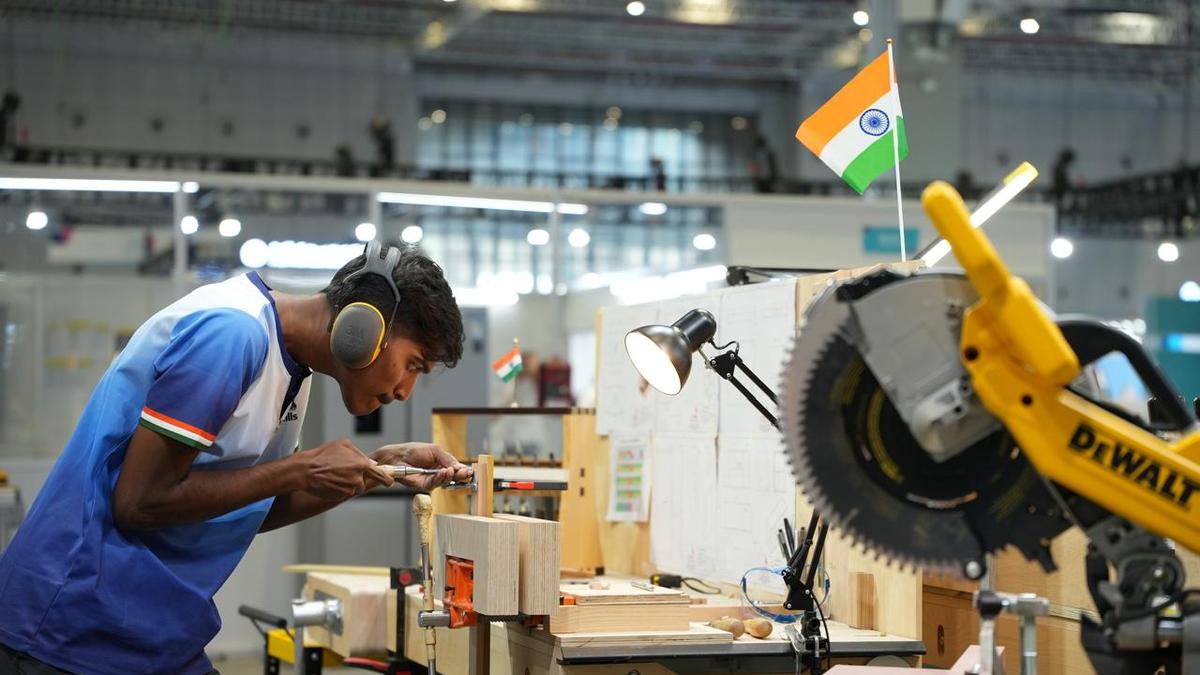
The Bhagavad Gita, in verse 18.46, says sva-karmana tam abhyarchya siddhimvindati manavah — a person attains perfection by worshipping through their own work. This implies that a workbench, a kitchen or a workshop floor can be a place of devotion, and a craft practised with care is a virtue in itself, not merely a means of livelihood. Prime Minister Narendra Modi recently met India’s medal winners at the 48th WorldSkills Competition, which was held in Shanghai, China (September 2026). These champions included bakers, welders, dental technicians, car painters and retail professionals. Their achievements placed India among the world’s top 10 for the first time. By welcoming them, the Prime Minister has nudged Indian families to look again at skilling, a path that deserves the same honour as any other.Skilled talent on world stageHeld every two years, WorldSkills is the Olympics of skills. More than 1,400 young people from about 70 countries and regions complete practical tasks, set and judged by international experts, in trades from welding and wiring to robotics and cyber security. Indian families know the podiums of education well — toppers’ lists, merit ranks and classroom gold medals. Skilling has had no such place in Indian public life. These winners are changing that. As their numbers grow, more families will recognise that skill-based careers are no less worthy and that a podium earned at the workbench stands as tall as one earned in the examination hall.India’s WorldSkills story began in a humble way and has climbed steadily. India was placed 39th in 2011 and 19th in 2017. It reached the 13th spot in 2019 and held that place in 2024, with the best results being four bronze medals. In Shanghai, India finished 10th, with six silver medals and 20 medals for excellence — 26 medals in all, and its largest haul ever. This came from India’s largest team of 70 competitors across 63 skills. Not only has the medal tally grown, but India’s best medals have also moved from bronze to silver.India competed in 11 skills for the first time, winning three of its six silver medals in these categories: Mohammed Salam in dental prosthetics, Kovid Gangrade in digital interactive media design and Saniya Joshi in retail sales. Smriti Nambiar bagged silver in bakery, alongside Parth Vohra in industrial design technology and Mehrunissa Begum in logistics and freight forwarding. ‘Behind the numbers are young people whose journeys began in very ordinary places’ | Photo Credit: SPECIAL ARRANGEMENT Humble beginnings to excellenceBehind these numbers are young people whose journeys began in very ordinary places. Kaif Khan of Lucknow, Uttar Pradesh, learnt his craft while working in a private car company’s workshop after class 10. He won gold in the State, regional and national rounds of IndiaSkills, trained with Maruti Suzuki and Axalta, and gained exposure in Germany and Denmark, before he earned a Medallion for Excellence in Car Painting in Shanghai. From the south, Mohammed Salam of Cuddalore, Tamil Nadu, won silver in dental prosthetics, a discipline judged on how precisely a crown or bridge fits, and one in which India had never competed before. All they needed was a fair test, comprehensive training, and an ecosystem that considered their skill seriously.Kaif Khan, Mohammed Salam, Saniya Joshi, Smriti Nambiar and their teammates did not reach Shanghai by chance. They are the fruits of a patient investment in people. Medallions for Excellence also went to Md. Seraj in automobile technology, Pavan Bhadravati Suresha in additive manufacturing, Mallinath and Suhan Mascarenhas in Industry 4.0, and Abhishek Somanna Shignalli and Vinay Muttayya Hiremath in robot systems integration.All of them climbed a ladder that begins in the districts and rises through State and regional rounds to the national finals. More than 3.65 lakh young people registered for IndiaSkills across 63 skills in this cycle. Five regional competitions narrowed the field to about 650 national finalists in Greater Noida (Uttar Pradesh), where 70 were chosen to represent India. A team from the Ministry of Skill Development and Entrepreneurship, the National Skill Development Corporation and the States, working with industry experts, has toiled to find, hone and polish these young people for the international stage. This is the whole-of-government approach at work, and marks a deeper shift.Nations have long measured progress in Capex, the roads, ports and factories they build, and in Opex, the cost of keeping them running. India has built on both, and now adds a third discipline, Skill-Ex — deliberate investment in the people who make every asset work. The recent Pradhan Mantri Skilling and Employability Transformation through Upgraded ITIs (PM-SETU) scheme is Skill-Ex at scale. This ₹60,000 crore scheme is upgrading 1,000 government Industrial Training Institutes (ITIs) as 200 hubs and 800 spokes, with industry partners managing the clusters. ‘The Prime Minister has nudged Indian families to look again at skilling, a path that deserves the same honour as any other’ | Photo Credit: SPECIAL ARRANGEMENT There must be a focus on ‘Skill-Ex’Industry must join this effort. A factory is only as good as the people who run it, and employers should spend on Skill-Ex as seriously as they spend on Capex and Opex. Capex gives India its assets, and Opex keeps them running; only Skill-Ex develops the manpower to keep assets productive. A nation is built not only by those who design and govern, but also by those who weld, bake, paint and wire with care. That care is a virtue, and the Gita reminds us that it is also a form of worship. If we value skilling as much as degrees, India’s young people will only ask how well they can walk their path, and India’s next generation will make India the skilling capital of the world.Jayant Chaudhary is Minister of State (Independent Charge) for Skill Development and Entrepreneurship, and Minister of State for Education, Government of India
India’s ‘WorldSkills’ medals reflect patient investment
Full Article
Original Source
Read the full article at Thehindu →KhanList aggregates and links to publicly available news content. We do not host full articles from third-party sources. Always verify important information with original sources.