
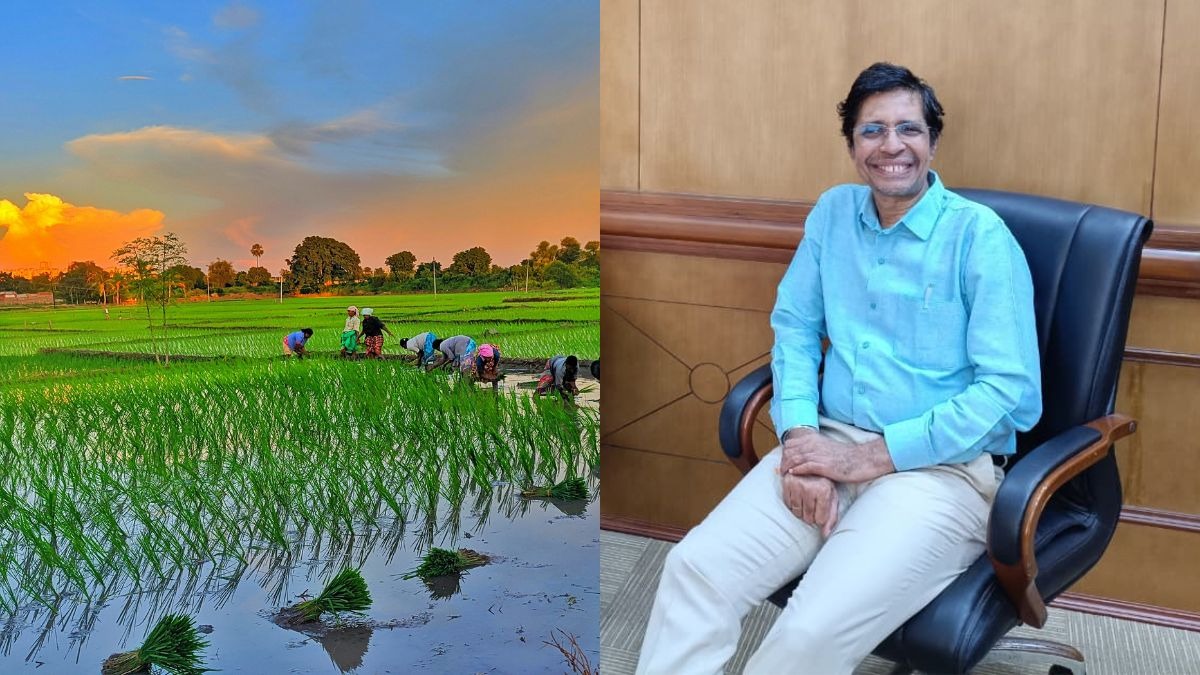
IIT Madras director Professor V. Kamakoti says the institute is working on precision agriculture to grow rice and sugarcane on far less water, work rooted in Mission Pravartak. Here is why India's rice habit drains so much water, and how smarter farming could ease the crisis.IIT Madras director V. Kamakoti says the institute is exploring precision agriculture to grow rice and sugarcane on far less water. (Photo: Unsplash/India Today)There is a sound most Indians have known since childhood, though few of us think of it as a sound at all. It is the soft slap of water in a flooded paddy field, ankle-deep and shining, where the rice on our plates begins its life standing in water for weeks on end.That water has a cost, and it is enormous. At one of India's most storied technology institutes, a place better known for rockets and microchips, someone has quietly turned to look at it."IIT Madras is also looking at what you call precision agriculture," Professor V. Kamakoti, Director, IIT Madras, told India Today Digital in an exclusive interview on campus. "Precision, where I can use a minimal amount of water and grow rice, grow sugarcane, etc."It is a short remark. It lands on one of the largest and least discussed problems in Indian farming. WHY DOES GROWING RICE IN INDIA USE SO MUCH WATER?Rice is, quite literally, grown underwater. Fields are flooded, so the crop can stand in a few inches of still water, which suits the plant and drowns the weeds. It also happens to be one of the thirstiest ways humanity has ever devised to feed itself.A detailed study of Indian paddy cultivation found that a single kilogram of rice takes, on average, 1,500 to 2,000 litres of water to grow in India. In Punjab and Haryana, where farmers draw hard on groundwater rather than waiting for rain, that figure climbs to between 2,270 and 2,672 litres. For one kilogram. Now picture the rice on every plate, in every home, at nearly every meal in this country, and you begin to see the size of the thing. Producing a single kilogram of rice can use over 2,000 litres of water in heavily irrigated Indian states. (Photo: Unsplash) The problem is national, not local. Agriculture drinks up roughly 90 per cent of all the fresh water India uses, and a handful of thirsty crops swallow most of that. Rice alone is thought to account for well over a third of the world's irrigation water.Sugarcane, the other crop Professor Kamakoti named, is no kinder; it must be kept damp through a long, slow season, and India grows more of it than almost any nation on Earth.IS THIS PART OF MISSION PRAVARTAK?The work he describes has a natural home. Mission Pravartak, formally the IITM Pravartak Technologies Foundation, is IIT Madras's own Technology Innovation Hub, funded by the Department of Science and Technology under the National Mission on Interdisciplinary Cyber-Physical Systems.Its entire business is sensors, networks and control systems, which is, more or less, the toolkit precision farming runs on. Pravartak has already held joint workshops with Canadian partners on using artificial intelligence for precision agriculture.WHAT DOES PRECISION AGRICULTURE ACTUALLY MEAN?Strip away the phrase and the idea is almost tender. Give a plant exactly what it needs, and not a drop more.In practice, three things work together. Sensors buried in the soil take its pulse, measuring moisture so that a field can say, in effect, when it is thirsty, rather than a farmer guessing by eye. Drip irrigation then answers that thirst precisely, carrying water to the roots in small measured amounts instead of flooding everything and hoping.Above it all, satellite and drone imagery watches for the patches of a farm that are struggling, long before anyone walking the rows would notice.For rice in particular, scientists have already shown that a method called alternate wetting and drying, letting a field dry out a little between watering episodes rather than holding it permanently underwater, can cut water use sharply with little or no loss of harvest. Not a different crop. The same rice, grown thoughtfully.WHY DOES THIS MATTER TO A WARMING, WATER-STRESSED INDIA?India is the largest user of groundwater on the planet, and in many of the districts that grow the most rice and sugarcane, that water is sinking further out of reach each year. A warming climate only tightens the grip, because thirsty crops grow thirstier as the temperature climbs.So precision farming is not a luxury imported from wealthy farms abroad. It is a question of whether a country of more than a billion people can keep feeding itself from a shrinking pool of water.If an institution with IIT Madras's engineering depth, its sensors, its data science, its habit of pushing ideas out of the laboratory and into the world, turns seriously towards the paddy field, the result will not be measured in papers published. It will be measured in the water table.The direction is clear. The next thing to come out of IIT Madras may not just be computation. It may simply be a field of rice, growing quietly on a fraction of the water it once needed.- EndsPublished By: Radifah KabirPublished On: Sep 10, 2026 07:00 IST
India's rice drinks too much water. IIT Madras has a fix, says Director Kamakoti
Full Article
Original Source
Read the full article at Indiatoday →KhanList aggregates and links to publicly available news content. We do not host full articles from third-party sources. Always verify important information with original sources.