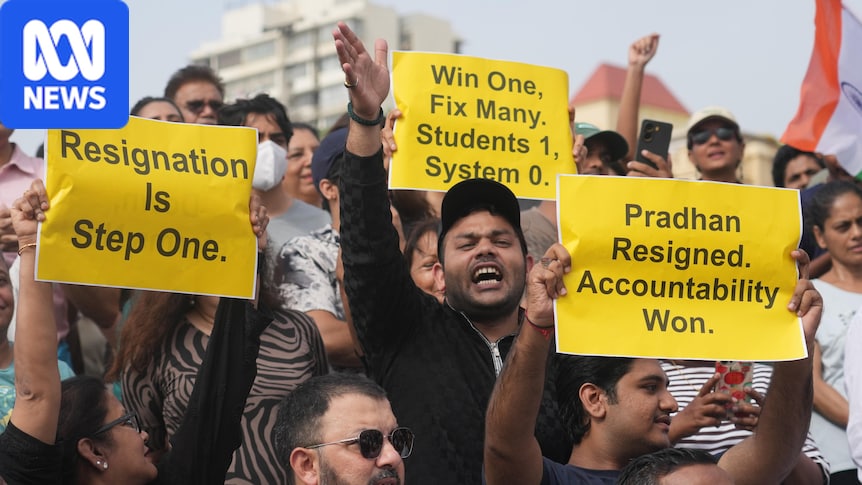
The "cockroaches" won.The group that spearheaded nationwide protests, sit-ins and hunger strikes over the last two months, the Cockroach Janta Party (CJP), has claimed victory following the resignation of India's education minister, Dharmendra Pradhan.During Prime Minister Narendra Modi's more than 12 years in office, the government has rarely yielded to sustained public pressure.Following Mr Pradhan's resignation last weekend, movement organisers called off the large-scale protests that rose up across the country.So what happens next? And is a one-off resignation enough to satisfy India's youth?For some, the government's concession was only "a small step" in a larger movement.Model and student Rhiya Ahir said the movement's focus should now be on the new education minister, Pralhad Joshi."The next step is making sure he enforces the new education reforms," the 27-year-old told the ABC.The protests were sparked by anger over the leaking of an exam paper that forced 2 million students to resit the test for entry to medical school. Local media reported that 20 took their own lives.Ms Ahir, who was the subject of a viral photo of her blocking a police van during a protest in Mumbai, also said the 20 students "must not be forgotten".Rhiya Ahir says the movement should now focus on Dharmendra Pradhan's replacement and the new reforms. (AP: Rafiq Maqbool)"How is the government dealing with the students who are no longer with us, and their parents?" she said."We must keep questioning this."Pradhan's replacement does not comfort allIn a letter published on X, Mr Pradhan said he "took responsibility" for the leaking of India's national medical entrance exam in May."I deeply respect the aspirations, feelings, and legitimate expectations of the country's youth," the letter said.For 22-year-old Ravi Vishwakarma, who attended protests in Delhi, Mr Joshi was "not a suitable leader".Ravi Vishwakarma says Dharmendra Pradhan's replacement is "not a suitable leader". (Supplied: Ravi Vishwakarma)For Mr Vishwakarma, Mr Joshi's ties to the Rashtriya Swayamsevak Sangh (RSS) — a right-wing Hindu volunteer organisation founded in 1925 — were a source of alarm.For the group, Indian civilisation is inseparable from Hinduism, while critics say its philosophy is rooted in Hindu supremacy. The RSS is often described as the ideological parent and mentor of Mr Modi's Bharatiya Janata Party (BJP)."The history of the RSS is totally against Indians," Mr Vishwakarma said."They know how to mislead the nation through casteism and religious discrimination," he said."If the government really want to improve India's education system, they must choose a worthy leader."Like many of India's youths, Ravi hopes to see "a transparent investigation and accountability" come out of this."We need meaningful reforms that improve safety and prevent similar tragedies from happening again," he said.Education in India a 'sensitive issue'In India, almost 40 per cent of graduates aged 15 to 25 and 20 per cent aged 25 to 29 are jobless, according to the latest State of Working India report by Azim Premji University.It is why education is "a very sensitive issue", said Harsh V Pant, professor of international relations at King's College London."A lot of middle-class families sacrifice and spend a lot on their child's education," Professor Pant said."They feel education is one of the most important ways for social mobility in India."Some experts say the government and youth should work together on long-term structural reform. (AP: Rafiq Maqbool)'It's time to revive' India's democracyYashi Verma believes the movement has inspired many in India to "look forward to a complete regime change".The 25-year-old lawyer and actor in Delhi said India's youth have been frustrated at the current regime for some time now."Be it the dwindling economy, unemployment rates or attacks on minorities and marginalised people," she said.Yashi Verma says a range of issues have contributed to people's frustration with the government. (Supplied: Yashi Verma)"I think people of the country have finally woken up to the fact that democracy in India has long been dead and it is time to revive it."International organisations such as the United Nations and Amnesty International have documented human rights concerns in India, including systemic police violence, suppression of free expression and discrimination based on religion, ethnicity and caste, affecting groups including Muslims and Dalits.The Indian government has consistently rejected these findings."Hopefully, the resignation of the education minister is only building momentum for far bigger reforms," Ms Verma said.For some members of India's diaspora in Australia, who had been following the protests from afar, the minister's resignation came as a shock."I didn't expect it to happen," said Mrinaal Datt, a news production editor and podcast host in Melbourne."Gen Z is usually looked down upon as a nonchalant generation. So to see them band together and own the 'cockroach' label was impressive."However, Ms Datt said paper leaks had plagued India for years.And they happened "because there's a market for it", she said."Who are the buyers? Sometimes, it's the very students and their parents who appear for these exams," she said.Mrinaal Datt says she did not expect India's education minister to resign. (Supplied: Mrinaal Datt)"It's an uncomfortable conversation, but an important one to have."Where to from here?A day after Mr Pradhan resigned, Mr Modi vowed to fast-track the court process to punish those responsible for the leak.Changes have been proposed to the Public Examinations Act, a law made in 2024 after similar National Eligibility Entrance Test (NEET) exam leaks.The 2024 law prescribed penalties for a range of violators, including those resorting to unfair means, firms involved in helping conduct the exam and those at the examination authority.The proposed amendments would increase the minimum prison term for culprits from three years to five years and raise the maximum fine five-fold from 10 million rupees ($149,623) to 50 million rupees ($748,169).The ban on firms found guilty would double to eight years.Narendra Modi has vowed to fast-track the court process to punish those responsible. (AP: Rafiq Maqbool)Following the protests, Mr Modi also announced a "high-powered panel" headed by technology expert Nandan Nilekani to focus on examination reforms, saying the government aims to make the "greatest possible use of technology" to strengthen the system.Mr Nilekani is an entrepreneur best known for leading the creation of India's digital identity system Aadhaar and co-founding software major Infosys.Based on the panel's recommendations, steps would be taken "as quickly as possible" to ensure the "credibility and reliability" of examinations, Mr Modi said.Professor Pant said Mr Pradhan's resignation reflected a pattern seen under Mr Modi and that it showed there was "flexibility" in his government to meet the demands of the youth protesters.But he said the outcome was a "short-term" solution."Whether these issues on India's education system posed by the country's youth are managed over a longer term remains to be seen," he said.He said the "real challenge" lay in the entire system, "not just one minister"."It's very likely that challenges in India's education system will continue. But whether the government and the youth can work together on long-term structural reform is the real issue," he said."If they can, I think that would be the real victory."
India's gen Z protesters forced a minister to resign. What's next?
Full Article
Original Source
Read the full article at Abc →KhanList aggregates and links to publicly available news content. We do not host full articles from third-party sources. Always verify important information with original sources.