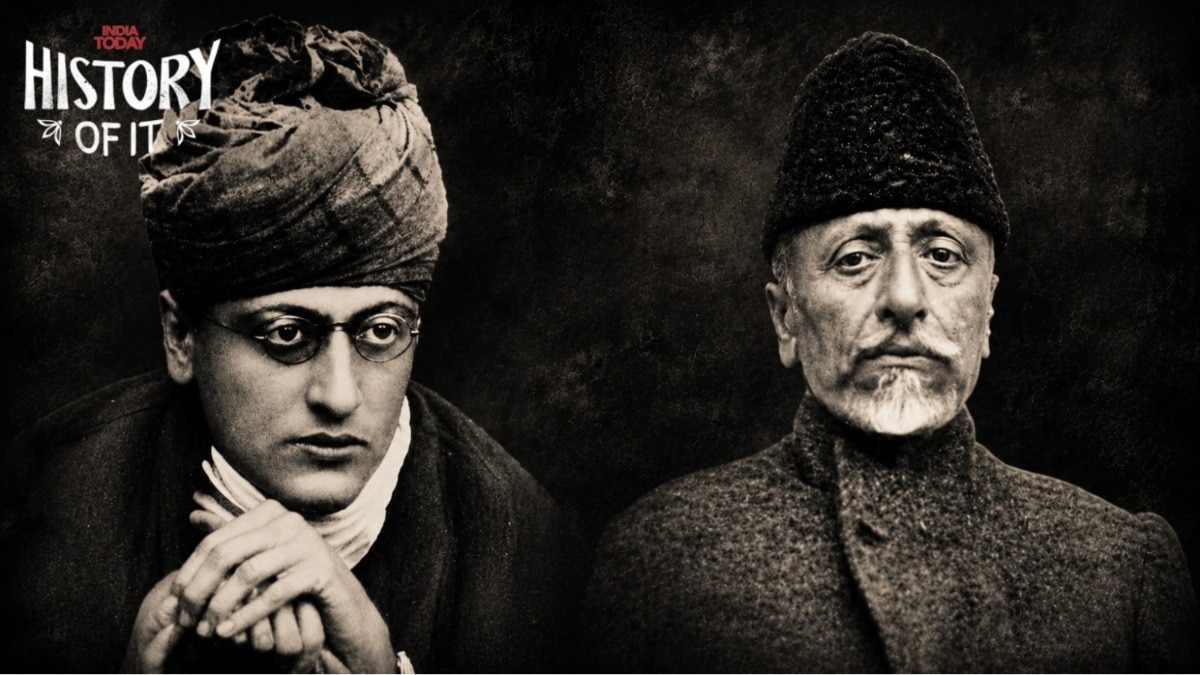
Home-taught by a father who distrusted Western education, India's first education minister, Maulana Abul Kalam Azad, laid the foundations of Independent India's modern education system. Azad's story is one of self-learning, nation-building, and institutions like IITs and AIIMS that he helped set up, that continue to shape generations of Indians."My father was a man who believed in the old ways of life. He had no faith in Western education," Maulana Abul Kalam Azad wrote. His father, Maulana Khairuddin, did not send him even to a madrasa. He preferred to teach him at home. The child who never entered a formal classroom would later become Independent India's first education minister, would spend 11 uninterrupted years designing the foundations of the modern education system.Before turning 10, Azad had begun working on a Persian dictionary. Historian S Irfan Habib wrote that he completed his early education by 12. By his early teens, he was composing poetry and publishing a poetic journal. At 15, he edited the monthly journal, Lisan-us-Sidq. Even before he met Mahatma Gandhi and joined the Congress, the man, born in Mecca (in Ottoman regions of present-day Saudi Arabia), challenged the British through his journalism. He even became the youngest to preside over a session of the Congress at 35. He stood like a rock against the Partition, and, after it became a reality, appealed to India's frightened Muslims from the steps of Delhi's Jama Masjid, not to abandon their country.Azad served as India's education minister from August 1947 until his death in February 1958. During his tenure, India established IIT Kharagpur, the UGC, the University and Secondary Education Commissions, the Indian Council for Cultural Relations (ICCR), and the Sahitya, Lalit Kala and Sangeet Natak Akademis, while playing a pivotal role in expanding technical education, adult literacy, free compulsory schooling, teacher training, women's education and scholarships.In 2026, India is thankfully again debating its education system. The conversations around it inevitably invite a look back at the man who laid much of India's post-Independence foundation in the key field. The Education Ministry has remained at the centre of public debate over examinations, institutional accountability and its state. After Dharmendra Pradhan resigned and Pralhad Joshi took over, many also began examining his educational qualifications. That's also perhaps why Azad's story needs retelling. It's not to argue that formal qualifications are irrelevant. It's to understand how a home-taught scholar became the minister who helped create institutions that educated generations of Indians. To understand Azad, his contributions, and his worldview, let's go back to where it all began.NO SCHOOL, NO COLLEGE, BUT A HOME CLASSROOM THAT CREATED AN AUTODIDACTAzad was born in Mecca in 1888 into a family of Islamic scholars. His father was a respected religious teacher who was suspicious of Western education. He believed it could weaken religious faith. After the family settled in Calcutta, Azad's education followed the traditional Muslim curriculum. Persian first, then Arabic, followed by theology, philosophy, geometry, mathematics and algebra. "My father had me taught at home," Azad wrote, according to his autobiographical memoir, India Wins Freedom (published in 1959, a year after his death). Khairuddin first taught Azad himself and later appointed different teachers, seeking accomplished scholars for each discipline. Azad was not uneducated. He was intensely educated, but outside every formal institution that normally certified learning at the dawn of the 20th century.S Irfan Habib described Azad as one of India's most remarkable autodidacts — a self-taught person who learns a subject or skill on their own without formal instruction. His pace was extraordinary. He had reportedly started compiling a Persian dictionary before he was 10 and completed the early phase of his education by 12. According to India Wins Freedom, Azad wrote that he finished the full traditional course by 16. It was years before the usual age of 20 to 25. He was then given around 15 pupils to teach higher philosophy, mathematics and logic.But the curriculum selected by his father soon became too narrow for him.After encountering Sir Syed Ahmad Khan's writings, Azad concluded that no one could be properly educated in the modern world without studying science, modern philosophy and literature. He secretly began learning English, initially with an alphabet book. He then read English, Persian and Urdu versions of the Bible side by side, worked through newspapers with a dictionary and moved on to books on history and philosophy.Azad's rebellion was intellectual before it became political. Azad refused to accept inherited beliefs just because they came wrapped in authority. Education, for him, became a way of questioning what had been presented as settled.HOW AZAD, THE TEENAGE POET, BECAME AN EDITOR AND TURNED JOURNALISM INTO ANTI-BRITISH WEAPONAzad's public life began long before most people complete school. By 15, Azad had launched Lisan-us-Sidq, a literary and intellectual monthly journal. His writings became so well known that people meeting him were often astonished by his age and had to be assured that the teenager before them was indeed the celebrated Abul Kalam, according to Maulana Abul Kalam Azad: A Centenary Volume, a book edited by political scientist and Secretary-General of the Lok Sabha, Subhash C Kashyap.In 1912, he launched Al-Hilal. Written in an elevated but forceful Urdu, the newspaper attacked imperial rule and challenged Muslims who viewed the British government as their protector. Azad linked freedom from colonialism with Hindu-Muslim unity, making the paper particularly threatening to the Raj."The colonial government saw the independently-run publication as seditious and mounted attacks in the form of fines and security deposits. In the face of mounting attacks, Maulana decided to shut down the paper and launched a fresh one called Al-Balagh in 1915, which continued till 1916. Maulana had to stop this paper as well because the government exiled him to Moorabadi, a small tribal village near Ranchi," Irfan Habib wrote.Journalism had transformed the son of a religious scholar into a political figure.After joining the freedom movement led by the Congress and Gandhi, Azad was repeatedly imprisoned. In 1923, at 35, he was chosen to preside over a special session of the Congress in Delhi. At a moment when the party was split between those seeking entry into Raj-run legislatures and those wishing to continue the boycott, Azad helped find a compromise without surrendering the struggle against imperial rule.HOW AZAD FOUGHT PARTITION, LOST HIS DREAM, CHOSE TO REBUILD INDIAIn the 1930s, when several Muslim leaders batted for an Islamic homeland in the subcontinent, Azad fiercely contested the principle. He asserted that India's Hindus and Muslims did not constitute two separate nations. He argued that both communities could share the new nation because nationality grew from territory, history, language, economic life and a collective political future.In his interpretation, Islam did not prevent Muslims from forming a common nation with non-Muslims. He invoked the Compact of Medina to argue that the Prophet himself had accepted a political community embracing different faiths. The Compact of Medina (or the Constitution of Medina or Charter of Medina) was an agreement drafted by the Prophet around 622 CE, after he migrated from Mecca to Medina.As Congress president between 1940 and 1946, Azad opposed the Muslim League's demand for Pakistan and invested his hopes in the Cabinet Mission Plan, which offered a framework for retaining Indian unity. When it collapsed and the Mountbatten Plan accepted division, he wrote that his "worst fears were realised"."The price for freedom was the partitioning of India into two States," notes Azad's autobiographical memoir, India Wins Freedom.Independence was therefore no uncomplicated victory for him. The Centenary Volume published by the Indian Government in 1989 recalled his grief amid the celebrations of August 1947. His face stood apart from the happiness around him. India had been divided and killings, displacement and fear were everywhere.Weeks later, in his famous Jama Masjid address, Azad confronted Muslims preparing to leave Delhi. He urged them to shed their fear, reclaim their confidence and remain in the country to whose history they belonged. It was like a final public defence of the "composite" India from his side.It was from within this wreckage that Azad entered the Education Ministry in PM Jawaharlal Nehru's Interim Cabinet.HOW AZAD PUT TECHNOLOGY AT HEART OF NATION-BUILDINGThe India Azad inherited as minister was poor, overwhelmingly illiterate and scarred by Partition. Schools were unevenly distributed, qualified teachers were scarce, universities needed reform, and millions of adults had never received basic education.Colonial education had largely produced clerks and graduates in literary disciplines. Independent India, however, needed engineers, scientists, doctors, researchers and trained industrial workers. Azad believed political independence would remain hollow without the technical ability to develop the country's resources.The first IIT emerged at Hijli near Kharagpur, at a site once used by the British to imprison political detainees. Initially called the Eastern Higher Technical Institute, it developed from the recommendations of the Nalini Ranjan Sarkar Committee and was formally inaugurated as IIT Kharagpur in August 1951.Habib recorded that Azad played an important role in establishing it despite severe resource constraints."Dr BC Roy, the CM of Bengal, donated 1,200 acres of land, and the institute was modelled on the Massachusetts Institute of Technology, USA. Azad, while speaking at the inaugural event, reiterated the fact 'that the prevailing system of education in the country has been mainly literary and academic. It has not supplied us with the high level of scientific and technical personnel that is necessary to develop economic and material resources and improve the standard of life of our peoples'," Habib noted."Indeed, I looked and still look forward to the day when the facilities for technical education in India will be of such a level that people from abroad will come to India for higher scientific and technical training," Azad said at the inauguration of IIT Kharagpur in PN Nehru's presence.It would be inaccurate to credit Azad alone with building the IITs. Nehru, scientists, state governments, committees and administrators were all involved. But Azad was the minister who converted the shared vision into educational policy. Under him, technical institutions expanded, the All India Council for Technical Education was reorganised, scientific manpower planning received attention, and laboratories under the CSIR became part of a larger research ecosystem.BEYOND IITs, AZAD WORKED ON UGC, UNIVERSAL EDUCATION, CULTURAL ACADEMIESAzad did not see higher education as the privilege of the elites. He described basic education as the birthright of every individual and pressed for free and compulsory schooling, adult literacy, teacher training and greater public expenditure. Back then, the challenges were bigger.India needed schools for millions of children and teachers on a scale that the new state could not immediately supply. Azad also faced resistance within the government, where education was often seen as an investment without quick economic returns. Near the end of his life, he acknowledged that education had initially been almost ignored in the First Five-Year Plan. He insisted that this was "basically wrong", because industrial progress itself depended on technical education. During his tenure, the central education budget rose from roughly Rs 2 crore to more than Rs 30 crore.In 1948, he appointed the University Education Commission under S Radhakrishnan. Its work helped shape the University Grants Commission, constituted in 1953, and later given statutory status in 1956. Azad's recommendations led to the UGC's establishment as the coordinating and standard-setting body for university education, Habib wrote.Azad believed a modern republic required laboratories and literature, engineering and music, scientific reason and an understanding of India's many cultural traditions. His ministry helped establish the Sahitya Akademi, Lalit Kala Akademi and Sangeet Natak Akademi, and the Indian Council for Cultural Relations.The paradox of Azad's life, then, is sharper than the headline suggests. Maulana Azad never attended a formal school, but he did not use his own experience to belittle institutions, degrees or scholarships. He spent his life constructing institutions he had never entered because he understood that a nation could not be led just by exceptional autodidacts like him. The man who had never occupied a school desk spent nearly 11 years trying to build a classroom large enough for an entire republic.- EndsPublished By: Anand SinghPublished On: Jul 31, 2026 07:00 IST
India's first education minister never went to school, built IITs, UGC
Full Article
Original Source
Read the full article at Indiatoday →KhanList aggregates and links to publicly available news content. We do not host full articles from third-party sources. Always verify important information with original sources.