
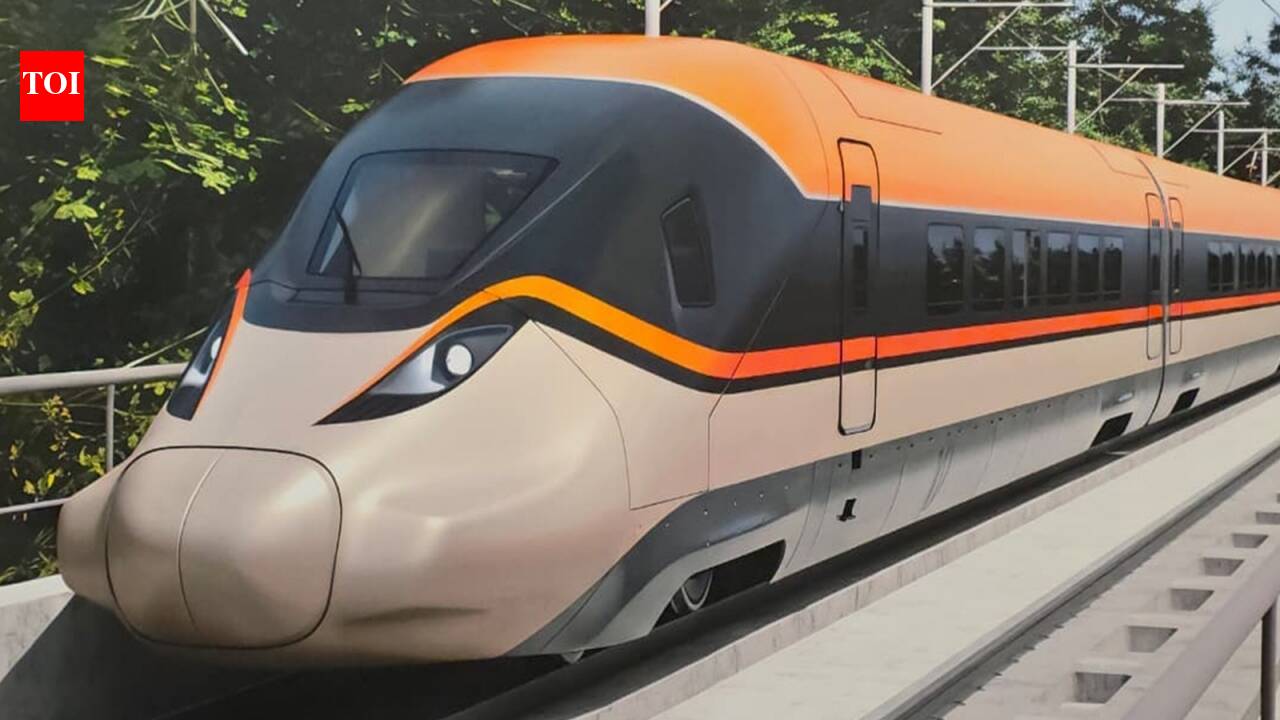
The contract covers the design, manufacture and commissioning of two train sets, each comprising eight coaches. (Design image of bullet train for representative purpose)Mumbai-Ahmedabad bullet train corridor: India’s first bullet train project is likely to begin trial runs in May 2027, with preparations under way to test the 50 kilometres long Surat-Bilimora stretch of the Mumbai-Ahmedabad high-speed rail corridor first, Union Railway Minister Ashwini Vaishnaw said on Monday.The Mumbai-Ahmedabad high-speed rail corridor, India’s first bullet train project, is being developed to establish high-speed rail connectivity between the two major cities.Speaking at a media briefing, Vaishnaw said electrification work on the section was complete, while signalling-related work was scheduled to be finished by January 2027.The overhead electrification system along the elevated stretch was energised on November 20, covering both tracks. The section uses a 2x25 kV traction system, and installation work at the Bilimora traction substation has also been completed.When will India get its first bullet train?Vaishnaw said the high-speed rail corridor would become operational in stages, rather than being opened along its entire length at one time.Under the proposed schedule, the Ahmedabad-Vapi section is expected to be completed by the end of 2027. The bullet train service is targeted to extend to Thane by 2029.The first round of trials will use the B-28 train, which has been built to run at speeds of up to 280 kmph.Vaishnaw explained that operating trains at speeds exceeding 240 kmph calls for specialised engineering, as the pressure forces generated while trains are in motion must be accounted for in the design of both the rolling stock and the supporting infrastructure.He said the B-28 train had cleared a squeeze test, during which it was subjected to pressure levels twice the atmospheric pressure expected during regular operations. The test was conducted to assess the train’s ability to withstand pressure-related stresses at high speeds.The minister also expressed satisfaction with the pace of construction in Maharashtra, including work on the undersea tunnel, describing the progress on these sections as encouraging.India makes bullet train for the first timeBEML Limited has secured a Rs 866.87 crore contract from Integral Coach Factory (ICF), Chennai, to manufacture two prototype bullet train, or high-speed train, sets designed to run at speeds exceeding 250 kmph. The trains will have a design speed of 280 kmph.The contract covers the design, manufacture and commissioning of two train sets, each comprising eight coaches.The trains will feature fully air-conditioned chair cars equipped with world-class passenger facilities, advanced onboard infotainment systems, reclining and rotatable seats, and dedicated amenities for divyangjans.To facilitate production, BEML has established a dedicated ‘Aditya’ High-Speed Rail Complex in Bengaluru for manufacturing the bullet trains.The trains, designated as B-28 train sets, will be built using advanced, precision-driven technologies. While bullet trains operating in countries such as Japan and across Europe are engineered to withstand cold climatic conditions, the Indian versions will be designed to cope with the country’s heat and dust.More bullet train projectsThe Mumbai-Ahmedabad bullet train corridor is one of several ambitious rail infrastructure projects planned by Indian Railways. The Union Budget for this year announced seven additional high-speed rail corridors. Developing domestic capabilities to manufacture bullet trains could help India meet the rolling stock requirements of these proposed routes more cost-effectively.The seven proposed corridors are Mumbai-Pune, with a journey time of 48 minutes; Pune-Hyderabad, at 1 hour 55 minutes; Hyderabad-Bengaluru, at 2 hours; Hyderabad-Chennai, at 2 hours 55 minutes; Chennai-Bengaluru, at 1 hour 13 minutes; Delhi-Varanasi, at 3 hours 50 minutes; and Varanasi-Siliguri via Patna, at 2 hours 55 minutes.
India's first bullet train targets May 2027 trials on 50-km Gujarat stretch
Full Article
Original Source
Read the full article at Timesofindia →KhanList aggregates and links to publicly available news content. We do not host full articles from third-party sources. Always verify important information with original sources.