
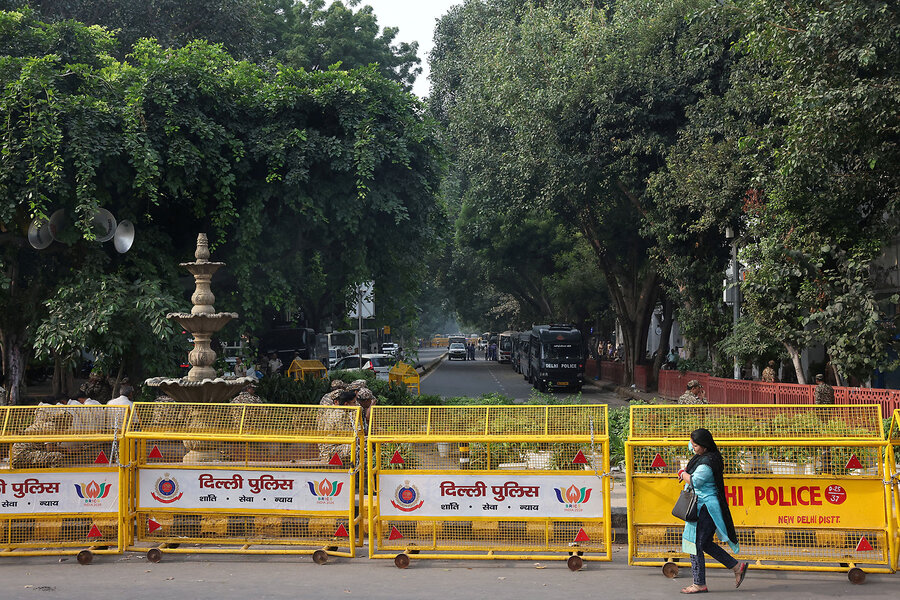
New Delhi | Oct. 21, 2026, 4:08 p.m. ET | 5 min read Police and paramilitary forces were already waiting at the central Delhi marketplace when protesters arrived. As the sun slipped low in the sky, about 15 young people emerged, seemingly from nowhere, and began chanting “vote chor sarkar” – “vote-thief government.”Within a minute, Delhi University undergraduate Sakshi Jain was pinned to the ground by an officer in riot gear, and then bundled into a police bus along with her peers.Small protests like these have been cropping up across Delhi in recent weeks as the government struggles to keep a lid on a growing youth movement known as the Cockroach Janta Party (CJP). The grassroots group, which successfully demanded the education minister’s resignation this summer, has turned its attention to voting rights, calling for India’s chief election officer to step down over the alleged manipulation of voter rolls. Thousands of protesters – and dozens of journalists – have been detained since demonstrations began earlier this month. Two prominent CJP activists were released Wednesday evening from Delhi’s high-security Tihar Prisons, after seven days in custody. The city is on tenterhooks, with yellow barricades and roaming security forces dotting the streets.But the protests and subsequent crackdown have had a galvanizing effect for many civil society and opposition party leaders, who have long criticized India’s democratic backsliding under Prime Minister Narendra Modi. They say this moment feels like a turning point.“Modi is scared,” says Ms. Jain from behind a metal grill as the police bus pulls away. “He is using the police to crush us. We are on the roads to save the constitution of this country, to save democracy.” Aakash HassanPolice detain a Cockroach movement protester in Connaught Place in New Delhi, Oct. 17, 2026. Dispute over voting rightsThese protests come amid a massive exercise to verify and update India’s voter lists. More than 130 million names have been removed during a voter registration update by the Election Commission. The commission, the constitutional body responsible for overseeing elections, says the deletions include people who have died, moved, registered more than once, or could not be traced. Yet the scale and timing of the purge – particularly in West Bengal, where the ruling Bharatiya Janata Party just celebrated its first election victory in May – has raised concerns among some academics and opposition parties that eligible voters are being removed by malpractice. The issue snowballed after The Indian Express newspaper reported that two of the commission’s top three officials had repeatedly objected to aspects of the revision, including voter deletion and registration procedures. The commission maintains its decisions were unanimous.Many see this crisis as part of an ongoing erosion of democratic norms and institutions under Mr. Modi’s Hindu nationalist government. Restrictions on press freedom, the use of anti-terrorism laws to keep activists in jail without bail, investigations targeting political opponents and media organizations, and the revocation of Indian-administered Kashmir’s limited autonomy have all sparked public outrage. But that anger was often fragmented, making it difficult to build a sustained, united protest movement.Yet that’s exactly what Sagarika Ghose witnessed on Oct. 12, when India’s mainstream opposition parties came together to march on the Supreme Court. Thousands of people followed, including young CJP activists, university professors, and local families.“I have never seen this kind of mobilization in Delhi,” says Ms. Ghose, a parliamentarian from West Bengal and longtime critic of the Modi government. Aakash HassanPolice officers guard a checkpoint in New Delhi to restrict movement and prevent protesters from reaching Jantar Mantar, a famous demonstration site, Oct. 10, 2026. Even as the size and frequency of protests have dwindled, Ms. Ghose remains optimistic. She says the BJP’s usual tactics of deflecting attention from protests by “name-calling” and stoking communal division are no longer working, because “the questions are becoming too huge.”“There is an economic crisis, an unemployment crisis, and a price-rise crisis. On top of that, the government is not allowing protest. The opposition is completely united this time. There is no disagreement,” says Ms. Ghose. “There are going to be 24/7 protests from now until 2029.”Indians rally around the CJPAt the heart of these demonstrations is the CJP, which first grabbed attention through protests over examination paper leaks and irregularities affecting students. A weekslong sit-in earlier this year led to the resignation of India’s education minister – a rare dent in Mr. Modi’s strongman image. Bhawika Chhabra/ReutersSaurav Das (at right), chief spokesperson of the Cockroach Janta Party (CJP), speaks next to Ashutosh Ranka, co-convener of the CJP, during a press conference at the Press Club of India in New Delhi, Oct. 11, 2026. The pair was released from jail after seven days in custody Oct. 21. The fight over voter lists, protesters say, is tied to problems that have weighed on young people for years: unemployment, insecure work, an education system they regard as broken, and a political establishment they feel does not listen to them. Dev Sharma, a young software engineer who says he’s been detained during multiple protests, sees the voter-roll dispute as one piece of a much larger “package of frustration.”“This outpouring is about everything wrong happening in this regime, and we are going to take on every issue, one by one,” he says.Devyani Sarkar, a Delhi University graduate student in English literature, says the demonstrations build on earlier student-led protests over education and violence against women, and the crackdown has only added to young people’s frustration.Police have repeatedly detained protesters in Delhi, with many alleging they were threatened or beaten by officers. Authorities have also restricted where protesters can legally gather, removing Jantar Mantar, a longstanding demonstration site in the heart of the capital, from the list of designated venues.“The more they try to suppress people, the sharper the movement becomes,” Ms. Sarkar says. Deepen your worldviewwith Monitor Highlights.Politics with respectGet political stories with respectful analysis.There‘s a world of new ideas in everyBooks newsletter.There‘s more to life, enrich yours withCulture & Learning weekly.Follow humanity‘s discoveries withScience & Nature stories in your inbox.Gain a spiritual perspectivefrom the stories in your inbox.Want to understand the deeper impact of critical events? Learn the Monitor‘s insight.Already a subscriber? Log in to hide ads. It has also brought the young activists closer to established opposition figures. Rahul Gandhi, leader of the opposition in India’s lower house of Parliament, has joined the call for the election commissioner’s removal, condemned the arrests of protesters, and even invited CJP founder Abhijeet Dipke for a high tea this week.The opposition’s backing could help keep the campaign in the public eye as its leaders face detention. In a video posted Monday after a court extended the custody of two prominent activists, Mr. Dipke vowed to continue the work. “If you think that sending us to jail will make us stop speaking or remain silent, that is not going to happen,” he said. ALREADY A SUBSCRIBER? LoginReal news can be honest, hopeful, credible, constructive.The Christian Science Monitor was founded in 1908 to lift the standard of journalism and uplift humanity. We aim to “speak the truth in love.” Our goal is not to tell you what to think, but to give you the essential knowledge and understanding to come to your own intelligent conclusions. Join us in this mission by subscribing.
India’s democracy has been backsliding for years. Its youth are drawing a line.
Full Article
Original Source
Read the full article at Csmonitor →KhanList aggregates and links to publicly available news content. We do not host full articles from third-party sources. Always verify important information with original sources.