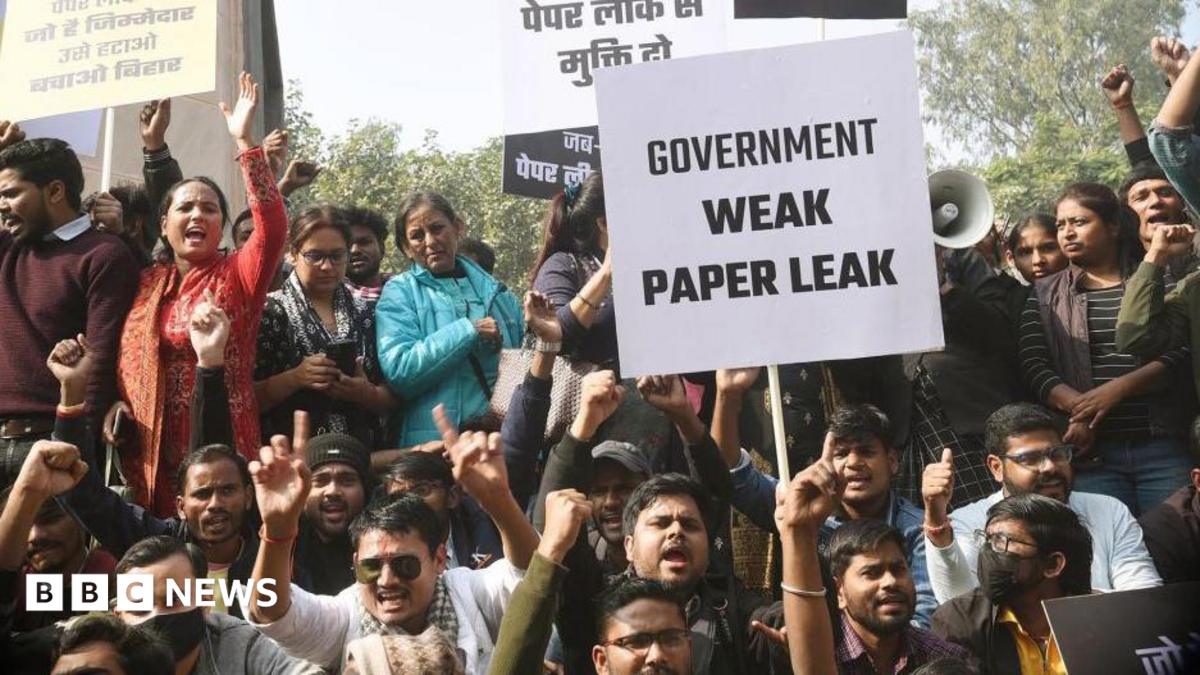
Image source, ReutersImage caption, There were countrywide protests against question paper leaks in JulyCan moving India's biggest entrance examinations from pen and paper to computers finally break the country's seemingly endless cycle of exam question leaks?The issue gained fresh urgency after weeks of protests over the National Eligibility cum Entrance Test (NEET) medical entrance exam forced the resignation of education minister Dharmendra Pradhan. Protesters say more than 20 students died by suicide, with their families blaming the exam scandal for their deaths.Prime Minister Narendra Modi responded by appointing an expert task force headed by Nandan Nilekani of the Indian IT giant Infosys to overhaul the National Testing Agency (NTA), which runs the exam. Modi recommends, external shifting the tests to computer-based testing (CBT) to make them more secure.How exam scandals threaten the future of India's young peopleHearing petitions on the reforms, the Supreme Court welcomed the government's efforts but cautioned that computer-based testing (CBT) alone would not eliminate the risk of exam paper leaks.That warning captures the challenge facing the task force: can technology fix what is ultimately a problem of trust, governance and incentives?The contrasting NEET paper leaks of 2024 and 2026 illustrate why the answer is more complicated than simply digitising exams. NEET uses four versions of the question paper, each containing 180 compulsory questions across physics, chemistry and biology. Image source, ReutersImage caption, Kahaan Patel, 17, was among more than 20 students whose families blamed exam paper leaks for their suicidesThe leaks occurred at opposite ends of the exam process. In 2024, the paper was allegedly leaked after printing, when sealed trunks were opened during transit to exam centres. Investigators said the breach was limited, involving about 40-50 people, and the Supreme Court ruled the exam's overall integrity remained intact, rejecting calls for a re-test.In 2026, the leak allegedly happened before the paper left the NTA, with teachers accused of leaking it from within the system. Officials say the safeguards on printing, transport and distribution held up. The vulnerability lay at the source, before the secure chain of custody even began.For Prof V Kamakoti, director of Indian Institute of Technology (IIT) Madras and a member of the task force, the two episodes expose where trust in an examination system ultimately resides. Why are thousands protesting for education reform in India?"The roots of trust lie in two places: the teachers who set the question papers and the invigilators who supervise candidates. If either is compromised, the system is vulnerable," he told the BBC.Officials have proposed extensive CCTV surveillance, with live feeds monitored from central control rooms. Kamakoti says AI could go further, automatically flagging suspicious behaviour - such as prolonged conversations between invigilators and candidates - so officials can intervene in real time. "At least the invigilator part we can certainly handle."But he argues that the bigger leap in security lies in moving exams online. Computer-based testing, he says, would make India's examinations far more secure. "Compromising the technology would be extremely difficult," he said, pointing to more than a decade of experience running large-scale computer-based examinations..Image source, Hindustan Times via Getty ImagesImage caption, Parents of candidates wait at a cooling station outside a centre in Delhi - NEET is one of the most competitive exams in the worldIIT Madras manages Swayam, the Indian government's online learning platform, and has extensive experience conducting large-scale computer-based examinations, including Graduate Aptitude Test in Engineering (GATE) and advanced Joint Entrance Examination (JEE), required for admission to the country's top engineering colleges.These systems, Kamakoti says, rely on "red teaming" - teams that constantly probe systems for weaknesses - and "air-gapped" networks physically isolated from the internet."No one can hack into that network," he says."The systems are designed to withstand technical failures. If a computer crashes or power fails, the timer pauses automatically and resumes on another machine."But even the most secure technology cannot eliminate the human factor. For Kamakoti, that is where the examination system's "root of trust" lies."The biggest challenge is to get trusted question setters," he says.Preparing a NEET paper is a complex exercise. The exam is conducted in 13 languages, including English, making it one of the world's largest multilingual entrance examinations. It requires subject experts, translators, reviewers and moderators. Kamakoti estimates that around 50 people may be involved in setting papers. "If even one person in that entire set is compromised, we are gone," he said.Computer-based testing removes one major vulnerability by eliminating the need to print, transport and store millions of question papers. Image source, AFP via Getty ImageImage caption, Many students say they have completely lost trust in India's examination systemSo why hasn't NEET already gone digital? Kamakoti says NEET has remained a paper-based exam, where answers are shaded on machine-readable answer sheets, because it is conducted in a single session for all candidates to ensure fairness. India can currently accommodate only about 300,000 candidates in one computer-based testing session, far short of NEET's 2.2 million test-takers, he says. "Moving to CBT would therefore require either a massive expansion of testing capacity or conducting the exam over multiple sessions."But not everyone believes moving online is, by itself, the answer. Dr Debananda Misra at the School of Public Policy, IIT Delhi agrees that CBT can significantly reduce opportunities for paper leaks. But he believes the debate risks becoming too narrowly focused on technology."CBT is not a silver bullet," he told the BBC. "It can strengthen exam security and improve efficiency, but it does not address the deeper incentives that drive malpractice."Those incentives are formidable.Nearly two million students appeared for NEET this year. More than half qualified. But the heavily subsidised government medical colleges, where an entire medical degree can cost less than 30,000 rupees (about $313; £235) have room for fewer than 6% of those who qualify - or under 3% of everyone who takes the examination. Candidates who miss out often face private college fees running into tens or even hundreds of thousands of rupees.Image source, Hindustan Times via Getty ImagesImage caption, A student arrives at a NEET centre in Delhi with her parent - many study for months or years to prepare for the examInvestigators say that scarcity has fuelled increasingly sophisticated paper-leak rackets, linking teachers, middlemen and exam-centre staff. Computer-based testing closes some of those vulnerabilities. But it creates others.Misra says even relatively minor technical failures can affect candidates in ways that are difficult to quantify."A non-functional mouse is not just about pausing the timer," he said. "It is also about disruption to concentration."He also worries about equity.He says success in CBT increasingly depends not only on subject knowledge but also on digital familiarity and opportunities to practise in simulated testing environments - advantages that remain unevenly distributed and may favour students attending coaching institutes over those from less-resourced schools.More fundamentally, Misra argues, India's examination system places too much weight on a single test."As long as a single test determines access to scarce opportunities, there will be strong incentives for exam malpractice, regardless of the testing format," he said.Misra argues that examination agencies need stronger governance through tighter procedures, regular audits, greater accountability and stricter enforcement. He also suggests multiple equivalent question papers allocated randomly, or localised papers, so that a breach in one location does not compromise an entire national examination.Over time, he believes India should also reduce its dependence on "single, high-stakes entrance tests" by creating multiple opportunities for assessment and broader pathways into higher education."If the purpose is to generate a ranked list and match students to institutions," he said, "perhaps we should also think about creating greater diversity on both sides."Image source, Hindustan Times via Getty ImagesImage caption, Students protest against a school exam paper leak in Delhi in 2018 - India has been been long plagued by such scandalsModi has repeatedly vowed , externalto crack down on exam fraud. Since 2023, he has promised that the "paper-leak mafia, external" would be "held accountable", said those "playing with the future of young people will not be spared", and insisted the government was acting on a "war footing" to stop leaks. Following the 2024 paper leak, his government appointed a high-level committee led by former space agency chief. It produced the most comprehensive review yet of India's examination system. But only about 57% of its 100-plus recommendations, external have reportedly been implemented - and paper leaks continue to plague exams.There is little time to overhaul India's exam system. The country's annual entrance exam season for engineering, medicine, universities and postgraduate admissions begins in December and runs through May or June. Kamakoti says any major changes will have to be finalised within the next month or two to be ready for the next cycle.Ultimately, the task force will be judged not by how many exams move online, but by whether students once again believe the system is fair.
India's CJP protests: Why tech alone won't stop exam paper leaks
Full Article
Original Source
Read the full article at Bbc →KhanList aggregates and links to publicly available news content. We do not host full articles from third-party sources. Always verify important information with original sources.