
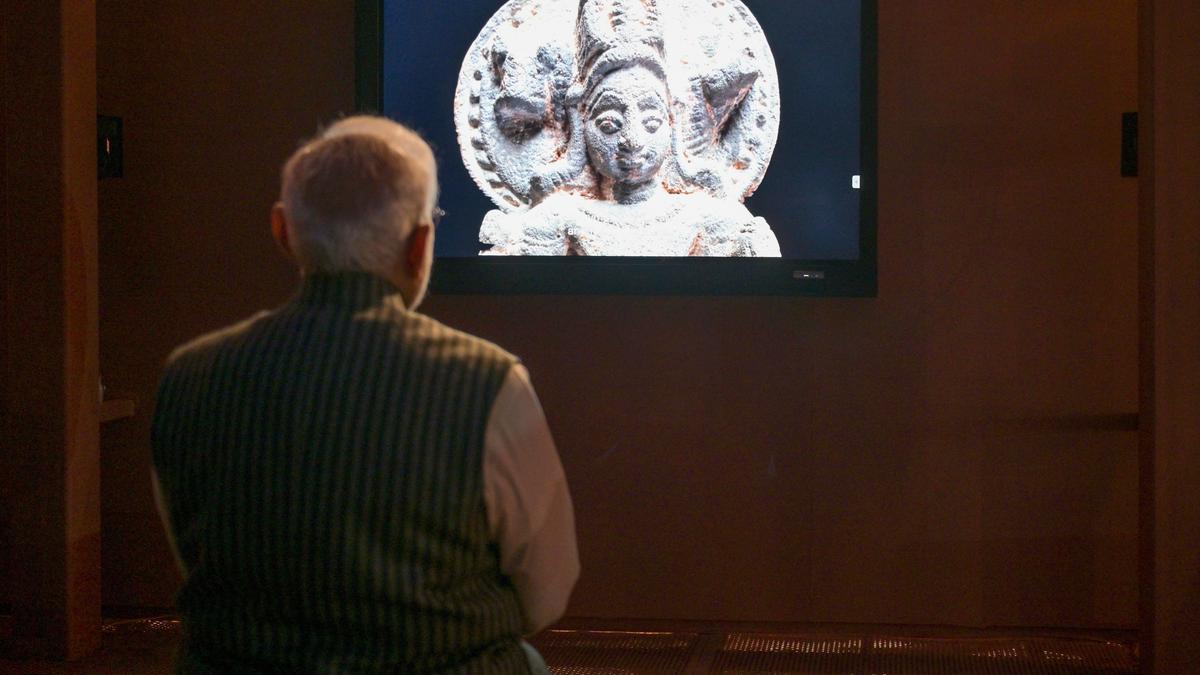
Prime Minister Narendra Modi watches an ancient relic on screen during his visit to an exhibition at the Purana Qila in New Delhi on November 20, 2026 ahead of the First Shanghai Cooperation Organisation Civilisational Dialogue Forum meeting. | Photo Credit: DPR PMO via ANI There are buildings which hold memories that run deeper than those of the people walking within them. The Purana Qila is one of them. The walls of the Purana Qila were built by Sher Shah Suri during the 16th century, and as per tradition and substantial archaeological evidence, the ancient city of Indraprastha can be found under it. And now, beginning November 20, the Ministers of culture of the Shanghai Cooperation Organisation (SCO), along with dialogue partners from over 25 countries, have gathered within the walls of the Purana Qila for the first Civilisational Dialogue Forum of the SCO. The idea was proposed by Prime Minister Narendra Modi during his visit to Tianjin in 2025, and is being conducted by the Ministry of Culture along with the Ministry of External Affairs. If one wants to have a better sense of why India wants to host such a forum, one needs to realise that the term ‘civilisation’ has become a contested territory in international politics. In the two decades since the end of the Cold War, the West had a monopoly over the language of universal principles such as democracy, markets and human rights. While the language was meant to be universally applicable, it implicitly belonged to those who had written the textbooks.Emerging powers while not rejecting the language, have relativised it. Beijing, for example, moved quickly to institutionalise it. Xi Jinping unveiled the Global Civilization Initiative in 2023. One year later, the UN General Assembly, on a Chinese initiative, designated June 10 as the International Day for Dialogue among Civilizations. In association with the 2023 initiative, China also organised a Ministerial-level meeting of the Global Civilizations Dialogue in July 2025, while the Nishan Forum on World Civilizations launched its 12th edition in September 2026 with the theme ‘Civilization, Order, and Justice’ at the birthplace of Confucius. Even the Internet conference at Wuzhen this month featured a sub-forum dedicated to civilisation. Clearly, China is not just experimenting in this area; it is developing a franchise which signals a much-recycled message — that modernity has many addresses.India has viewed these developments with the look of a man who has found someone selling his family silver at the fair. After all, India has the better claim of being the centre of civilisation than many of the current claimants vying for the position. The conference in Delhi is India’s attempt to set up its own stall in an organisation that has its secretariat in Beijing. It also fits a pattern of agenda-setting, with the AI Impact Summit earlier this year and the BRICS chairmanship now.The behaviour of a great power is driven more by what it believes about itself than by what it states as its objective. There are three objectives of India here, and only one is explicitly stated: soft connectivity, which includes Buddhist circuits, Sufi lineages and the trade routes that ran from Taxila to Samarkand much before anyone drew maps. Published - November 21, 2026 01:14 am IST
India’s civilisational gambit in China’s backyard
Full Article
Original Source
Read the full article at Thehindu →KhanList aggregates and links to publicly available news content. We do not host full articles from third-party sources. Always verify important information with original sources.