
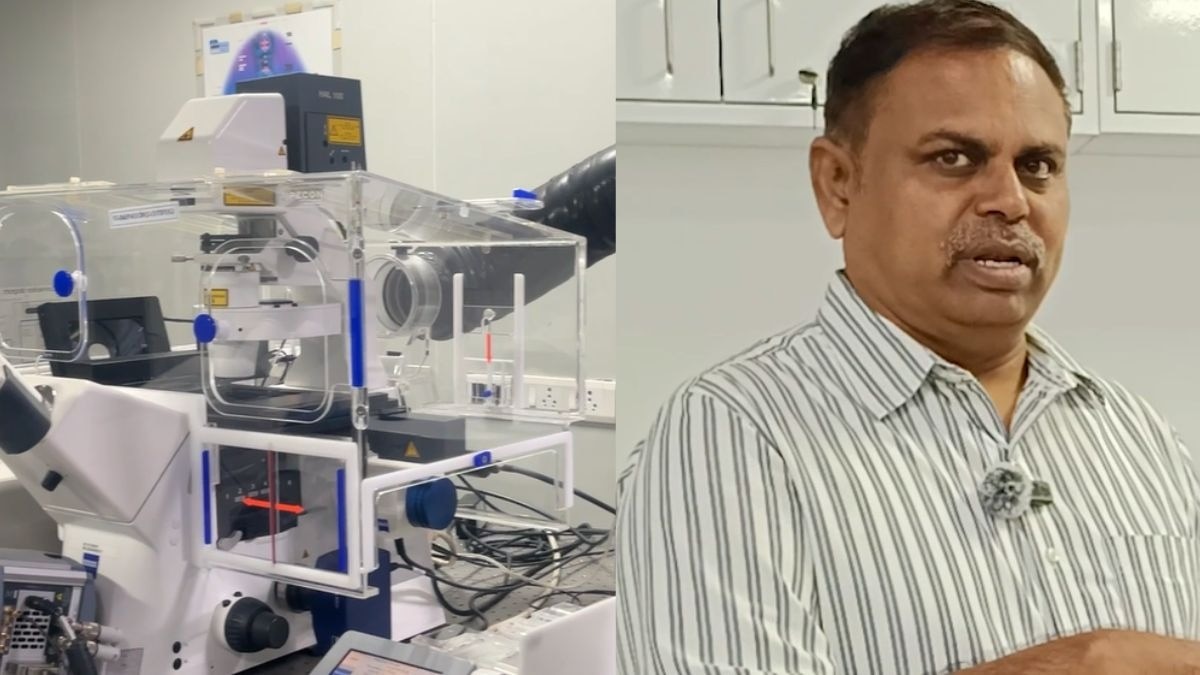
Scientists at IIT Madras have found cancer mutations unique to Indian patients, ones the world's imported cancer drugs were never designed to fight. Here is what the Bharat Cancer Genome Atlas has uncovered, and why it could change how India treats cancer.Prof. S. Mahalingam's team at IIT Madras has found cancer mutations unique to Indian patients, ones the world's drugs were never built to fight. (Photo: Radifah Kabir/India Today)A drug does not arrive from nowhere. It is built, patiently, around a body, a particular chemistry, a particular set of flaws to exploit, and for decades, almost every cancer drug that has ever reached an Indian pharmacy shelf was built around a body that was not Indian at all. Somewhere in that quiet mismatch, invisible on any label, lies one of the more consequential science stories to have emerged from Chennai in recent years.“He has found certain genome sequences that are unique to India,” IIT Madras Director Prof. V. Kamakoti told India Today Digital, in an exclusive interview on campus, describing the work of Professor S. Mahalingam at the institute's National Cancer Tissue Biobank. “All cancer drugs are developed abroad, so they don't have exposure to that genomic sequence.”WHAT IS THE BHARAT CANCER GENOME ATLAS?The project behind this is called the Bharat Cancer Genome Atlas, or BCGA, India’s first large, open-access database of cancer genomes, built by IIT Madras with the healthcare company Karkinos. In an interview with India Today Digital, Professor Mahalingam explained how it began. “We have collected more than 10,000 samples from different hospitals, diagnosed with different types of tumours,” he said, “and we have sequenced breast cancer, pancreatic cancer, paediatric leukaemia and colon cancer.”The atlas exists because Indian patients have long been near-invisible in global cancer genetics. Most of what pharmaceutical companies know about which mutations drive cancer, and which drugs might target them, comes from studies done on European and American populations. A mutation common in an Indian patient but rare abroad can simply be missed by a drug designed without ever seeing it. WHAT HAVE THEY FOUND THAT IS DIFFERENT?The findings are not uniform, and that nuance matters. Professor Mahalingam’s team found that the well-known BRCA mutation, observed in breast cancer genetics, actually appears in roughly 4 per cent of Indian patients, lower than figures reported elsewhere.A separate, peer-reviewed study by his team, published in BMC Cancer, went further, finding that nearly one in four Indian breast cancer patients carries an inherited genetic risk variant, and that most of these sit outside the familiar BRCA genes altogether. Instead, the team found something India-specific hiding elsewhere. “We identified a higher frequency of mutations in genes like RECQL,” Professor Mahalingam said, “particularly in Indian breast cancer patients.”A related gene, TP53, one of the most important tumour-suppressing genes in the human body, also showed a distinct pattern of mutation unique to the Indian samples. Professor Kamakoti, describing the same body of work, pointed to the scale of the problem it responds to: a cancer with, in his words, “very high incidence, high mortality rate, around 35 per cent.”WHY DOES THIS MATTER FOR TREATMENT?A mutation the rest of the world’s drug developers never tested for is a mutation their drugs were never built to fight. That is the practical consequence of India sitting outside most global cancer genome studies until now.It cuts both ways. Knowing that BRCA runs lower than expected in Indian patients could change how screening decisions are made here. Knowing that RECQL and TP53 carry a distinct, higher-frequency signature in Indian tumours opens the door to treatments aimed specifically at that signature, treatments no foreign drug company had any reason to design.Professor Mahalingam went further still, describing work that remains genuinely early. “We identified new antigens unique to Indian patients,” he said.WHAT HAPPENS TO THIS DATA NEXT?The atlas is deliberately public. Anyone, a researcher or a pharmaceutical company, can access it, which is the point. India’s cancer numbers are not small; the Indian Council of Medical Research estimates roughly one in nine Indians will develop cancer in their lifetime. A database this size, reflecting Indian biology rather than borrowed data, gives both public researchers and private drug developers a genuine reason to design medicine for the population that actually needs it.For a country that has spent decades treating cancer with drugs built somewhere else, for someone else, that alone is the quiet beginning of something larger.- EndsPublished By: Radifah KabirPublished On: Sep 15, 2026 18:16 IST
India's cancers carry mutations foreign drugs weren't built to cure. A professor's fix
Full Article
Original Source
Read the full article at Indiatoday →KhanList aggregates and links to publicly available news content. We do not host full articles from third-party sources. Always verify important information with original sources.